What is in this guide
Slow cooker meals often turn out watery because little liquid evaporates during cooking, so a sauce that would reduce on the stove stays thin. For an already-cooked dinner, reduce the sauce separately if it needs stronger flavour, or thicken it with cornflour if the flavour is already right.
The useful distinction is between too much liquid and too little body. Both can leave a puddle around dinner, but they do not need the same treatment. Choose the finish before adding another ingredient, rather than trying several fixes at once.
Work out what needs fixing
Once the meal has completed its recipe’s cooking requirements, check the sauce’s flavour and consistency. A watery appearance does not establish whether the food is cooked safely.
Ask three questions:
- Does the sauce taste diluted, or does it already taste well seasoned?
- Is there simply more sauce than you want to serve?
- Are the meat and vegetables ready, so further cooking would be unwelcome?
If the flavour is weak and the volume excessive, choose reduction. If the flavour suits you but the sauce runs straight off a spoon, choose thickening. If dinner has plenty of acceptable sauce, you can serve a smaller amount rather than changing the whole batch.
Set a target that suits the meal. A casserole may need gravy that coats its pieces. A soup can stay loose. Pulled meat for rolls needs only as much sauce as you want in the filling. Trying to make every dish equally thick creates unnecessary work.
Understand where the extra liquid came from
Crockpot’s manufacturer guidance explains that slow cookers lose very little liquid through evaporation. A stovetop recipe may rely on evaporation to reach its final consistency; copying its liquid quantity into a slow cooker removes that part of the process.
Meat and vegetables also release moisture as they cook. The stock you pour in is therefore only part of the liquid to consider.
Audit the recipe as written and what actually went into the pot. Did you add the juice from tinned tomatoes as well as stock? Did a recipe call for drained beans, but you tipped in the entire tin? Was extra water added because the mixture looked dry before cooking? These are useful questions for your own batch, not proof that any one ingredient caused the problem.
Check substitutions too. Write down whether you changed the vegetable quantity, used a different sauce base or doubled some ingredients while leaving others unchanged. A note that says “extra stock added at the start” is more useful than “slow cooker dinner failed”.
For morning preparation, keep that liquid note alongside your slow cooker prep-ahead plan, so the correction is available when you assemble the next meal.
Reduce the sauce when it tastes diluted
Reduction removes liquid and concentrates flavour. Good Food also warns that reducing a stew can overcook its ingredients, which is why separating the sauce is useful when the solids are already ready.
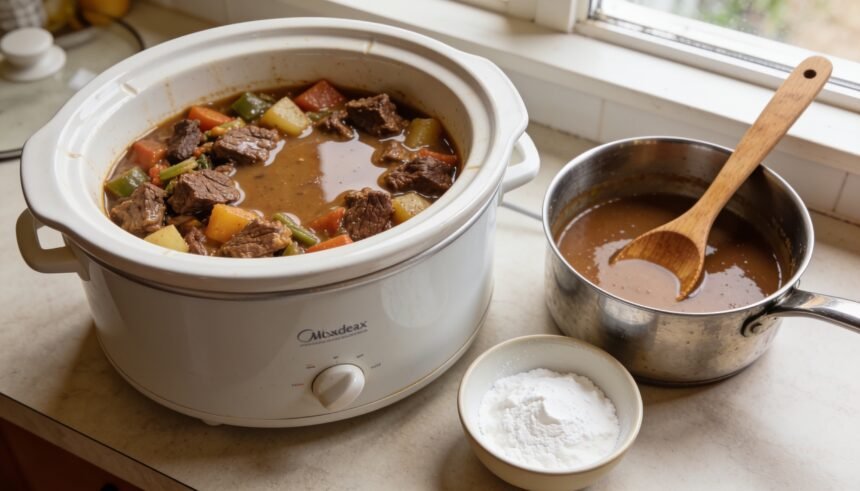
Ladle the liquid you want to reduce into an ordinary saucepan. Leave the cooked meat and vegetables out of that pan. Bring the sauce to a simmer and let liquid evaporate, stirring and checking it as it changes. Follow the recipe and appliance instructions for the remaining meal while you finish the sauce.
Taste before taking reduction further. Stop when the flavour and quantity suit dinner, then combine the finished sauce with the meal for serving. If seasoning becomes too strong before the sauce reaches the thickness you want, more reduction is the wrong direction; consider thickening instead.
There is no reliable universal countdown for this step. Your aim is a particular sauce, not an extra fixed period of cooking. It also adds a saucepan to the washing up. On a busy evening, decide whether that stronger sauce is worth the extra job.
Use cornflour when the flavour is already right
Cornflour changes consistency without needing to boil away a large volume of sauce. Good Food suggests starting with a teaspoon or two blended into a paste with a little cold water, then stirring it into simmering slow cooker contents and replacing the lid.
Use that as a modest starting addition, not a fixed dose for every pot size. Follow your recipe’s thickening instructions where supplied. Blend until smooth before adding it; sprinkling dry powder into dinner is not the method described.
Allow the addition to cook and thicken before deciding whether another small addition is needed. Good Food notes that excess cornflour can make a sauce gloopy, and that some slow cookers may not supply enough heat for starch thickening. Transfer the sauce to a saucepan if the recipe requires a boil that your cooker cannot provide.
The amount of sauce will still be broadly similar. If your complaint is a huge quantity of liquid, rather than its consistency, thickening alone may leave you with more gravy than you want.
Avoid adding more problems while finishing dinner
Do not repeatedly lift the lid during the main cook in an attempt to watch the sauce improve. Good Food’s slow cooker guidance notes that opening it releases heat. Follow the recipe’s lid and cooking instructions, then make a deliberate finishing decision once cooking is complete.
Treat dairy sauces separately. Crockpot says milk, cream and sour cream can break down during extended cooking. If a creamy meal looks separated, check when the recipe wanted the dairy added rather than assuming every loose-looking sauce needs more cornflour. Follow that recipe’s finishing method instead of putting it through a prolonged reduction intended for stock-based gravy.
Avoid adding pasta or rice just to absorb unwanted liquid unless the recipe specifically includes that step. You would be changing the meal and taking on another ingredient’s cooking requirements. Finishing the sauce separately keeps tonight’s correction easier to judge.
Make one change before the next batch
For the repeat meal, start with a recipe written for slow cooking and follow its liquid quantity. For a stovetop conversion, consult the appliance manual and a suitable adaptation recipe rather than applying one reduction percentage to every dish. Soup, gravy and a thick curry have different intended results.
Record the original liquid, any extra liquid you added, the final sauce problem and the finish that suited you. Change one thing next time so the result tells you something useful. Put the corrected recipe into your weekly family meal plan rather than relying on remembering what went wrong.
If you regularly cook extra portions, decide how much finished sauce belongs with each serving. Preparing cooked meals for freezing without spoiling their texture covers the component-planning side of that job.
For tonight, choose reduction, thickening or simply less sauce on the plate. Write that choice beside the recipe before clearing the kitchen, along with the one liquid adjustment you want to check next time.
The one-page family week
One printable page that holds the whole week: meals, school, activities and who is doing the pickup. Free, and we send one useful email a week.
One email a week. No spam, unsubscribe in a click.