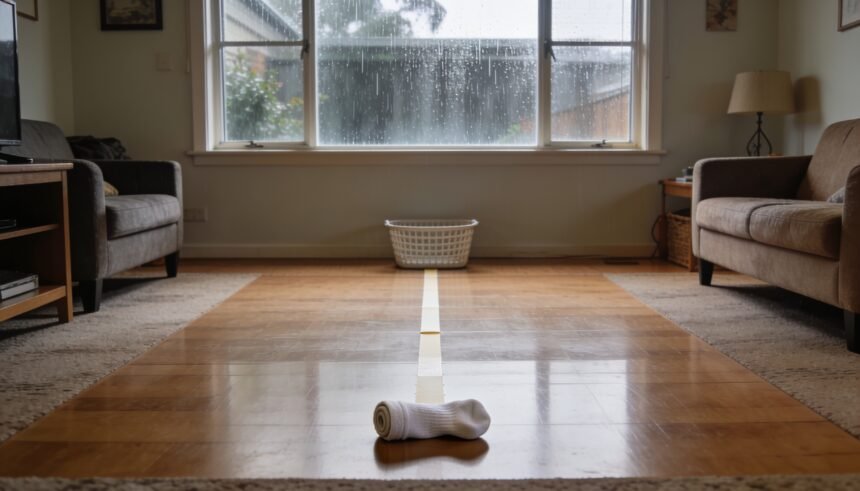
Start with three floor-level stations: follow a path, copy a movement and deliver a rolled pair of socks to a basket. For indoor games to burn energy, choose movement that fits the room, then vary the rules instead of adding height, speed or more furniture. A small course is enough to begin.
Set the boundary before building the course
Choose a clear patch of floor where an adult can watch the whole game. Move loose toys and trailing cords out of the route, leave doorways clear and keep the course away from glass, heaters and furniture corners. Give pets somewhere outside the play area.
Keep every station on the floor. Leave out sofa jumping, stacked cushions, broomstick hurdles and anything children would have to climb. Walk through the route together before starting, checking that there is space to turn without bumping into furniture. If there is not, use a stationary game instead.
Set two rules: one person travels through the course at a time, and everyone stops when the adult calls stop. Use a normal walking pace for the first round. Children can repeat movements without racing between stations.
For a wider choice of activities after movement time, the indoor activity list for primary school kids includes things to build, draw and make.
Build a three-station course with what you have
You need a rolled pair of socks, an empty washing basket and a little open floor space. Optional low-tack tape can mark a path, but only use it if it is suitable for your floor finish. An imaginary line works too.
Station one: follow the path. Make a short straight line or a gentle bend. Ask the child to walk alongside it, pause at the end and turn around. The line is a route marker, not a raised balance beam. For a child who wants a different task, try side steps along the same route.
Station two: copy three movements. Stand in a clear spot and show a reach upwards, a march on the spot and a wide arm circle. Let the child choose comfortable versions of each movement. There is no required height, speed or number of repetitions. If the sequence is too much to remember, call out one action at a time.
Station three: make a delivery. Carry the rolled socks to the washing basket, place them inside, then walk back to the start. Keep the basket beside the route so nobody has to step into it or jump over it. For another round, carry the socks on an open palm or use both hands to carry two pairs.
Run through the stations once with the child. Then offer a choice: repeat the same course or change one station. Changing only one instruction keeps you from having to explain an entirely new game every round.
Choose a standalone game when the course feels too crowded
A course is optional. These games use either a single standing spot or a short, clear route.
| Game | What to set out | How to play | Quieter version |
|---|---|---|---|
| Copycat leader | Nothing | One person chooses a movement; the other copies | Use reaches, arm circles and slow side steps |
| Musical statues | Optional music | Move while the music plays; pause when it stops | Use a spoken cue and keep feet on the floor |
| Sock delivery | Rolled socks and a basket | Move one pair at a time to the basket | Walk each delivery without a timer |
| Movement story | Nothing | Act out actions as an adult tells a short story | Choose stretching, pointing and gentle marching |
Take turns leading copycat
Start with three actions, such as reaching for an imaginary apple, rowing a boat and marching. Swap leaders after the sequence. The follower can choose a smaller movement or a seated version. Make copying the task, rather than judging whose version looks better.
For older children, build a sequence one move at a time. The first leader chooses one action; the next adds a second. If someone forgets, show the sequence again and continue without eliminating anyone.
Play statues without making anyone sit out
Choose one song, or simply call “move” and “pause”. When the music or cue stops, everyone holds a comfortable pose briefly, then starts again. A wobble does not end a turn. Let children take turns calling the pauses if they would rather lead than dance.
Agree on the movement area first. If children keep travelling beyond it, switch to dancing on individual spots or copying arm movements.
Give the sock deliveries a story
Call the basket a post office and the socks parcels. Each child chooses a pretend destination, delivers one parcel, then returns for another. Add variety through the story: today’s delivery is to a lighthouse or a space station. Keep the physical route the same.
With two children, alternate deliveries rather than sending them towards the basket together. The waiting child can announce the next destination.
Tell a movement story
Use a short sequence: wake up, reach for a hat, march to a boat, row across the river and wave to someone on the bank. Pause after each action so children can join in. Ask them what happens next, then act out their suggestion within the available space.
This needs no props. If the story calls for jumping off a mountain, change it to looking at the mountain through imaginary binoculars.
Adjust the instructions to the child
For a toddler or a child new to the game, start with one action and demonstrate it. A single delivery to a basket can be the whole activity. Add a second action only if they want more. The rainy-day ideas for under-fives offer other starting points when a sequence does not appeal.
For primary-aged children, hand over a specific decision: invent a movement, name the delivery route or choose the order of the stations. Keep the room boundary and floor-level rule fixed.
For children playing together, offer different versions of the same task. One might march while another copies the arm movements from a chair. Let each child choose movements they already use comfortably. Nobody needs to match another child’s pace to take part.
Keep the movement but change the noise
In a flat, or with someone asleep nearby, choose a no-jumping round. Use reaching, slow marching, side steps and pretend rowing. Skip music if spoken cues are enough. This changes the game without promising that any indoor activity will be silent downstairs.
If your available space is only a spot beside the sofa, drop the delivery route entirely. Play copycat with one person moving at a time. Do not squeeze a travelling course into a narrow gap just to keep all three stations.
Give the game a clear finish
Agree on a small endpoint, such as one song or two turns as leader. Those are suggested boundaries, not targets children have to complete. Pause sooner if anyone wants a break or the game becomes too crowded or rough.
Finish by carrying the socks back and putting the basket away. Offer the next activity rather than expecting movement to guarantee a quiet afternoon. A contained craft setup is one option; if dinner is approaching, use the late-afternoon routine ideas to plan what comes next.
For today, choose the three stations, clear their route and walk through one round together before adding another rule.
How we checked this
Reviewed on 28 September 2026. These are editorial activity suggestions, not a tested exercise programme. The comparisons describe the proposed setup and rules; they do not predict how long children will play or how they will feel afterwards.
The one-page family week
One printable page that holds the whole week: meals, school, activities and who is doing the pickup. Free, and we send one useful email a week.
One email a week. No spam, unsubscribe in a click.