What is in this guide
An Australian summer does two things to a child’s bedroom at once. It gets light very early, and the room holds the heat of the day long after the sun goes down.
Both are problems with the room rather than with the child, which is useful, because rooms are much easier to change than children.
Almost everything below is cheap. The expensive option is the last one, and most households do not need it.
The light problem
In the southern states, daylight saving pushes midsummer sunrise well before 6am, and first light earlier again. A room that is fine in June is unusable in January.
The order worth working through:
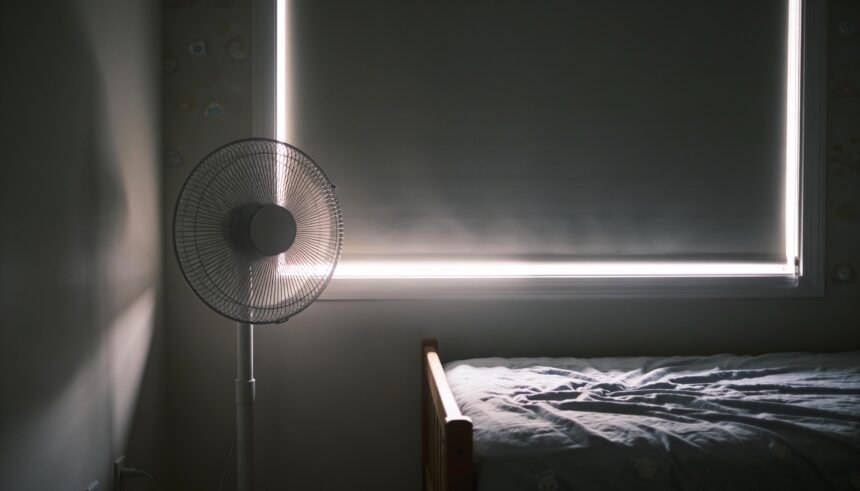
Block the window properly. Most curtains are not the problem, the gaps are. Light comes around the edges, over the top and under the bottom, and a blockout blind with a 30mm gap at each side is not a blockout blind.
- A blockout roller blind fitted outside the window reveal, wider and taller than the opening, beats an expensive blind fitted inside it
- Blockout curtains on a return rod, where the rod curves back to the wall at each end, close the side gap that ordinary rods leave
- A pelmet or a fitted box above the curtain stops the light spill over the top, and does the same job for heat
- The cheap version that works: a blockout blind plus curtains over it. Two imperfect layers beat one good one
The renter’s version. Removable blockout blinds that fix with adhesive or tension, or blockout fabric with press studs, or in the short term a folded blanket over the rod. None of it is elegant and all of it works.
Check the door. Hallway light under a door is often the actual culprit once the window is dealt with.
A very dim night light is fine for a child who needs one. Warm colour, lowest setting, not in the child’s line of sight from the bed.
Cord safety, which is not optional
Children have died in Australian homes from blind and curtain cords. Australia has had a mandatory standard for corded internal window coverings since July 2010, with a separate regulation covering installation services from January 2015.
The requirement is specific, and it is worth knowing the numbers because they tell you what to check: a loose cord must not be able to form a loop 220mm or longer at less than 1600mm above floor level, and a cleat used to secure a cord may not be installed lower than 1600mm above the floor. The standard also requires cord guides or cleats, installer details and warning labels.
The practical rules:
- A cot, a bed, a change table or any furniture a child can climb never goes near a window with a cord. This is the single most important sentence on this page
- Loose cords must be secured with a cord guide or wound around a cleat fixed high on the wall, above that 1600mm line
- Do not tie cords together or leave a loop hanging, including a loop left over a cleat
- Cordless, motorised or wand-operated blinds avoid the problem entirely and are worth the extra when the room is a young child’s
Compliance is not something to assume. When the ACCC surveyed corded blinds and curtains in 131 display homes, it found only 10 per cent would have complied with all of the standard’s requirements. If a cord in your house is reachable from a bed, that is the common case rather than the unusual one.
If you are choosing new blinds for a child’s room, choosing cordless is the easiest safety decision available in this whole article.
The heat problem
A bedroom that is hot at 9pm is usually hot because of what happened at 3pm, not because of the night air.
Stop the heat getting in, during the day:
- Shade the outside of the glass. External shading is dramatically more effective than internal, because once sunlight is through the glass the heat is already in the room. An external blind, an awning, a shade sail or a tree beats any curtain
- Close up the room in the morning on a hot day and do not open it again until the outside air is cooler than the inside air. This is counterintuitive and it is the single biggest free improvement in a west-facing room
- Blockout blinds and pelmets do double duty, which is why solving the light problem often solves part of the heat problem
Get the heat out, in the evening:
- Cross ventilation beats one open window. Two openings on different sides of the house, with a fan pushing air one direction, moves far more air than any single window
- Run a fan overnight. Air movement makes a room feel several degrees cooler without changing its temperature, and a pedestal or ceiling fan costs a fraction of what air conditioning costs to run
- Ceiling fan direction matters. Anticlockwise, pushing air down, in summer
- Light bedding, and natural fibres. Cotton over polyester, one layer rather than three
One safety point on fans: a pedestal fan in a young child’s room needs a fine guard, a stable base and a cord that is not reachable from the bed. A ceiling fan avoids all three problems.
Air conditioning last. If you do use it, running it to cool the room before bed and then switching to a fan overnight uses far less power than running it all night, which matters when cooling costs are the other half of an Australian summer.
The combination that usually solves it
For most households, in order of cost:
- Close the room up in the morning on hot days
- Fan on, cross ventilation opened once the outside air is cooler
- Blockout blind fitted outside the reveal, cordless if the child is young
- Curtains over the blind, on a return rod, with a pelmet if possible
- External shading on a west-facing window
- Air conditioning to pre-cool, then fan
Steps one and two are free and solve a surprising number of rooms.
If it is still 5am
Once the room is genuinely dark and genuinely not hot, and a child is still up at five, the remaining variables are bedtime, daytime sleep and what happens when they wake. That is a different problem and a different article, and it is worth doing in that order: fix the room first, because otherwise you are trying to solve with routine something the room is causing.
If two children share the room, the light and heat fixes come first, because they are the ones that affect both. Two kids sharing a bedroom covers the rest.
And if the reason the room bakes is that the west side of the house has no shade at all, that is a garden problem before it is a bedroom problem, and it is worth reading alongside watering a garden under water restrictions, since a tree on the western side is the cheapest long-term air conditioning there is.
The one-page family week
One printable page that holds the whole week: meals, school, activities and who is doing the pickup. Free, and we send one useful email a week.
One email a week. No spam, unsubscribe in a click.