FOGO stands for food organics and garden organics. It is the green-lidded bin that takes food scraps as well as garden waste, and it is being rolled out across Australia on a council-by-council timetable.
It is also the bin people get most confidently wrong, because the rules are close to the opposite of what a sensible person would guess.
Meat, bones, seafood shells and dairy: yes. These are exactly what industrial composting handles well and home composting does not.
Pizza boxes, tea bags and paper towel: no, in most areas now. They were allowed in some early schemes and the advice has been revised.
Why the rules reversed
This is the part that makes the rest make sense.
FOGO is processed at industrial scale, at temperatures and over timeframes that break down animal products safely. That is why bones and meat are in, even though every home-compost guide tells you to keep them out.
The things that came out of the list came out for contamination reasons rather than composting reasons. Pizza boxes carry plastic film, tape and grease. Tea bags very often contain plastic in the bag material. Paper towel and vacuum dust carry whatever was cleaned up with them, including microplastics and chemicals. Compostable-looking cups are lined. None of it is about whether the material eventually rots; it is about what ends up in the finished compost, which is sold and spread on farms and gardens.
So the useful mental model is not “will this break down” but “do I want this in soil”.
The current list
Rules are set council by council, so check yours. What follows is the common shape as at 13 September 2026.
In
- All food scraps, raw and cooked
- Meat, bones and seafood shells
- Dairy, including cheese
- Bread, pasta, rice, cereal
- Fruit and vegetable scraps, peel, cores
- Out-of-date and mouldy food, out of its packaging
- Egg shells
- Coffee grounds, loose
- Garden waste: grass clippings, leaves, prunings, weeds
- Small branches, within the size your council states
- Certified compostable caddy liners carrying the Australian Standard AS 4736 seedling logo, where your council accepts them
Out
- Pizza boxes
- Tea bags
- Paper towel, tissues and serviettes
- Vacuum cleaner dust and dryer lint
- Pet faeces and poo bags, including compostable ones
- Single-use cups, including compostable ones
- Wooden and bamboo cutlery
- Soil, rocks, stumps and turf
- Anything in packaging. Take the mouldy yoghurt out of the tub
- Plastic of any kind, including bags that merely look compostable
The single most common error is putting food in the bin inside an ordinary plastic bag. That contaminates the load in the same way bagging kerbside recycling does, and it is the reason councils run bin inspections.
The caddy routine that actually works
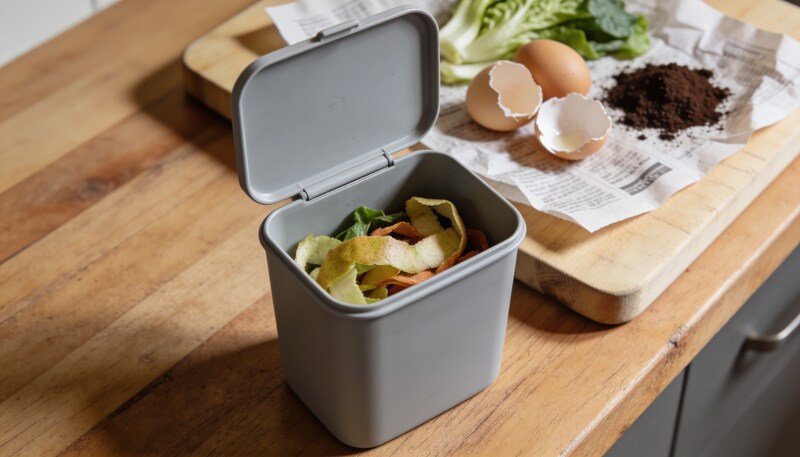
The bin is outside. The reason FOGO succeeds or fails is what happens on the kitchen bench, and this is where council pages stop.
- Keep the caddy where the scraps are made, which is beside the chopping board, not under the sink behind the cleaning products
- Line it with what your council accepts. Newspaper works everywhere and is free. Certified AS 4736 liners work where accepted. Ordinary plastic never works
- Empty it every second day in summer. The smell and the fruit flies come from leaving it, not from the bin itself
- Freeze the difficult things. Fish skins, prawn shells and bones can live in a container in the freezer until bin night. This one habit removes almost every complaint people have about FOGO
- Rinse the caddy when you empty it and let it dry in the sun. Thirty seconds
- Put the bin out every week, even when it is not full, in warm weather
A household system for four bins and two drop-offs covers where the caddy and everything else physically goes in a normal kitchen.
Fruit flies, smell and maggots
The three reasons households give up, and all three are solvable.
- Fruit flies breed on exposed fruit scraps. A lidded caddy that is actually closed, emptied every second day, solves it
- Smell is a warm-and-wet problem. Newspaper in the bottom absorbs liquid, and freezing the protein scraps removes the worst source
- Maggots in the outside bin come from flies laying on exposed food. Wrapping food scraps in newspaper, keeping the bin lid shut and keeping the bin in shade prevents it. A sprinkle of grass clippings or dry leaves over food scraps helps too
- Do not use fly spray inside the bin. It contaminates the compost
Does it actually work
Worth being honest about. Reporting on the national picture indicates that a large share of FOGO material still ends up in landfill rather than compost, driven by contamination and by processing capacity.
That is not an argument against using it. It is an argument for using it properly, because contamination is the part households control. A clean FOGO bin is cheaper for a council to process than a contaminated one, and the finished compost is only usable if the input is clean.
It is also worth knowing that FOGO is not a replacement for a home compost or worm farm if you have one. Home composting handles fruit and vegetable scraps perfectly well and keeps the material on your own garden. FOGO is what handles the things home composting cannot: meat, bones, dairy and cooked food. A vegetable patch kids will actually help with is where that finished compost is most useful.
What it does to your other bins
Two effects worth expecting:
- The general waste bin gets much lighter and much less smelly, because food was most of the weight and all of the smell. Some councils reduce general waste collection frequency when FOGO starts, for exactly this reason
- Food waste becomes visible. A caddy filled every two days is an unmissable measure of what the household is throwing out. What food waste actually costs a household is worth reading once the caddy has made the volume obvious
Common questions
Can I put it in a compostable bag? Only if your council says so, and only if the bag carries the Australian Standard AS 4736 seedling logo. Some councils accept them, some explicitly do not because they do not break down fast enough in their process.
What about tea bags, really? Most contain plastic in the bag or the heat-seal. Loose leaf tea is fine. Check your council, because a few still accept them.
Can I put in the compostable coffee cup from the café? No, in almost all areas. Single-use cups are excluded even when labelled compostable.
Does it go in if it is mouldy? Yes, out of its packaging. Mouldy food is exactly what this bin is for.
What about ash from a fire? Usually no. Check locally.
Can I put weeds in with seed heads? Yes. Industrial composting reaches temperatures that kill weed seed, which is one of the real advantages over a home compost heap.
The short version
Anything that was food goes in, including the meat and bones your compost bin cannot take. Anything that was packaging, paper towel or a cup stays out, even when it says compostable. Line the caddy with newspaper, freeze the smelly things until bin night, and put the bin out weekly in summer.
And check your own council once, because the details at the edges are genuinely local.
The one-page family week
One printable page that holds the whole week: meals, school, activities and who is doing the pickup. Free, and we send one useful email a week.
One email a week. No spam, unsubscribe in a click.