The thumping starts around dusk, moves across the ceiling, and comes back at three in the morning. By the second week most people have searched for somewhere to take it.
That is the option to cross off first.
Possums are protected native wildlife in every Australian state and territory. It is an offence to harm, poison or kill one. It is also an offence to trap one and release it somewhere else, and the penalties run into the tens of thousands of dollars.
The second thing people consider is also out: sealing the hole while the animal is inside means it dies in your roof. That is both an offence and, in entirely practical terms, a smell you will be dealing with for months.
So the legal method is narrower than it first appears, and it is also the only one that works long term.
Why relocation is illegal, and why it would not work anyway
Both worth knowing, because the rule feels unreasonable until you understand it.
A possum holds a territory. Moved outside it, it arrives in country already occupied by other possums, without known food, water or a den, and its survival prospects are poor. Relocation is not a kind alternative; it is a slow one.
And it does not solve your problem. A roof cavity with a way in is a vacancy. If the resident leaves and the entry stays open, another possum takes the space within days or weeks, because the roof is a better den than anything else in the neighbourhood.
Which is why the actual fix is the hole, not the animal.
The legal method, in order
1. Work out where it gets in.
This is the whole job and it takes patience rather than skill.
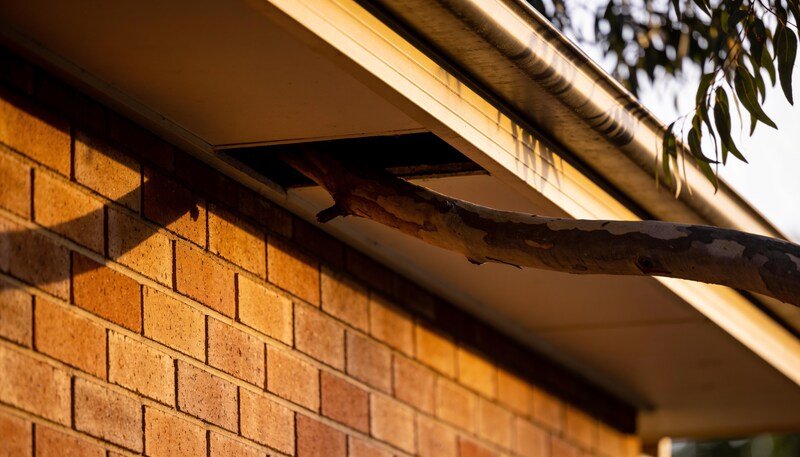
- Watch at dusk. Possums leave to feed shortly after dark. Stand outside and watch the roofline, particularly the eaves, the gable ends, where the roof meets an extension, broken tiles, and the gap where a downpipe or a vent passes through
- Look for the signs by day. A polished, discoloured patch of fur grease at an entry point. Scratch marks. Droppings on a beam or in the gutter below
- Check the trees. An overhanging branch is usually the access road. So is a fence line, a pergola and a climbing plant
2. Give it somewhere else to live, first.
Put a possum box in a tree in the yard, ideally before you close the roof, positioned high, sheltered from the afternoon sun and away from where a cat can reach. A possum that is evicted with nowhere to go is a possum trying very hard to get back in.
Some councils and wildlife groups sell or supply boxes, and some have design specifications for the local species.
3. Fit a one-way door, after the young are independent.
A one-way exit lets the animal leave and not return. It is the legal method and the effective one.
The timing is the part people get wrong and it is the part that matters most. If there is a dependent young in the roof, a one-way door separates a mother from her young and the young starves in your ceiling. Ringtails commonly live in groups.
- Do not install a one-way door if you hear small sounds, multiple animals, or anything at all during the day
- Spring and early summer are the highest-risk period for dependent young, though breeding varies by species and region
- If you are not certain the roof is empty of young, this is a licensed wildlife controller’s job, and that is the honest answer rather than a sales line
4. Close it properly once it is out.
- Seal with something that will hold: metal flashing, heavy gauge mesh, timber. Chicken wire and expanding foam will not last
- Close every gap, not the main one. Possums are persistent and a second entry becomes the first entry
- Trim branches back so nothing overhangs the roof by less than about two metres
- Cap the gap where the downpipe and vents pass through
5. Then check it held. Listen for a week. A single night of scratching at the sealed point is normal; sustained noise means there is another way in, or something is still inside.
When it has to be a professional
In practice, most of these:
- Anyone needs to be in the roof cavity. A ceiling space contains wiring, insulation, sometimes asbestos in older homes, and a ceiling that does not carry weight between the joists. It is not a casual climb
- You are not certain there are no dependent young
- The animal is injured, sick or clearly in distress
- It has to be trapped at all. In Australia only a licensed wildlife controller may trap and handle a possum, and in most states a permit is required even to trap one on your own property. Where relocation is allowed at all it is tightly limited, commonly to the same property
- Roof work at height
Contacting a licensed controller is not giving up. It is the only lawful route for the handling part.
Living with the one in the yard
Once the roof is closed, the possum is still in the neighbourhood, and that part is not a problem to solve.
- Do not feed them. Bread, fruit and pet food cause serious health problems in possums and turn an occasional visitor into a resident
- Protect specific plants rather than the whole garden: netting over the vegetable patch, a collar of smooth metal around the trunk of a fruit tree
- Roses and new growth are the usual casualties. A pet-safe garden plan helps here, and a pet-friendly garden covers the same ground for plants and animals generally
- Keep the compost closed and the bins lidded
- Accept the noise on the roof. They walk on roofs. It is not a sign they are back inside
Getting the backyard ready for summer covers the tree and gutter work that overlaps with keeping them out.
Common questions
What is actually making the noise? Heavy, deliberate thumping and walking at dusk and dawn is usually a possum. Fast, light scurrying and constant gnawing is more likely a rat, which is a different problem with different rules and no legal protection.
Can I use a repellent? Commercial repellents exist and results are inconsistent. They do not close a hole, which is the actual fix.
Is there a smell? Yes, and it is one of the reasons people notice. Urine soaks into insulation and ceiling plaster, and badly affected insulation sometimes has to be replaced.
Do I have to tell my insurer? Possum damage to insulation, ceilings and wiring is sometimes covered and often excluded. Read the policy before you assume either way.
What if I rent? Report it to the agent in writing. A possum in the roof is a property maintenance issue rather than a tenant one, and the repairs to the roofline are the owner’s.
Can I just wait for it to leave? It will leave every night and come back every morning. Roof cavities are excellent dens and there is no reason for it to give one up.
The short version
You cannot move it and you cannot seal it in. Find the entry, put a box in a tree, and let it leave through a one-way door once you are certain there are no dependent young. Then close every gap with something solid and cut the branches back.
And if there is any doubt about young in the roof, or if anyone would be climbing into the ceiling space, that is a licensed wildlife controller and a roofer, not a Saturday.
The one-page family week
One printable page that holds the whole week: meals, school, activities and who is doing the pickup. Free, and we send one useful email a week.
One email a week. No spam, unsubscribe in a click.