What is in this guide
- Where it actually goes
- The fix for leftovers, which is the biggest single one
- The fix for vegetables
- The fix for duplicates
- The fix for portions
- Where the money shows up
- Dates on packaging, which cause a lot of avoidable waste
- What to do with what you genuinely cannot eat
- A one-week diagnostic
- Common questions
- The short version
Australian research on household food waste puts the figure at more than $1,500 a year per household, and finds that around 70 per cent of what is thrown out was perfectly edible.
The number is striking and, on its own, not very useful. Nobody wastes $1,500 in one go. It disappears in small amounts, in four specific places, and each of them has a different fix.
Where it actually goes
1. Leftovers nobody claimed. The research points at this directly: uneaten leftovers and vegetables together account for a very large share, described as a leftover problem worth over $500. Food gets cooked, a portion goes in the fridge in good faith, and nobody eats it because nobody decided who would.
2. Vegetables bought with good intentions. The tomatoes, carrots, leafy greens and herbs bought for the version of the week that did not happen. Bought on Saturday for a plan, superseded by Tuesday’s reality.
3. Duplicates. A second jar of something already open. Half a bag of spinach behind the milk. This is a visibility problem rather than a planning one.
4. Portion overshoot. Cooking for six when four are eating, consistently, and the surplus becoming leftovers that then fail at point one.
Notice that only one of those is a shopping problem. Most household food waste is a fridge management and decision problem, which is why buying less is not by itself the fix.
The fix for leftovers, which is the biggest single one
Leftovers do not fail because they are unappealing. They fail because they are undecided.
- Name it as a meal before it goes in the fridge. “That is Thursday lunch” is the whole technique. Food with a job gets eaten
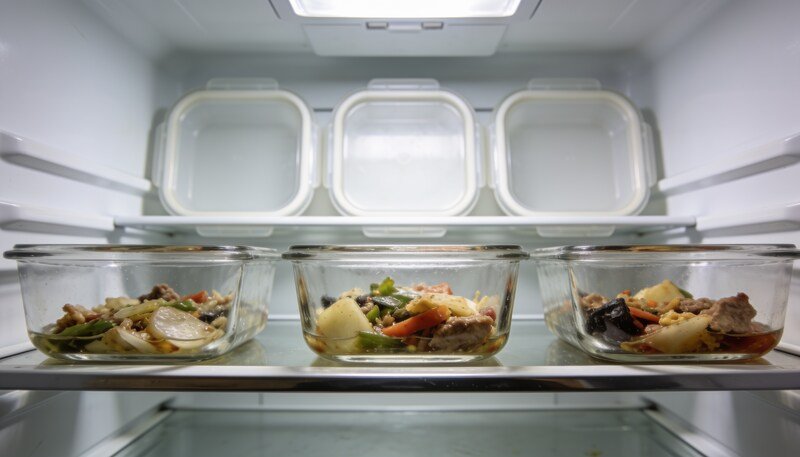
- Put leftovers at eye level, at the front. The single most effective change in the fridge. Food at the back of a shelf is food nobody will see again
- Use clear containers. Opaque containers are where leftovers go to be forgotten. Freezer and meal-prep containers covers choosing them, and the visibility point is the one that matters here
- Date them. A strip of masking tape and a marker. Undated leftovers are thrown out on suspicion, which is waste created by uncertainty rather than by spoilage
- Have a leftovers night. One night a week where the meal is whatever is in the fridge. It works because it is scheduled, not because it is inspired
- Freeze it on day one, not day three. A portion frozen while it is fresh is a future meal. A portion frozen on day three is a portion you have already decided not to eat
The fix for vegetables
- Shop for the week you will actually have, not the one you intend to have. If Wednesday is always chaotic, do not buy Wednesday’s fresh ingredients
- Buy some fresh and some frozen. Frozen vegetables are the honest answer for the back half of the week, and they waste nothing
- Prep on arrival, not before use. Vegetables washed and cut when they come home get eaten. Vegetables in a crisper drawer in a bag do not
- One crisper for this week only. A drawer with a defined job
- Herbs are the worst offender per dollar. Buy the smallest quantity, or freeze them in oil in an ice cube tray on the day you buy them
- Cook the oldest thing first. Not the nicest thing
The fix for duplicates
Pure visibility.
- Shop from the fridge, not from memory. Two minutes looking before you write the list
- One shelf for open things. Opened jars, half-used packets, the things that already exist
- Take a photo of the fridge before you shop. Crude, free, works
- Group by type rather than by who bought it. Fridge organisation for a full family fridge covers the layout properly
- Check the pantry too. Freezer and pantry staples worth always having is the list, and the point of a list is that you stop buying what is already on it
The fix for portions
- Weigh the rice and pasta once to learn what your household actually eats, then use that measure permanently. Most households overshoot dry goods substantially and never recalibrate
- Cook deliberately for leftovers or deliberately not. The problem is accidental surplus, not planned surplus
- Serve less and go back, rather than plating more than anybody wants
Where the money shows up
This is not a saving you will see as a single line. It shows up as a slightly smaller shop, more often, because you are not replacing things you already had.
If it helps to make it concrete: the reported figure is over $1,500 a year per household. Cutting it by a third is somewhere around $10 a week. That is not life-changing and it is also more than most of the things people try when they are trying to reduce a grocery bill, and it requires eating no worse.
A family budget that survives a real month and feeding a family of four on a weekly grocery budget are where that saving actually lands.
Dates on packaging, which cause a lot of avoidable waste
A genuine source of unnecessary throwing out.
- Use-by is a safety date. Do not eat food after its use-by date. This is the one that matters
- Best-before is a quality date. Food is generally safe after it, though it may have lost quality. It is legal to sell it after that date in Australia and it is commonly fine to eat
- Baked on and baked for dates on bread are not safety dates
- Eggs carry a best-before. The float test is folklore rather than a safety standard; the date and the smell on cracking are better guides
Throwing out food on a best-before date is one of the easiest wins available, and it requires nothing except knowing which word is on the packet.
What to do with what you genuinely cannot eat
Some waste is unavoidable: peelings, bones, the end of the celery.
- FOGO, if you have it. Food scraps in the green bin rather than landfill, and it takes meat and bones that a home compost cannot. The FOGO bin covers what is in and out
- Home compost or worm farm for fruit and vegetable scraps if you garden
- Freezer bag for stock. Onion ends, carrot tops, celery leaves, chicken bones. Fill it over a fortnight, make stock once
- Not the general waste bin, where organic material produces methane in landfill
A one-week diagnostic
If you want to know where your own waste actually is, rather than where the average household’s is:
- Put a container on the bench for one week and put everything you throw out in it, or photograph it
- At the end of the week, sort it into the four categories above
- Fix the biggest one first. It is almost always leftovers
- Do not try to fix all four. One change that holds beats four that last a fortnight
Common questions
Is it cheaper to buy less more often? Usually yes for fresh food, and it depends entirely on whether the extra trip costs you time or fuel you value more.
Are meal kits less wasteful? They portion precisely, which reduces ingredient waste, and they generate packaging. On cost per meal they are generally more expensive than shopping well.
What about buying in bulk? Bulk works for shelf-stable staples and is a common source of waste for fresh food. The saving per kilo is irrelevant if half of it is thrown out.
Do supermarket specials cause waste? They cause waste when they change what you buy rather than when you buy them. A special on something you already use is a saving; a special on something you do not is a $6 experiment in the crisper.
Is a smaller fridge better? Anecdotally people waste less in a smaller fridge because they can see everything. That is the visibility principle again rather than the fridge.
The short version
Most household food waste is leftovers nobody claimed and vegetables bought for a week that did not happen. Name leftovers as a meal before they go in the fridge, put them at the front at eye level, date them, and schedule one leftovers night.
Learn the difference between use-by and best-before. And spend one week seeing what you actually throw out, because the average household’s problem may not be yours.
The one-page family week
One printable page that holds the whole week: meals, school, activities and who is doing the pickup. Free, and we send one useful email a week.
One email a week. No spam, unsubscribe in a click.