What is in this guide
The Australian retail calendar repeats every year and it is entirely predictable. Buying against it is one of the very few household savings that requires no ongoing effort, no behaviour change and no comparison shopping. You buy the same things, at a different time.
Almost every article about retail timing is written for the northern hemisphere, which means the months are wrong for Australian readers on every single item. Here is the Australian version.
The calendar
January. Back to school peak, and the worst time to buy anything school-related at full price. Stationery is genuinely cheap in the January promotions, and uniforms and shoes are not. Late January is when school-specific items start clearing, which is useful for next year rather than this one.
February. Summer clothing clearance begins as retailers make room for winter. Swimwear, shorts, summer dresses, sandals, hats. Buy the next size up for next summer.
March and April. Winter ranges arrive at full price. A poor time for clothing. Reasonable for sporting goods as winter seasons start and retailers compete.
May and June. End of financial year sales in June are genuinely significant in Australia and cover appliances, electronics and homewares more than clothing. Mid-year is also when winter clothing gets a first markdown.
July and August. Winter clearance. The best time of the year to buy winter clothing, jackets, boots and school jumpers for next year. Also a reasonable time for outdoor and camping gear.
September and October. Summer ranges arrive. A poor time for clothing. Good for gardening and outdoor items as they are promoted into spring.
November. The large November sales events are now firmly established in Australia and are genuinely competitive, particularly for electronics, toys and larger items. This is the right time to buy Christmas presents, and it is six weeks before the point at which most households start.
December. The most expensive month for almost everything. Post-Christmas clearance from about the twenty-sixth is good for toys, decorations and wrapping for next year.
What to buy when, by item
School uniforms: end of January and through February, when the back to school rush ends and remaining stock clears. Also check the school’s second-hand uniform shop or parents’ association sale, usually held at the end of the school year, which is almost always the largest saving available in this category.
School shoes: not in December. Feet grow over a six-week summer holiday and shoes bought early frequently do not fit by February. This is the one item where buying ahead reliably fails.
Stationery: January promotions, and buy for the whole year. Stationery does not grow, does not date and does not spoil.
School bags: end of the school year or early in the new year, after the peak.
Winter clothing: July and August clearance, one size up.
Summer clothing: February clearance, one size up.
Swimwear: February and March.
Toys: the November sales, and post-Christmas clearance. Not December.
Sporting equipment: at the end of that sport’s season, when clubs and retailers clear stock.
Bikes and scooters: post-Christmas and end of season.
Camping gear: after the summer holidays and in the winter clearance.
Furniture, appliances and electronics: end of financial year in June, and the November events.
The trap: buying the wrong size
Buying a size up at clearance is the core technique and it fails in specific ways worth knowing.
Shoes are the worst candidate. Feet grow unpredictably and width changes as well as length. Do not buy shoes ahead for a growing child.
Buy one size up, not two. A jacket bought two sizes ahead is stored for two years, goes out of favour, and is frequently the wrong size anyway when the moment comes.
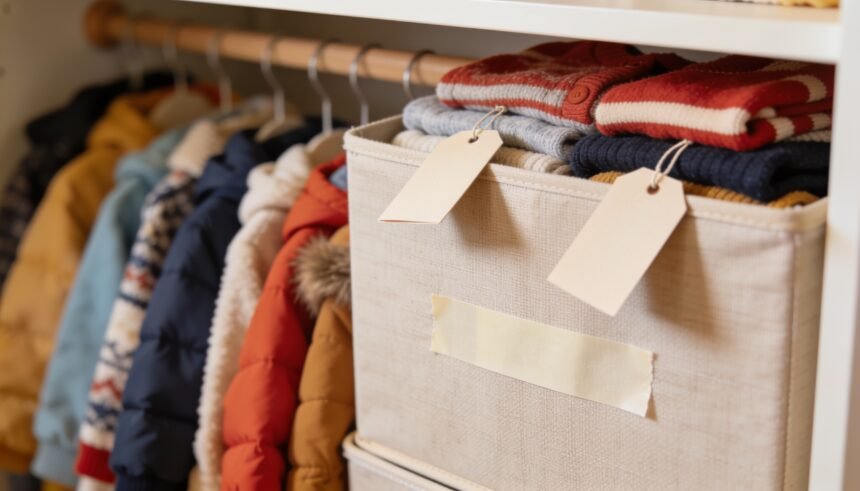
Store it where you will find it. A garment bought in July for next winter and put in the back of a wardrobe is discovered in September of the following year. A labelled box with the size and the season on it solves this.
Keep a list. What you bought, what size, where it is. Two minutes when you put it away, and it prevents buying the same thing again.
Some children grow in bursts and some do not. A household with a child who has been in the same size for eighteen months can buy ahead confidently. One with a child who grew three sizes in a year cannot.
Second-hand, which beats every sale
The largest savings in children’s clothing are not in retail at all.
School second-hand uniform shops and parents’ association sales are typically at the end of the school year.
Community buy-and-sell groups and marketplace listings are where children’s clothing, bikes, sporting equipment and toys move for a fraction of retail, largely because they were outgrown rather than worn out.
Hand-me-downs within a network of friends and family. Worth organising deliberately rather than hoping.
Check safety before buying second-hand for anything with a safety function, including car restraints, cots, prams and helmets. Product recalls are published on Product Safety Australia and a check takes under a minute. Some items should not be bought second-hand at all when their history is unknown, and helmets are the clearest example.
What this saves
No figure is given, because it depends entirely on what a household buys and where.
Structurally, it is one of the very few savings with no ongoing cost: no time each week, no change to what anyone eats or wears, no comparison shopping. You buy the same item at a different point in a calendar that repeats.
The one requirement is a small amount of cash flow ahead of the need, which is exactly what a sinking fund is for, as covered in a family budget that survives a real month. A household with nothing set aside buys at full price in January by necessity, which is the more expensive version of the same year.
Next: Christmas and back-to-school: budgeting for the two spikes covers funding it, a family budget that survives a real month covers the sinking fund, and what back to school actually costs per child covers the January total.
The one-page family week
One printable page that holds the whole week: meals, school, activities and who is doing the pickup. Free, and we send one useful email a week.
One email a week. No spam, unsubscribe in a click.