What is in this guide
Almost nobody throws out a freezer container because it is the wrong size. They throw it out because the lid went brittle, or warped in the dishwasher, or stopped sealing and the contents got freezer burn.
That is the whole buying problem in one sentence, and it is not what the listings talk about.
This guide compares published specifications and materials rather than any hands-on testing, and says so wherever a claim would otherwise imply otherwise.
Freezer duty and lunch duty are different jobs
A container that is excellent in a freezer is often mediocre in a lunch bag, and the reverse.
- Freezer duty wants a straight-sided, stackable shape, a lid that seals against air rather than against leaks, and a material that does not go brittle cold
- Lunch duty wants a genuine liquid seal, a shape that fits a bag, and a lid a child can open
Buying one set for both is how people end up with twelve containers and no lids. It is usually cheaper to buy a small freezer set and a separate small lunch set than a large set that does neither well. Leakproof lunchboxes covers the second job properly.
The specifications that actually decide it
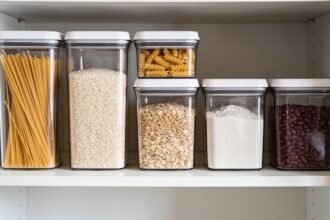
Stackability, not capacity. A freezer is a volume problem with a geometry constraint. Round containers waste roughly a fifth of the space between them. Square and oblong containers with vertical sides stack flat and interlock. Check whether the lids are recessed so the base of the next container sits into them, because that is what stops a stack sliding.
Lid design. This is the failure point, so it is worth the attention:
- Clip lids seal well and the clips are what snaps, usually at the hinge, usually in year two
- Push-on lids have nothing to break but loosen as the plastic relaxes
- Screw lids survive best and are slow to use
- Vented lids exist for microwave reheating, and a vent is a hole, so they are not a liquid seal
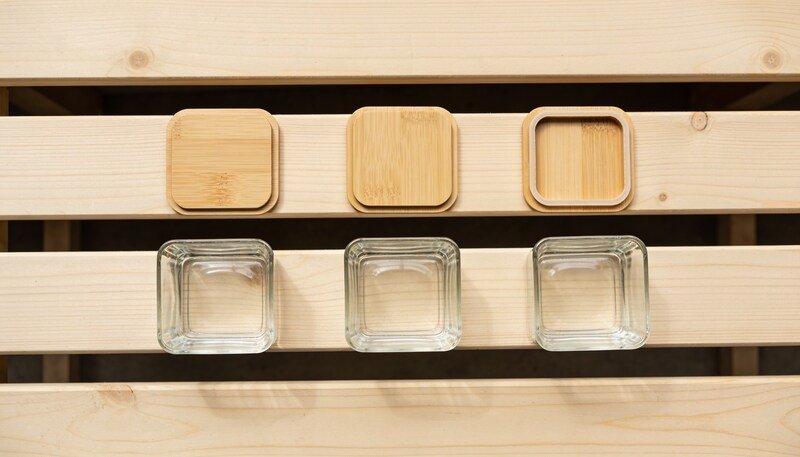
Whether replacement lids are sold. This is the single most useful thing to check and almost nobody does. Decor’s Australian range lists individual replacement lids for its Tellfresh, Vent & Seal, Design Series, Style & Organise and glass bamboo canister lines, at $2.00 to $3.00 each on 13 September 2026. A system where a $2 lid replaces the whole container is a materially different purchase from one where a lost or warped lid retires the base.
Material. Covered below.
Dishwasher and microwave ratings. Both are printed on the listing. Microwave-safe and dishwasher-safe are separate ratings and a container can carry one without the other.
Volume markings on the side. Trivial until you are portioning, then constant.
Glass or plastic
Both work. They fail differently.
Glass
- Does not stain, does not hold smell, does not absorb curry colour
- Goes from freezer to oven in the borosilicate types, though not from freezer straight to a hot oven
- Heavy, and a full glass container of frozen soup is genuinely heavy
- Breaks, and breaks in a way that ends the container and sometimes the contents
- Usually dearer per litre
Plastic
- Light, cheap, survives being dropped
- Stains and holds odour, particularly with tomato and turmeric
- Lids degrade faster
- Look for BPA free on the listing, which Australian ranges including Decor state explicitly
The practical answer for most households is plastic for the freezer, glass for anything reheated often, and neither for anything that needs to travel with a toddler.
Sizing, which is where most sets go wrong
Buy for the portion, not for the pot.
- Single portions, roughly 400 to 600 mL. The most useful size and the one most sets under-supply
- Two portions, roughly 800 mL to 1 L
- Family portions, 1.5 to 2 L. Fewer of these than you think, because a 2 L block takes a very long time to defrost
- Flat and wide beats tall and narrow for anything that needs to thaw, because thawing is a surface area problem
Measure the freezer shelf before ordering: the internal depth and the clear height between shelves. A container 5 mm too tall is useless.
Filling and freezing, briefly
Not the buying part, but it decides whether the containers work.
- Cool food before refrigerating or freezing it, and do not leave it out to cool for hours. Australian food safety guidance is to cool food quickly and refrigerate it, rather than letting it sit at room temperature
- Leave headspace. Liquids expand and a full sealed container will push its own lid off or crack
- Label with contents and date. A chest freezer without labels is an archaeology project
- Freeze flat first where the container allows, then stack
Freezer meals that actually taste good reheated is the cooking side of this, and freezer and pantry staples worth always having is what ends up in them.
What no listing tells you
Stated plainly, because the absence matters:
- No brand publishes a cycle count for how many dishwasher runs a lid survives
- No brand publishes cold-brittleness data for freezer temperatures
- Stain resistance is never specified, though it varies a lot between plastics
- Stack load is not published, so nothing here ranks how high a stack can go
Anyone claiming a hard number on any of those is estimating.
Before you buy
- Measure the freezer shelf height and depth
- Decide the portion sizes you actually use, and buy more small than large
- Check whether replacement lids exist for the range
- Check the microwave and dishwasher ratings separately
- Buy one set and live with it for a month before completing it, because the size you need is not the size you expect
If the containers are going into a pantry rather than a freezer, pantry and fridge storage containers is the other half of the same decision.
The one-page family week
One printable page that holds the whole week: meals, school, activities and who is doing the pickup. Free, and we send one useful email a week.
One email a week. No spam, unsubscribe in a click.