What is in this guide
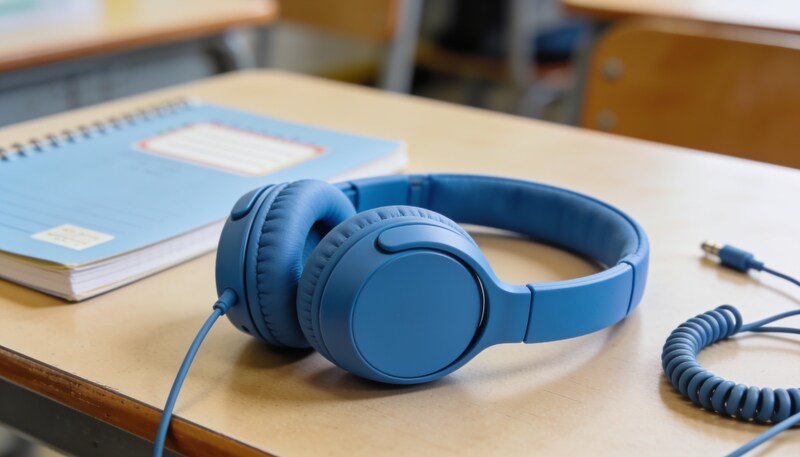
Almost every pair of children’s headphones sold in Australia advertises a volume limit, usually 85 decibels. It is a real feature and it is narrower than it sounds.
What it does: caps the maximum output of the headphone itself, so turning the device up past a point produces no more volume.
What it does not do: control how long the child listens, survive a swapped cable on a wired pair, or apply to any other headphones plugged into the same device.
This guide compares published specifications and Australian retailer listings. No pair was worn, measured or tested by us, and no claim is made here about hearing outcomes.
Level and duration, together
Safe-listening guidance from the World Health Organization is built on both how loud and how long. A level that is fine for an hour is not automatically fine for a whole flight, and the 85 dB figure that manufacturers cite comes from occupational exposure limits that are defined over a working day rather than as a universally safe number.
The practical translation for a household is that a volume cap is one control and listening time is the other, and the second is the one parents actually have to manage. A device screen-time setting or a household rule does more than the headphone does. A family device agreement that actually holds is where that belongs.
Where the limit stops working
Worth knowing before relying on it:
- A swapped cable. On a wired pair where the limiting is in the cable rather than the cup, using a generic 3.5 mm cable removes the limit. Puro Sound Labs sells a limiter cable separately, listed at $19.00 on 13 September 2026 and described as keeping volume at 85 dB and below, which tells you plainly where the limiting lives on that design
- A second pair. The cap belongs to the headphone, not the device, so the older sibling’s earbuds bypass it entirely
- Splitters. Two children on one device with a splitter, one limited pair and one not
- Bluetooth pairing to a different source. The cap travels with the headphone, but nothing stops the child pairing something else
If you want the control at the device instead, both major mobile platforms have a volume limit setting, and that applies to whatever is plugged in.
What the Australian listings actually state
Reported as manufacturer claims, because that is what they are:
- BuddyPhones Explore+ states certified built-in volume limiting capping sound at 85 dB, and was $29.99 on 13 September 2026
- BuddyPhones School+ Wireless was also $29.99, and BuddyPhones Play+ $49.99, on the same date
- Puro Sound Labs PuroBasic wired with in-line mic was $29.00, JuniorJams-Plus on-ear $55.25 and BT2200-Plus Bluetooth $99.00, all on 13 September 2026
- ONANOFF states its BuddyPhones range uses BPA-free and phthalate-free plastics
- Puro Sound Labs lists a 3.5 mm audio cable on several models so the headphones still work when the battery is flat
No independent Australian testing of these volume caps is published, so the cap figures are the manufacturer’s own.
The features that decide it for school
The cap is the headline. These decide whether the pair survives a term.
Wired or wireless. Many Australian schools require wired headphones, because pairing thirty Bluetooth devices in one classroom does not work and a flat battery means a child cannot participate. Check the school’s list before buying. BYOD device rules at Australian schools covers where to find it.
A microphone, if the device is used for recording or calls. In-line on a wired pair is the common arrangement.
Foldable or not, because the pair lives in a school bag. This is the main cause of death for school headphones.
A detachable cable, which means a chewed cable is a replacement cable rather than a replacement pair. It is also the thing that removes the volume limit, so buy the manufacturer’s replacement rather than a generic one.
On-ear or over-ear. Over-ear is more comfortable for long use and bulkier in a bag. On-ear is lighter and presses on the ear. Small heads need a headband that adjusts genuinely small.
Sharing. Some kids models chain one pair to another so two children listen to one device without a splitter, which is a car-trip feature rather than a school one.
Noise cancelling. Useful on a plane, not needed at school, and it is most of the price difference on the dearer models.
Bone conduction, which sits on the cheekbone and leaves the ear open. Puro lists two at $34.50. It suits a child who needs to hear the room, and it is a comfort and awareness choice rather than a safety one.
What no listing tells you
- Actual measured output at the ear, which no Australian body independently verifies
- Durability, and this category is bought mainly because the last pair broke
- Battery life over years on a wireless pair
- Headband fit range in centimetres, almost never published
Nothing here is ranked on sound quality or durability, because no published data exists to rank on.
Before you buy
- Check the school’s requirement first, especially wired against wireless
- Decide whether the limiting is in the cup or the cable, and buy a spare manufacturer cable if it is in the cable
- Set the volume limit on the device as well, because that one covers every pair
- Choose foldable with a detachable cable for school
- Treat listening time as the control that matters, and agree it rather than policing it
If the real question is not headphones but the device itself, when should a child get their first phone is the prior decision, and if it is what to do with the device at home, that is the family device agreement.
Pick 1
PuroBasic Wired Volume Limited Headphones with In-line Mic
Puro Sound Labs
Pick 3
BuddyPhones School+ Wireless
ONANOFF
Pick 5
JuniorJams-Plus Volume Limited On-Ear Headphones For Kids
Puro Sound Labs
Pick 6
BT2200-Plus Volume Limited Kidsu2019 Bluetooth Headphones
Puro Sound Labs
The one-page family week
One printable page that holds the whole week: meals, school, activities and who is doing the pickup. Free, and we send one useful email a week.
One email a week. No spam, unsubscribe in a click.