What is in this guide
A reverse cycle air conditioner is the cheapest way to heat a room in every Australian state, and the same physics applies in reverse for cooling. It moves heat rather than generating it, which is why reverse cycle units on the Australian market run at 300 to 600 per cent efficiency against exactly 100 per cent for any plug-in electric heater.
What that means for summer: the unit itself is rarely the problem. How the house is run around it usually is.
What actually drives the summer bill
How many rooms you cool. Cooling the whole house to keep one room comfortable is the single most expensive habit in an Australian summer, exactly as it is in winter.
How long it runs. A unit holding a room at a steady temperature costs far less per hour than one repeatedly pulling a hot room back down from 38.
How much heat gets in. Australian housing stock is poorly insulated by international standards, and glass is the weakest point. A room with afternoon sun on a large window is being reheated continuously while the unit fights it.
The temperature you set. Every degree lower costs more, and setting it to 16 does not cool the room faster. It just overshoots and runs longer.
The free changes, which come first
Close the doors to rooms you are not cooling. Same rule as winter. This is the largest single lever and it costs nothing.
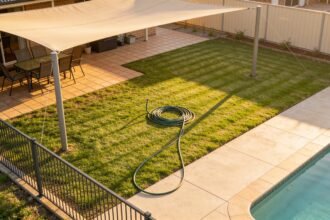
Block the sun before it gets in. External shading beats internal curtains by a wide margin, because once the sun is through the glass the heat is already in the room. Awnings, external blinds, shade cloth or a well-placed tree all work. Where external is not possible, close curtains and blinds on the sunny side before the room heats, not after.
Close up during the day, open up at night. In most of Australia the outside air is cooler than the house by late evening. Opening the house then and closing it early in the morning does real work for free.
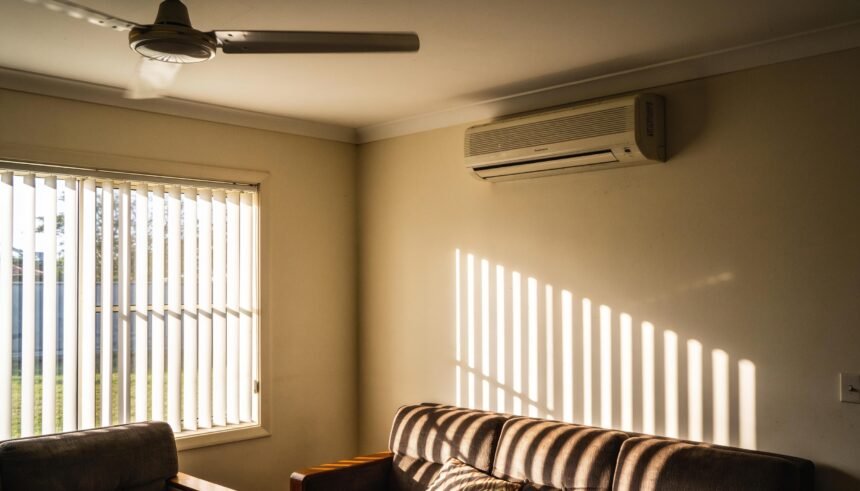
Use fans with the air conditioning, not instead of it. A ceiling or pedestal fan lets you set the thermostat a couple of degrees higher for the same comfort, because moving air makes a room feel cooler. Fans cool people, not rooms, so turn them off when the room is empty.
Set it and leave it. Around 24 to 25 degrees is the usual recommendation for cooling. Adjusting it constantly costs more than choosing one setting.
Clean the filters. A blocked filter makes the unit work harder for the same result. This is a ten minute job a couple of times a season.
Running it on the hottest days
Start earlier than you think. Pulling a house down from 38 degrees at 5pm costs more than holding it from 1pm. If you know the day is coming, get ahead of it.
Cool the room you are in. Close the rest.
Use the timer. Cooling a bedroom for an hour before sleep and then letting it cycle costs less than running it all night at a low setting.
Do not use the aircon to dry laundry or cool a space with the door open. Both are common and both are expensive.
What it costs relative to the alternatives
Published Australian comparisons put a reverse cycle split system as the cheapest option for climate control, with a 3.5kW unit in the region of $0.28 to $0.36 an hour for a room. Those figures are published for heating and the same unit and efficiency logic applies to cooling, though cooling demand varies with outside temperature in a way that makes a single hourly figure less reliable.
Evaporative cooling is cheaper to run than refrigerated cooling but only works well in dry heat. In humid conditions, which covers much of the Australian east coast in summer, it is far less effective.
Fans alone are by far the cheapest option and are genuinely sufficient on many days. A pedestal or ceiling fan costs a small fraction of an hour of air conditioning.
Check your own tariff and bill rather than relying on any published average, including these.
If you are buying
Size it to the room, not the house. An oversized unit short-cycles, which costs more and dehumidifies less effectively.
Compare the annual energy figure on the label, not the star rating alone. Stars are assigned within a size class, so a five-star small unit and a five-star large unit are not equivalent.
Reverse cycle rather than cooling-only, in almost every case. The same unit then handles winter as the cheapest heating option available, which changes the payback substantially.
Check for concessions and rebates. These are state-based and change, and they are rarely advertised at the point of sale.
The order that saves the most
- Close the doors and cool one room.
- Block the sun on the western and northern windows.
- Open the house at night, close it in the morning.
- Fans with the aircon, set two degrees higher.
- Thermostat at 24 to 25, left alone.
- Clean the filters.
- Then consider the unit itself.
Most households never get past step two before the bill moves.
Next: heating a house cheaply through an Australian winter is the same unit and the same logic in reverse, and bathroom mould is what happens when a closed-up house has nowhere to put its moisture.
The one-page family week
One printable page that holds the whole week: meals, school, activities and who is doing the pickup. Free, and we send one useful email a week.
One email a week. No spam, unsubscribe in a click.