What is in this guide
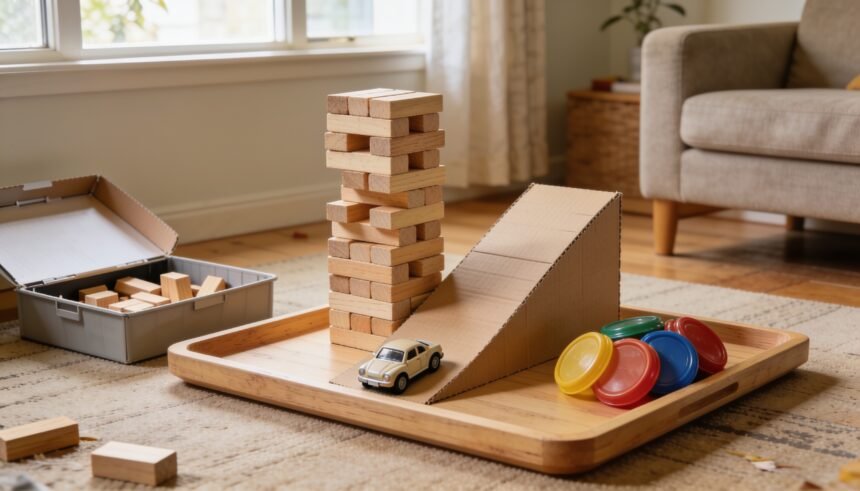
A STEM kit for a three-year-old does not need circuits, instructions or a brand name. It needs a small number of large pieces that fit together in more than one way, a repeatable action the child can do alone, and a container that goes away and comes back. You can buy that for little money or assemble it from what is already in the house.
What does STEM actually mean at age three?
At three, STEM is not a subject. It is stacking, pouring, sorting, fitting, balancing and knocking down. NAEYC’s guidance on block play describes engineering happening when a child builds something, finds a problem and changes the design. For a three-year-old that might be a tower that keeps falling until the big block goes on the bottom.
The useful test for any kit is whether it lets the child do those actions over and over with a visible result. A kit that produces one finished model and then sits on a shelf is a craft project, not a STEM kit, however it is labelled. What open-ended play means and why STEM toys talk about it covers the distinction in more detail.
What should a kit for this age contain?
Keep it to four kinds of pieces. More than that and the box becomes a tipping game rather than a building one.
| Component | Why it earns its place | Low-cost versions |
|---|---|---|
| Large connecting or stacking pieces | The core build action; big enough to grip and place without frustration | Wooden blocks, large interlocking bricks, stacking cups, cardboard boxes of different sizes |
| Things that roll or pour | Introduces cause and effect and simple ramps | Toy cars, large balls, dried pasta in a sealed tub, water in the bath |
| A sorting element | Colour, size or shape matching is maths at this age | Pegs, bottle lids from the recycling, large buttons kept for a supervised session |
| A surface or base | Gives the build a place to live and the session a boundary | A tray, a chopping board, a shallow storage box lid |
Nothing here has to be bought new. Op shops, school fete stalls and secondhand marketplaces usually have blocks and bricks in bulk. If you do buy a packaged kit, check that the pieces are large, that there are fewer than you expect and that there is no booklet of models to copy. STEM toys by age and what a child can actually do alone explains why the age on the box is a safety rating rather than a difficulty rating.
How do you check it is safe for a three-year-old?
Australia has a mandatory safety standard for toys for children up to and including 36 months, covering small parts. A three-year-old sits right at that boundary, so treat anything that fits inside a toilet roll tube as a small part and keep it out of the kit unless you are sitting beside them. Bottle lids and buttons are useful sorting pieces for exactly that reason: they are good for a supervised tray and wrong for a self-serve box.
Check Product Safety Australia’s toy guidance and current recalls before buying any kit secondhand. Avoid anything with button batteries or small magnets at this age. If a younger sibling is in the house, assume whatever is in the kit will end up on the floor.
How do you keep a three-year-old engaged with it?
Three things make the difference, and none of them cost anything.
Give it a job, not a model. Instead of showing a picture to copy, give a problem the child can hold in their head: make a bed for the toy dog, build a wall taller than the cup, find a ramp that makes the car reach the rug. ACECQA’s guidance on child-directed learning describes children planning and leading their own play while adults listen and support. At home that means you set the question and they choose the answer.
Change one piece, not the whole kit. The fastest way to lose a three-year-old is to tip out every toy in the house. The second fastest is to offer the same six blocks every day. Swap one component each week: cars out, balls in; wooden blocks out, boxes in. The build action stays familiar and the result changes.
Put it away while it is still fun. A kit that lives permanently on the floor becomes furniture. One that comes out on the tray for twenty minutes after lunch and then goes back on a high shelf stays interesting. Toy rotation is covered in detail elsewhere on Dovelyne, but the short version is that absence does most of the work.
For sessions that need no kit at all, free STEM activities using household items and free activities for toddlers both work at this age.
What goes wrong, and how do you fix it?
The child only wants to knock it down. That is the physics lesson. Build, they knock, you build again. After a few rounds, ask them to put the last block on before it falls. The build action arrives on its own.
The pieces end up everywhere. The tray or board is the fix. The rule is that the build happens on the tray. Pieces that leave the tray go back in the box. Three-year-olds accept a physical boundary far more readily than a verbal one.
They lose interest in a week. Check the piece count first. A kit that is too generous is as dull as one that is too small, because nothing has to be chosen. Halve the pieces, keep the other half for the swap, and give one job per session.
An older sibling takes over. Give the older child the harder version of the same job on their own tray. A wall taller than the cup for one, a wall that holds a book for the other.
When is it worth paying more?
Rarely, at three. The exception is a well-made set of large blocks or bricks that a child will still use at six, because the same pieces carry a more complex build later and can be passed on. Before spending more than pocket-money prices, run the set through how to evaluate an educational toy before buying it. If it fails on piece size, on needing an adult for the whole session or on having one finished model, the cheaper tray kit will be used more.
Your next step: choose a tray, put four kinds of pieces on it from what you already own, give one job, and set a twenty-minute timer. Notice which pieces get used and swap one of the others next week.
The one-page family week
One printable page that holds the whole week: meals, school, activities and who is doing the pickup. Free, and we send one useful email a week.
One email a week. No spam, unsubscribe in a click.