What is in this guide
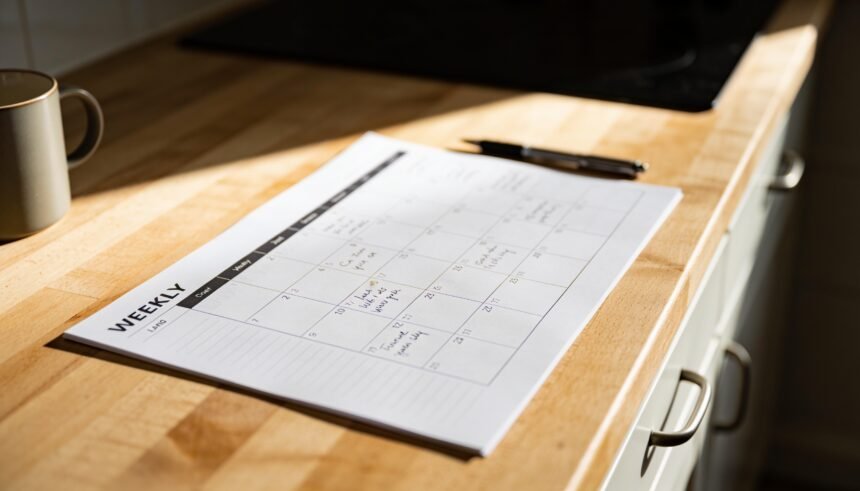
One sheet. Seven day columns, four rows, and a strip along the bottom. It takes about six minutes to fill in on a Sunday and it replaces the pile of notices, the group chat scrollback and the mental list you are currently carrying around. Print a fresh one each week rather than reusing a whiteboard, because a blank page forces a reset and a whiteboard slowly turns into a smear.
This is deliberately one page. Planners fail when they ask for more detail than the week deserves.
What is on the sheet
Seven columns. Monday to Sunday, equal width. Not five weekdays plus a squeezed weekend, because the weekend is where most of the logistics actually live.
Row one: who is where. Work patterns, late finishes, someone away, the day one parent has the car. This row answers the question that causes most of the friday-night arguments.
Row two: what is on. Sport, appointments, excursions, birthdays, anything with a time attached. One line per item. If it does not fit on one line it belongs in your phone, not here.
Row three: dinner. Five weeknight meals and two blanks. The blanks are not laziness, they are the shock absorber that lets the plan survive a bad Tuesday.
Row four: who is doing it. Drop-off, pick-up, cooking, the one who is home for the delivery. This is the row that stops the load quietly landing on whoever asks first.
The bottom strip. Three short sections across the page:
- Needs signing or paying. School notices, excursion payments, forms.
- Needs to leave the house. Library books, the uniform, the thing due Thursday.
- Pets. Worming or flea date, who is walking, whether the food is running low.
That is the whole sheet. No habit trackers, no gratitude box, no hourly grid.
How to fill it in
Do it at the same time every week. Sunday evening suits most households. Friday afternoon suits shift workers and anyone whose weekends move.
- Empty the paper tray first. You cannot plan a week around notices you have not read. Sign, bin, or move to the out pocket.
- Fill row one across all seven days. Availability before activities, always. Everything else depends on who is actually there.
- Fill row two. Add the times. An event without a time causes more problems than no event at all.
- Fill row three last. You can only plan dinners once you know which nights are compressed. Put the fastest meal on the tightest night.
- Assign row four. Out loud, with the other adult in the house if there is one. This takes ninety seconds and prevents most of the week’s resentment.
- Glance at next Monday. Just the first three days of the following week. This is what catches the payment due before you next sit down.
What makes this version different
Most printable family planners are built around a tidy ideal week. Three things here are built for a real one.
The two blank dinner slots. Every meal plan collapses the first time something goes wrong. Building in slack means one bad night does not invalidate the whole sheet.
The in and out split at the bottom. Separating what needs signing from what needs to physically leave the house is a small thing that fixes a surprisingly common failure, which is a signed form sitting on the bench for a fortnight.
The pet strip. Worming dates, flea treatment, who is walking, when the food was last bought. These jobs get forgotten precisely because nobody owns them, and they cost nothing to track once they are on the same page as everything else.
Printing and using it
- A4 landscape. Portrait squeezes the seven columns too narrow to write in.
- One copy per week, not laminated. Laminating means reusing, and reusing means last week’s ghost entries.
- Clip frame or clipboard at eye level, near the door the household actually uses. A planner in a drawer is a diary.
- Keep the pen with it. On a string if necessary. The wandering pen is the single most common reason these stop being updated.
- Keep last week’s sheet for a fortnight. Occasionally you need to check what happened. Then bin it.
If you already run a shared digital calendar, this still works alongside it. The sheet is the at-a-glance version for the people standing in the kitchen. Put appointments with reminders in the phone, put the shape of the week on the wall. What does not work is maintaining two full calendars and trusting neither.
If it stops working
You skipped a week and never restarted. Print two and do this week only. Do not try to catch up.
Nobody else reads it. It is too high, or too far from the door, or the handwriting is too small. Move it before you redesign it.
The dinner row is always wrong by Wednesday. You are planning too many nights. Drop to three planned meals and four blanks for a month.
It became a chore for one person. Hand over one row. The pet strip is the easiest to give away and the most satisfying to own.
Get the sheet
The printable template is a single A4 landscape page with all seven columns, four rows and the bottom strip laid out and ready to fill in. There is an editable version as well if you would rather type than write.
Next: how to build the family command centre this sheet lives on, and the school morning routine that turns the plan into an actual Tuesday.
The one-page family week
One printable page that holds the whole week: meals, school, activities and who is doing the pickup. Free, and we send one useful email a week.
One email a week. No spam, unsubscribe in a click.