What is in this guide
- 1. List what stays on and why
- 2. Look at the fridge’s surroundings and door
- 3. Reconsider the second fridge’s current job
- 4. Check whether long-running settings still suit the day
- 5. Put an evidence label beside every cost estimate
- 6. Measure only where the answer will change a decision
- 7. Give each finding an owner and a next date
Start an appliance running costs check by listing what stays on, what job it does and whether that job has changed with the season. Then check condition and settings before estimating costs, using energy consumption and your own electricity rate rather than a generic dollar figure.
The checklist below is for equipment you already own. Keep a short note on your phone or one sheet near your household paperwork. You are aiming to finish with a few specific actions, not an instruction to replace everything that has been around for a while.
1. List what stays on and why
Walk through the kitchen, laundry, living areas and any garage or study. Include the main fridge, separate freezer, second fridge, home office equipment and any appliance you leave working for long stretches. Write down the room as well as the appliance so that two similar items do not get confused later.
Use these headings for each entry:
| Record | What to write |
|---|---|
| Appliance and location | Enough detail to identify this particular unit |
| Current job | What the household needs it to do now |
| Schedule or mode | Always connected, timed, automatic or manually operated |
| Evidence available | Model details, energy label, meter reading or none yet |
| Next action | Leave, check instructions, maintain or measure |
Make a clear distinction between doing a job and waiting for one. South Australian Government guidance defines standby as electricity used while an appliance is not performing its main function. A fridge preserving food belongs in a different decision from an unused screen waiting for a remote.
Keep medical equipment, security equipment and systems supporting people or animals outside switch-off experiments. If you cannot confidently explain what a device supports, mark it “leave running, identify first”. For optional idle electronics, use the separate guide to cutting standby power without unplugging everything.
2. Look at the fridge’s surroundings and door
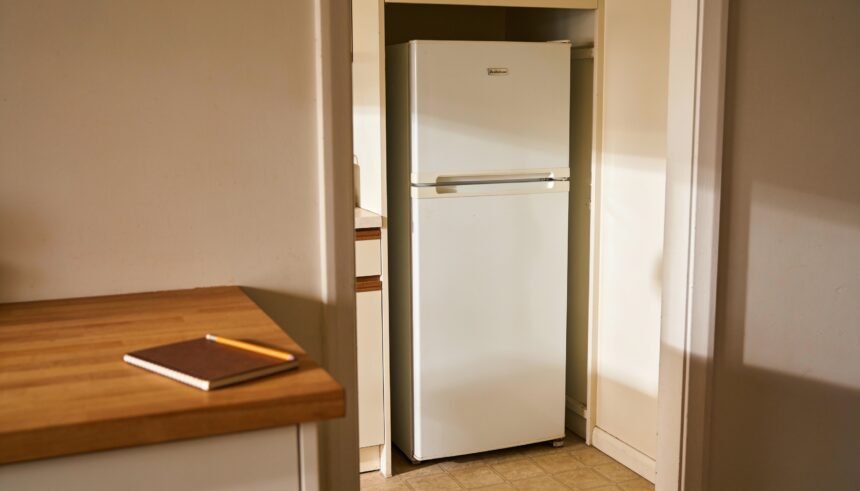
Australian Government appliance guidance recommends ventilation space around fridges, positioning away from heat sources and sunlight, and attention to frost build-up. Check the clearances specified in your own model’s instructions rather than guessing a gap that should suit every fridge.
Look for belongings that have crept into that space. Inspect the accessible door seal and check whether anything inside prevents the door closing properly. Record visible damage for follow-up; this is an inspection, not a repair session.
A useful entry is specific: “Find the manual’s side-clearance requirement” or “Photograph the damaged seal and ask about replacement”. “Fridge seems expensive” leaves you with nothing concrete to do.
Follow the manufacturer’s cleaning and defrosting instructions where maintenance is due. Do not dismantle panels or pull a heavy appliance out just to complete this list. If access is awkward, leave that task for suitable help. Renters can send the owner or agent a clear description of an appliance problem without trying to diagnose the fault themselves.
3. Reconsider the second fridge’s current job
Government guidance advises avoiding use of an additional fridge when it is not needed. Before deciding whether yours is needed, write down what it holds and why those things are there.
Perhaps it supports regular batch cooking or a larger household. Perhaps it was switched on for visitors and is now holding a few drinks. Those are different circumstances, and neither needs a judgement about the household’s habits.
If you no longer need it, first organise appropriate storage for everything inside, then follow its shutdown and storage instructions. A working fridge or freezer holding food should not become a daily timer experiment. If you do need the extra space, keep it on the list and review its condition and consumption evidence like the main unit.
4. Check whether long-running settings still suit the day
Read the existing schedule on equipment you operate through timers or automatic modes. Write it down before changing anything. Ask whether the setting still matches when the room is occupied and what the appliance is being asked to do.
For example, a study schedule chosen during a period of working from home deserves another look when the room is used only occasionally. The checklist does not prescribe a new schedule: the person using the space should decide what is still needed, within the appliance’s instructions.
Keep specialist systems on a separate follow-up list if you are unsure. Do not shorten pool filtration, change hot-water safety settings or interrupt equipment supporting pets just because its running time looks long. Record the question for the manufacturer or appropriate service provider.
For heating and cooling decisions, continue with running air conditioning sensibly. Here, simply note the present settings and any question that needs answering.
5. Put an evidence label beside every cost estimate
For a fridge with an Energy Rating label, record its annual consumption in kWh. The Australian Government’s Energy Rating guidance explains that this figure comes from standardised testing; your actual use can differ. Keep it labelled as an estimate, rather than a measurement of your kitchen.
For a flat usage rate, the basic calculation is:
Estimated annual electricity usage cost = annual kWh multiplied by your rate in dollars per kWh.
If your bill lists cents per kWh, divide that rate by 100 before using this dollar formula. Energy Made Easy distinguishes the usage charge from the daily supply charge, which applies even when you use no electricity. Do not count that fixed charge as a saving from changing one appliance’s operation.
Time-of-use plans need more care because the rate changes across periods. One annual kWh figure does not tell you when that electricity was used. Mark the cost “needs usage timing” instead of multiplying everything by the cheapest rate. Treat solar and battery households as needing a more specific calculation too; a label alone cannot establish their grid cost.
6. Measure only where the answer will change a decision
South Australian Government guidance points to plug-in power meters and library Home Energy Toolkits for measuring appliance consumption. Ask your library what is available before buying a meter. Use only a meter suitable for the appliance and follow both sets of instructions; leave inaccessible connections and hardwired equipment out of this exercise.
As a practical recording method, note the observation period, operating mode and accumulated kWh rather than copying an isolated display number without context. Keep notes about unusual use during that period. A visitors’ weekend and an ordinary workday should not silently become equivalent entries.
If the equipment or instructions do not support a useful measurement, write “not measured”. That is more useful than a precise-looking cost built on an assumption nobody remembers making.
7. Give each finding an owner and a next date
Finish each entry with one action and the person taking it on. Choose tasks small enough to complete: locate instructions, clear an accessible ventilation gap, ask about a seal, or gather consumption evidence.
Add the next seasonal review to your household bill calendar, along with any earlier maintenance follow-up. Keep expected savings out of your family budget until you have evidence to support them. If you compare later bills, also record changes in rates, household routines and the period covered before attributing a difference to this checklist.
Start with the main fridge today. Write down its model, the job it does and one observation that needs a follow-up. Complete that action before expanding the list.
How we checked this
Reviewed on 30 September 2026 against Australian Government, Energy Rating, Energy Made Easy and South Australian Government guidance. The checklist and record-keeping method are editorial recommendations. No appliances were tested and no household saving is promised.
The one-page family week
One printable page that holds the whole week: meals, school, activities and who is doing the pickup. Free, and we send one useful email a week.
One email a week. No spam, unsubscribe in a click.