
What is in this guide
Most homework arguments are not about homework. They are about a tired child being asked to do school at the worst possible time of day, for longer than they can concentrate, by a parent who has become a second teacher.
Change those three things in order and a large share of the fight disappears without anyone becoming more disciplined.
1. Change the timing
The most effective single change and the one most households have never tried.
Straight after school is the worst moment for most primary-aged children. They have concentrated all day, they are hungry, and their tolerance is at its lowest point of the twenty-four hours.
Try, in order:
Food first, always. A substantial snack before anything else. A meaningful proportion of homework refusal is hunger, and it resolves in ten minutes.
A genuine break. Half an hour to an hour of nothing required. Outside if possible.
Then homework, before dinner rather than after it.
Or after dinner, if your child is one who recovers rather than fades. Some children are far better at seven than at four.
Or before school, which suits a small number of children extremely well and is worth trying for a week if the afternoon is a war.
The right slot is child-specific. Test one for a fortnight before judging it.
2. Change the length
Set a time limit, not a completion target.
A child who knows the reading is twenty minutes and then it is finished works differently to one who knows it ends when the page is done. Open-ended tasks produce stalling, because stalling has no cost.
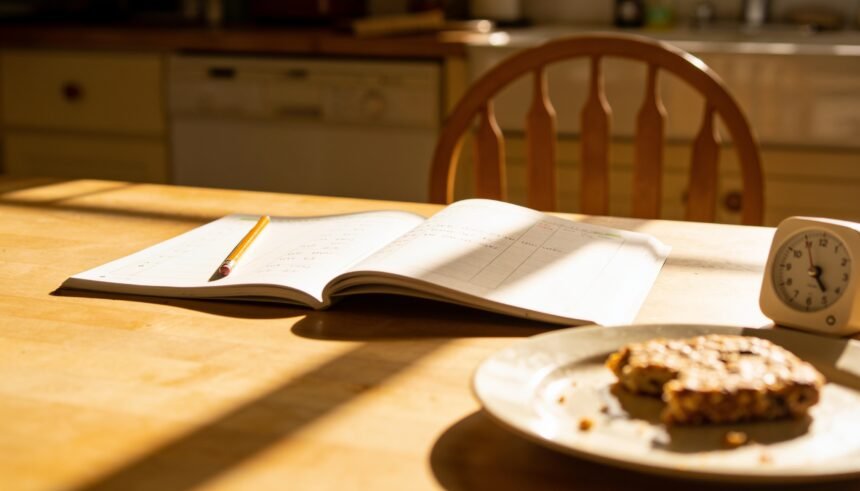
Use a visible timer. A child who can see the time remaining settles faster than one who cannot.
Stop when the time is up, even if it is unfinished. This is the part parents find hard and it is the part that works.
If the task routinely takes far longer than the time set, that is information for the teacher, not a reason to extend the session. Australian schools generally have homework expectations by year level, and a task consistently taking two or three times as long is worth raising.
Break it up. Two fifteen minute blocks with a break beats one thirty minute block for most primary children.
3. Change your role
This is where most long-running homework battles actually live.
A parent who sits over the work, corrects it as it happens, explains the method and pushes for accuracy has become a teacher, and the child has a teacher at home who they can argue with in a way they cannot argue at school.
Be available, not attached. In the same room, doing your own thing, able to help when asked.
Let it be wrong. Work sent in with mistakes tells the teacher what the child does not understand, which is what homework is partly for. Work corrected by a parent tells the teacher nothing.
Help with the method, not the answer. “What did the teacher say about these?” and “show me the one you did at school” are the useful questions.
Do not re-teach a method differently to the school’s. It is the single fastest way to produce tears, particularly in maths, because the child now has two conflicting approaches and no confidence in either.
4. Change the place
A consistent spot, with nothing else on it. Not a bed. Not in front of a screen.
The kitchen table is a completely legitimate homework space and for most primary children it is better than a bedroom desk, because the child is near people rather than isolated.
Remove the device unless the task needs it. If the task needs it, the other applications do not need to be open.
Everyone else doing something quiet for that twenty minutes helps considerably. A child doing homework while a sibling watches television is being asked to do something unreasonable.
Making a kids room work as a study space covers the setup in detail, and setting up a homework space when there is no spare room covers doing it in a house with no spare corner.
5. Work out what is actually happening
If the first four have not helped, the resistance is usually about something specific.
It is too hard. A child who does not understand the work will avoid it and will very rarely say so, because saying so is worse. The tell is that avoidance is subject-specific.
It is too easy or pointless. Less common and real. Repetitive work a child has already mastered produces reasonable resistance.
Something at school is wrong. A friendship problem, a difficulty with a teacher, or anxiety about the subject. Homework is where it surfaces because home is safe.
They are exhausted. A child in a heavy week of sport and activities may simply have nothing left. Getting kids to bed without the two-hour battle covers the sleep side, which is frequently underneath this.
There is an undiagnosed difficulty. Persistent difficulty with reading, writing, attention or numbers that is out of step with everything else is worth raising rather than managing indefinitely at home.
Talk to the teacher
This is underused and it works. Teachers would rather know.
Say what is happening factually: how long it is taking, what the child does, where it breaks down.
Ask what they want from it. Some teachers will say a task not finished in the set time should simply be stopped and noted, which removes the whole problem in one conversation.
Ask whether what you are seeing matches what they see at school. A child who is fine at school and falling apart at home is a different problem to one who is struggling in both.
Australian school homework policies vary by school and by state, and some schools set very little in the primary years. It is reasonable to ask what the school’s expectation actually is.
When it is more than homework
Persistent distress, refusal to attend school, or anxiety that extends beyond homework is a conversation with the school and with a GP rather than a routine to be fixed at home. Raising Children Network publishes Australian guidance on school refusal and on learning difficulties.
Suspected learning difficulty should go to the school first, which can arrange assessment or refer you.
This article does not diagnose anything and none of the patterns above is a diagnostic indicator on its own.
What not to do
Do not make it a punishment, or link it to removing things the child values. Homework becomes the enemy rather than the task.
Do not do it for them, even at 8pm when everyone has had enough. The short-term peace costs you the long-term position.
Do not fight every night on principle. A note to the teacher saying it was not completed is a normal and acceptable outcome.
Next: getting kids to bed without the two-hour battle covers the tiredness underneath much of this, making a kids room work as a study space covers the physical setup, and the school-year calendar setup covers keeping track of what is actually due.
The one-page family week
One printable page that holds the whole week: meals, school, activities and who is doing the pickup. Free, and we send one useful email a week.
One email a week. No spam, unsubscribe in a click.