What is in this guide
A family command centre fails for one of two reasons, and both of them are decided at the point of purchase.
The first is placement: the board goes on a nice wall in the hallway rather than the wall where the bags actually land, so nobody looks at it. The second is update friction: writing on it takes longer than typing into a phone, so after three weeks it shows a term that has finished.
Everything below is about buying against those two failures rather than buying the prettiest board.
This is an editorial comparison of formats and what they cost to run. No board was installed or used by us.
Decide the wall first, then the board
The board goes where the household already stops. In most Australian houses that is one of three places:
- Inside the back or garage door, where school bags are dropped
- The kitchen bench end or fridge side, where the notices get put down
- The hallway between the bedrooms and the door, if that is genuinely a bottleneck
It is not the formal entry, and it is almost never the study.
Measure the wall before shopping. The usable area is what is left after the light switch, the door swing and the height a child can reach. Most disappointment with a bought board is a size mismatch with a wall that was never measured.
The formats, and how each fails
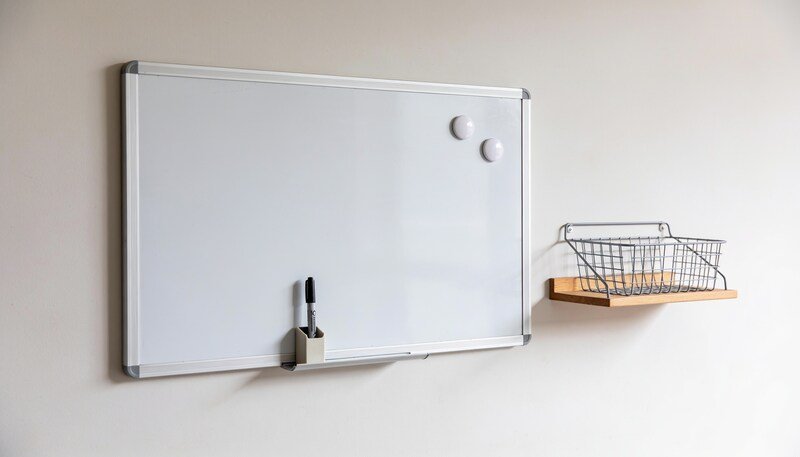
Magnetic whiteboard. The default. Writes and wipes, holds notices with magnets, and handles a term of changes. Fails by ghosting, which is old marker staining the surface. Porcelain and glass surfaces resist it, painted steel does not, and the cheap ones ghost within a term.
Glass board. Does not ghost, wipes perfectly, looks like furniture. Heavy, more expensive, and the mounting is a serious job because glass is unforgiving of a badly fixed bracket.
Chalkboard. Looks the best in photographs and is the worst to live with. Dust, poor legibility at a distance, and a wipe that is never clean. Avoid for anything that changes weekly.
Corkboard. Excellent for what it is for, which is holding paper: notices, invitations, the term calendar the school sent. Useless for anything you need to change often. A corkboard beside a whiteboard is a better pair than either alone.
Printed perpetual wall planner. A year on one sheet, usually laminated, written on with whiteboard marker. Cheap, genuinely useful for a whole-year view of terms and holidays, and impossible to reorganise. Buy one as a supplement, not as the system.
Fabric or pocket organisers. One pocket per person for notes and permission slips. Better than they look, and the pockets are where the paper actually goes.
The honest pairing for most families: a magnetic whiteboard for the week, a pocket or file holder for paper, and a year planner if the household thinks in terms.
Update friction, which is the real specification
Ask of any board: how long does a change take?
- A weekly grid that gets wiped every Sunday is quick, and it is the format most households sustain
- A monthly grid needs less updating and shows less of what is happening this week
- A magnetic name-and-task system with movable tiles is the fastest to change and the slowest to set up
- Anything requiring neat handwriting will stop being used by whoever is not neat, which is half the household
Two pens on the board. A marker in a holder attached to the board is the difference between a board that gets updated and a board that requires finding a pen first. This is a trivial component and it decides the outcome.
Mounting, and the rental problem
This is where most of the practical difficulty is, and almost no listing addresses it.
- Adhesive strips hold a light board on clean, sound paint and fail on textured or freshly painted walls. Check the weight rating against the board, and note that glass and large steel boards are usually well over it
- Adhesive removal takes the paint off more often on rendered and older walls. In a rental this is a bond conversation
- Screws into a stud are the reliable answer and are a hole. Most Australian tenancy agreements treat picture hooks and small fixings differently from anchors and brackets, and the position differs by state, so check your agreement and your state tenancy authority rather than assuming
- Over-door hooks and freestanding easels avoid the wall entirely and are the right answer in a short tenancy
- Weight matters more than size. A large lightweight board is easier to hang than a small heavy one
Getting your bond back covers how wall damage is actually assessed at the end of a tenancy.
What is not worth buying
- A second board for a second room. One board that is looked at beats two that are not
- Anything requiring a subscription to print refills
- Chalk markers for a wall used weekly
- A board so large it needs professional mounting, unless the wall is permanent
- Decorative label sets. They date, they peel, and a marker does the job
What it costs to run
The board is bought once. The running costs are small and constant: whiteboard markers, an eraser, magnets, and printer paper if the household prints anything. Budget for markers to be lost rather than to run out.
Setting it up so it survives February
- One colour per person, agreed on day one
- This week only in the main grid, with the term view elsewhere
- A landing spot for paper right beside it, because paper is what breaks a digital-only system
- A weekly reset, five minutes, same time each week. The school-year calendar setup that stops missed notices covers what belongs on it
- Put the chores on it or keep them separate, but decide. Chore charts that kids actually use is a different rhythm from a family calendar and mixing them badly ruins both
If the paper is the part that is out of control rather than the calendar, the family paperwork system is the thing to fix first, and setting up the family year in January is when most of this gets done.
Before you buy
- Choose the wall, then measure it
- Check the mounting method against your wall type and your tenancy
- Prefer porcelain or glass over painted steel if the board will be written on weekly
- Buy a pen holder that attaches to the board
- Add a paper holder, because the calendar is only half the problem
The one-page family week
One printable page that holds the whole week: meals, school, activities and who is doing the pickup. Free, and we send one useful email a week.
One email a week. No spam, unsubscribe in a click.