What is in this guide
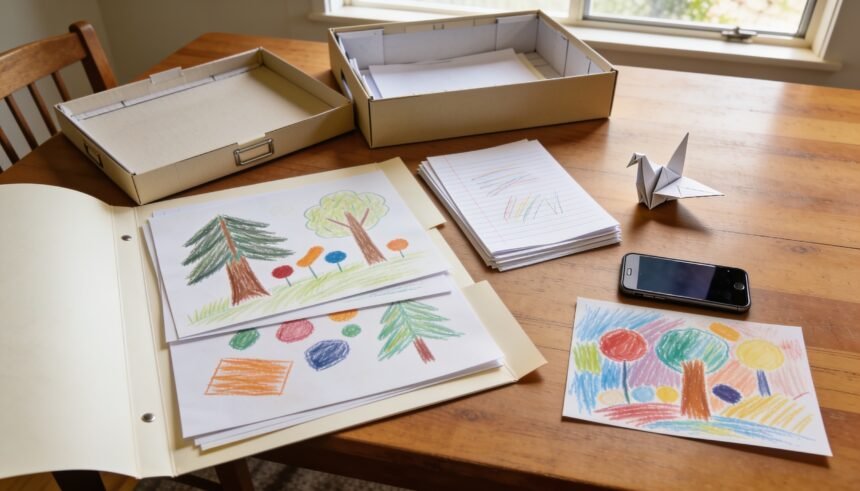
Store kids artwork in a small collection of dated originals, with photographs of pieces you want to remember without keeping. Give incoming school work a temporary tray, then sort it at the end of each term so unfinished work, favourite pictures and school records have separate homes.
1. Separate today’s paperwork from keepsakes
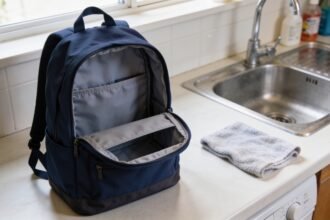
Start where school bags are unpacked. Use a tray or an existing folder for work that has come home, and give each child a separate section. This is a waiting place, not the permanent archive.
Before choosing keepsakes, remove anything that needs action: a permission slip, an unfinished assignment or something the teacher wants returned. Put school reports and documents you may need for future school discussions in a separate records folder. Do not apply the artwork clear-out rule to those records.
For completed work, make three groups: display now, consider keeping, and photograph before letting go. You can also let an ordinary worksheet go without photographing it. Recording every page is optional, not another school task for the parent.
2. Choose what the originals will represent
Decide where the finished collection will live before buying storage. A folder for each school year or a shared shelf with separate sections for each child are workable starting points. Choose a space limit that fits your home rather than a fixed number of pictures every child must produce.
Look for variety: a drawing the child is proud of, an example of their handwriting, a story with their own ideas, or a piece connected to something they remember. Keep the rough drawing if it matters more than the carefully coloured worksheet.
Ask, “Which would you like to show someone again?” Add your own favourite openly. If you disagree about a piece, leave it in the temporary folder until the next review rather than forcing the decision immediately. These are suggested sorting prompts, not rules about children’s development.
For belongings beyond paper, decluttering kids' toys without the tears covers the separate task of sorting toys.
3. Match the storage to the artwork
For the selected originals, the Canadian Conservation Institute recommends acid-free folders and lidded acid-free boxes. Choose a folder large enough to hold the whole sheet without folding it. Keep A3 pictures together in a larger folder instead of trimming them to fit an A4 collection.
Avoid ordinary cardboard boxes for long-term contact with valued artwork. Store the collection indoors, away from direct sunlight and heat, rather than in a roof space with fluctuating conditions. The Institute notes that light can fade colours and damage paper.
Chalk, pastel and charcoal need different treatment: the Institute advises against plastic sleeves or sheets touching these easily disturbed surfaces. Keep such work separate from the ordinary paper stack and seek suitable mounting advice if preserving the original matters. Photographing it is another way to record its appearance.
Label the outside of each folder with the child’s name and school year. Add a separate note describing an undated piece, including the child’s explanation if they want to give one. Do not guess a date for older work; “approximately Year 1” is more useful than false precision.
4. Photograph the pieces you want to remember
Use a plain background and photograph each piece square-on, with all its edges visible. Check the image before putting the original aside: can you see the detail that made you want to keep it? Retake blurred pictures straight away. For writing, capture the whole page and check that the words are legible when enlarged.
For a cardboard model or sculpture, take a front view and another angle showing how it was made. Record the child’s description in a note. A photograph keeps the visual record, but it cannot preserve the feel, size or moving parts of the original. Keep the object if those are the features that matter.
Save the files together under a child and year, with names such as “2026-Term-3-paper-bird”. The Library of Congress recommends descriptive organisation and copies stored in different places. Keep a backup separate from the phone, and periodically check that the saved files open.
5. Give displays and bulky projects a review date
Choose a modest display area, such as a shelf or a section of a noticeboard. When a new favourite arrives, decide whether the outgoing piece joins the keepsake folder or the photograph collection.
For an especially valued picture, display a copy and store the original. This applies the conservation advice about limiting light exposure without requiring an empty wall.
Give bulky projects their own space limit. For example, reserve one shelf for models and review it at the end of term. Treat that as a household choice, not an expiry date imposed on every project. Agree which pieces will stay before dismantling anything.
If you are also clearing unrelated household belongings, what to actually throw out, and what to keep covers the broader sorting job.
6. Close the term without creating another backlog
At the end of term, empty the temporary folder. Return anything still needed for school, choose the originals, photograph the selected remainder and put the finished collection away. If a subject or assignment continues next term, leave that material with current school work.
For years of accumulated paper, start with the current year and choose one older bundle for a later session. Sort that bundle by child and approximate year before making individual decisions. There is no need to catalogue the whole cupboard before the new system can begin.
Start today: choose the incoming tray and the permanent storage space, then put the current term’s work together for the first review.
How we checked this: Paper-care details were checked against Canadian Conservation Institute guidance and digital-copy advice against the Library of Congress on 21 September 2026. The sorting routine is editorial guidance, not a tested storage system.
The one-page family week
One printable page that holds the whole week: meals, school, activities and who is doing the pickup. Free, and we send one useful email a week.
One email a week. No spam, unsubscribe in a click.