What is in this guide
The constraint is not ideas. It is that you have ten minutes before you leave and you are already late.
So this is built around that: a morning routine that takes about ten minutes, uses food you are already buying, and occupies a meaningful part of the dog’s day.
The single change underneath all of it: stop using the bowl.
A bowl of food is ninety seconds of a dog’s day. The same food delivered differently is thirty to sixty minutes, and it costs nothing extra.
The ten-minute morning
Minute 1 to 2: measure the day’s food into two lots. Half for the morning, half for when you get home.
Minute 3 to 5: make the morning half into work.
Pick one, and rotate through the week:
Scatter it. Across the lawn, across a rug, under things in a room. Fifteen to thirty minutes of searching, and sniffing is genuinely tiring.
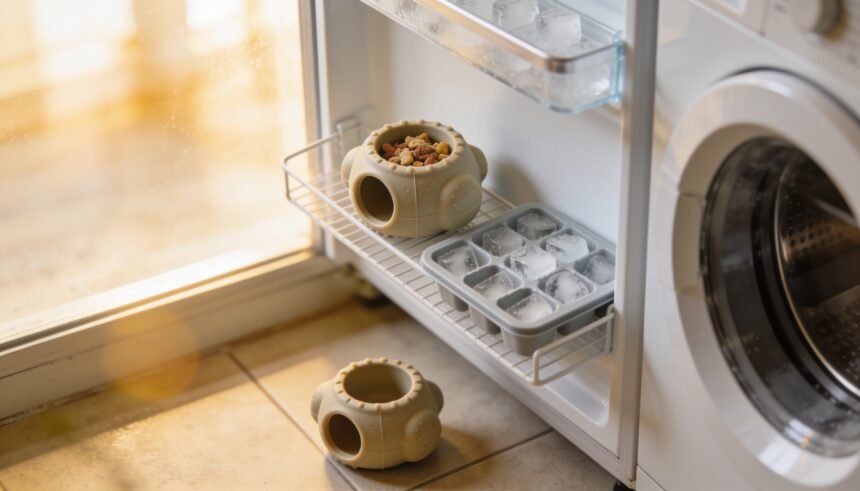
Stuff it. Into a hollow toy, packed tight. Frozen the night before, it lasts considerably longer.
Hide it. Four or five small portions around the house or yard in places the dog can reach.
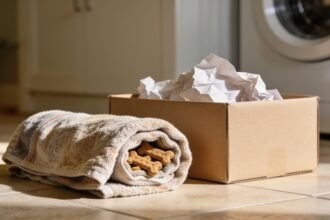
Wrap it. In a towel, rolled and loosely knotted, or in a cardboard box with paper. Supervise the first few times to see whether your dog shreds and eats the packaging or works around it.
Muffin tin puzzle. Food in the wells, tennis balls or similar on top. Free if you own a muffin tin.
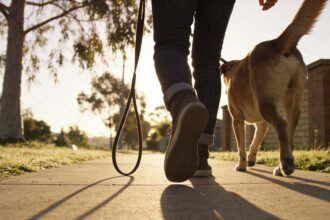
Minute 6 to 8: a short walk or a few minutes in the yard. Not a proper walk. Enough to toilet and to smell something new. A dog that has been outside settles better than one that goes straight from bed to alone.
Minute 9 to 10: set up the afternoon. A second frozen stuffed toy left in the fridge for whoever gets home first, or a timed feeder if you have one.
That is it. Ten minutes, and the dog’s morning has three or four things in it.
The afternoon is the harder half
The morning routine handles the first few hours. A dog alone from eight to six still has a long flat middle, and that is where boredom behaviours start.
Options, in order of how much they help:
Someone comes in. A neighbour, a family member, a dog walker, a friend on a day off. A twenty minute break in the middle of a ten hour day changes it substantially.
Day care, once or twice a week. Not for every dog, and social dogs benefit considerably.
A second frozen toy, left somewhere findable or given by whoever arrives first.
Change the environment. A window with a view, a radio, a different room. A dog that can see the street has something happening, though for some dogs that becomes barking rather than entertainment, as covered in dog barking at everything.
Accept that ten hours is long. If the household regularly leaves a dog that long, the honest questions are about arrangements rather than toys.
What to leave, and what not to
Safe to leave for most dogs: a hard rubber stuffable toy, a durable chew appropriate for that dog, a snuffle mat, a scattered meal, a puzzle feeder the dog cannot destroy.
Do not leave unsupervised: anything the dog can tear into pieces and swallow, rope toys that shed strands, soft toys with stuffing or squeakers if your dog disembowels them, anything smaller than the dog’s mouth, cardboard if your dog eats cardboard rather than shredding it.
Chew safety varies by dog and a vet is the right source. Some chews present fracture, choking or obstruction risks, and what is fine for one dog is not for another. Ask at the next routine visit.
Watch the calories. Enrichment should use the day’s existing food, not be added on top. Weight is a veterinary conversation.
The Australian outdoor question
A dog left outside in an Australian summer needs shade that moves with the sun, water that cannot be tipped over, and honest assessment of the temperature. Heat stress in dogs develops quickly and is serious. RSPCA Australia publishes hot weather guidance.
Frozen enrichment does double duty here. A stuffed toy frozen solid, a block of ice with food frozen into it, or a shallow tray of water are all cooling and occupying at once.
In winter and wet weather the problem reverses and an inside dog with nothing to do is the standard boredom setup.
Whatever is left outside must not create a barking problem, because that becomes a council matter. Blocking the view of the street is usually the fix.
What does not work
More toys. A dog with twenty toys available plays with none of them. Three at a time, rotated weekly, is better than twenty always out.
Leaving the television on for most dogs, though a radio genuinely helps some by masking outside noise.
A bigger yard on its own. A dog alone in a large yard does very little. Space is not stimulation.
A second dog, as a solution. Sometimes excellent, sometimes two bored dogs, and never the answer if the underlying issue is distress rather than boredom.
Telling boredom from distress
This matters and the fixes are opposite.
A bored dog settles first and finds something to do later. A distressed dog escalates within minutes of you leaving, with pacing, howling, drooling, and damage concentrated at doors and windows.
Everything in this article is for boredom. If it looks like distress, stopping a dog from destroying things when left alone covers how to tell and why it needs a vet and a qualified behaviourist rather than a puzzle feeder.
Next: stopping a dog from destroying things when left alone covers the diagnostic, how much exercise does my dog actually need covers why mental work tires a dog more than distance, and stopping a dog inhaling dinner covers slowing the meal itself.
The one-page family week
One printable page that holds the whole week: meals, school, activities and who is doing the pickup. Free, and we send one useful email a week.
One email a week. No spam, unsubscribe in a click.