What is in this guide
A window perch works because it gives a cat three things at once: height, a view, and a warm place to settle. Most cats use one more than almost any other item in the house, provided it is placed properly and the window behind it is safe.
Quiet enrichment is the category this sits in. It asks nothing of the owner day to day, unlike play sessions or puzzle feeders, and it suits cats that prefer watching to chasing.
Why cats gravitate to a window
Height on its own matters to cats, and a window adds movement to look at on top of it. Birds, traffic, washing on a line, people walking past. A cat at a window is doing something closer to hunting than resting, tracking movement without the effort of a chase.
Sun is part of it too. A perch that catches morning light gets used even when nothing outside is moving.
What makes a perch actually get used
Height that clears the sill properly. A perch flush with the window edge, rather than below it, gives an unobstructed view rather than a strip of sky.
A surface wide enough to lie flat on, not just sit. Cats spend long stretches at a good perch, and a narrow ledge gets abandoned for the nearest alternative.
A secure fit. Suction or clamp-mounted perches need to hold real weight without shifting. A perch that wobbles once is often avoided afterwards, the same way an unstable scratching post gets ignored.
A window the cat already visits. Moving a perch to whichever window has the most outside activity works better than picking the window that suits the room’s layout.
The safety checks that get skipped
Flyscreens are not cat-proof. A cat leaning or pushing against a screen at height can go through it. If a perch sits at an open window, the screen needs to be a proper cat-rated or reinforced type, or the window needs to be restricted to an opening a cat cannot fit through.
Heat is a real Australian risk. A north or west-facing window that is pleasant in winter can become dangerously hot in summer, and a perch in direct sun for hours needs a shaded alternative nearby along with water close by. Cats can develop heat stress, and it develops faster than most owners expect.
Check the drop. A perch on an upper floor above a hard surface, with no screen at all, is a fall risk worth fixing before the perch goes in, not after.
Glass alone is not a barrier a cat respects fully at speed, particularly a young or excitable cat reacting to something outside. A secure screen is still the safer setup even with the glass closed.
Quiet enrichment beyond the perch
A window perch is the anchor, but a few low-effort additions extend it.
A second lower perch or windowsill nearby, so a cat that wants a different angle does not have to give up the window entirely.
Bird feeders or a bird bath outside the window, positioned so the cat can see activity without any access to it. This turns a static view into something that changes through the day.
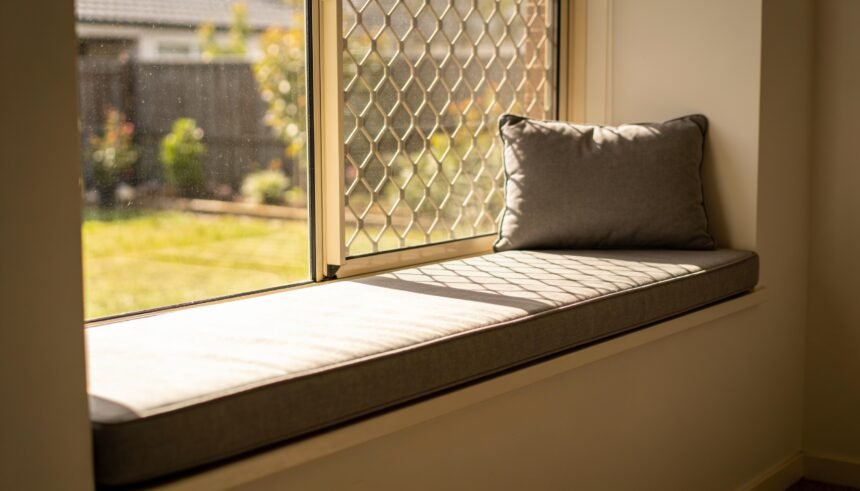
A soft mat or bed on the perch itself. Cats settle for longer stretches on a surface that holds warmth, and a plain hard sill gets used in shorter bursts.
Rotating what is visible from the perch, such as moving a plant or a hanging object outside occasionally, keeps a familiar view from going stale. This matters less than the view itself, but it costs nothing to try.
None of this requires daily involvement, which is the appeal for a household that wants a cat settled without a play schedule.
Where this fits with the rest of an indoor setup
A window perch is one piece of vertical territory, not the whole answer. Keeping a cat happy indoors covers the fuller picture of height, hunting and control that an indoor cat needs, and a perch is usually the easiest of those to add because it doubles as a view.
If a cat has started scratching near the window frame or the perch itself, that is a placement problem rather than a behaviour problem, and cat scratching: redirect it rather than stop it and cat scratching posts a cat will actually use cover what to do about it without discouraging the cat from using the spot.
In a multi-cat house, one perch is rarely enough. The same resource competition that shows up around litter trays, covered in why is my cat not using the litter tray, applies to window space. A second perch at a different window avoids one cat guarding the good spot.
Before you set one up
- Confirm the window has a secure or cat-rated screen, or that the opening is restricted
- Check which side of the house gets harsh summer sun and plan shade for that window
- Choose a window the cat already visits rather than the most convenient room
- Add a soft surface rather than leaving a bare sill or plastic shelf
- Watch for any sign the perch is unused after a week or two and try a different window before assuming the cat is not interested
The one-page family week
One printable page that holds the whole week: meals, school, activities and who is doing the pickup. Free, and we send one useful email a week.
One email a week. No spam, unsubscribe in a click.