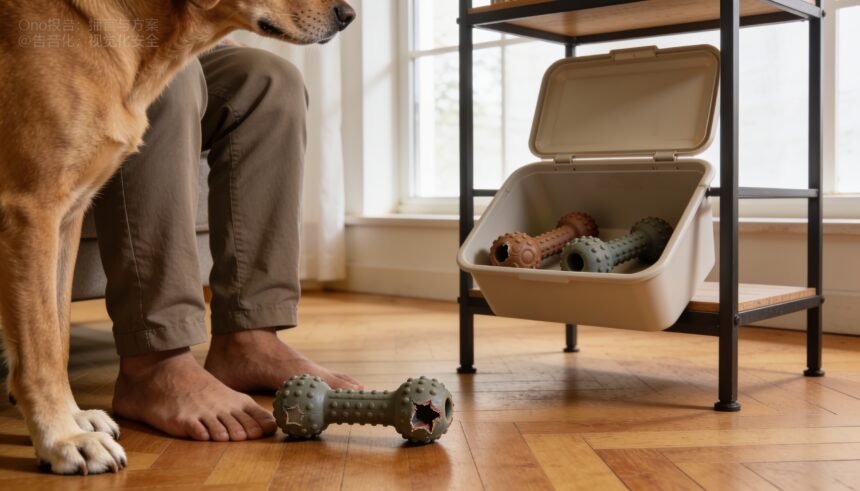
What is in this guide
To rotate dog toys so old ones feel new again, put a few previously enjoyed toys away, leave a small useful selection available and bring one stored toy back during a play session. Treat the return as an invitation to play, rather than tipping the whole collection onto the floor and expecting renewed interest.
The RSPCA Australia recommends variety and regular rotation to sustain interest, but this does not guarantee that every old toy will become a favourite again. [S1] The reset below is an editorial way to work through a neglected collection. For the ongoing storage and swap routine, start with setting up a dog toy rotation.
Choose old favourites before untouched purchases
Gather the toys and ask a practical question about each intact item: has your dog ever chosen to play with it? A ball brought to you repeatedly belongs in a different group from a puzzle that has sat unused since it arrived.
Start the reset with the first group. You already have a reason to offer those toys again. Give the never-used items a separate place so they do not repeatedly return simply because they are still in the basket.
You do not need to remember dates or score enthusiasm. A rough note such as “likes this with someone” or “usually ignores this” is enough. The RSPCA notes that individual animals have different preferences. [S1] Your aim is to make room for those preferences, rather than make every purchase justify itself.
Keep a familiar toy available if your dog regularly carries it or settles beside it. For this routine, there is no need to remove an object the dog is already choosing just to make the change more dramatic.
Check condition before putting anything away
An ignored toy is a candidate for another turn. A damaged toy is a separate decision. Inspect seams, surfaces and attachments before storing it, then inspect it again before the return session.
The RSPCA’s criteria include suitable materials and size, no sharp edges or loose parts, and regular inspection. It also recommends supervision during enrichment, particularly with new items, soft toys, rope toys, chew toys and small parts. [S1] Put aside items with exposed stuffing, broken attachments or pieces coming away rather than treating time in a cupboard as a repair.
Clean toys according to their care instructions and let them dry before packing them away. If you need the material-by-material process, washing pet toys and bowls covers that job. Keep items awaiting cleaning separate from the ones ready to return, so the next swap does not begin with a laundry task.
Make a small return queue
Pick two or three intact, previously enjoyed toys to store out of your dog’s reach. That is a suggested starting size for a manageable reset, not a welfare requirement. Leave a selection that still includes things your dog uses.
If you only own a few toys, put one away rather than dividing them into elaborate sets. If you have a large collection, do not feel obliged to cycle through every item equally. A rotation can be selective.
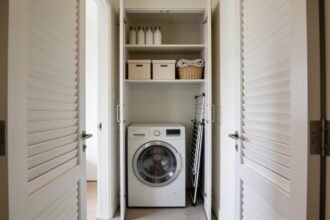
Use a cupboard, drawer or container you already own. In a flat, the laundry cupboard may be easier than another basket beside the sofa. Keep the return queue together so you can pick one toy without emptying the entire cupboard.
There is no prescribed number of days in this method. Choose a convenient occasion to review the queue, such as the weekly tidy, and offer a stored toy when you have time to join the play. That occasion is a reminder for the person, not a deadline for the dog.
Bring back the activity with the toy
Think about how the toy was enjoyed before. A tug toy can return with an invitation to a familiar tug game. A fetch toy can return when you are available to play fetch. Simply laying either beside the bed may not recreate the activity you had in mind.
Offer one returning item at a time and allow your dog to approach or decline it. Avoid repeatedly pushing it towards the dog’s mouth or throwing several alternatives in quick succession. One clear invitation is easier for you to assess than a pile of competing toys.
For a food-stuffable toy your dog already uses, follow its instructions and your usual feeding plan. Using a Kong or another stuffable toy covers the preparation separately; this reset does not require adding food to every toy.
Your involvement matters too. The RSPCA says enrichment activities cannot replace time interacting with carers. [S1] A rotation gives you something different to offer during that interaction, rather than removing the need for it.
Try this return-session example
Suppose your collection includes two fetch toys, a tug toy, a soft favourite and a stuffable toy. This is an illustrative household, not a tested result.
Leave the soft favourite available if it is regularly used. Store one intact fetch toy, and keep the other equipment according to when you supervise its use. At a later planned play session, bring the stored fetch toy back and invite the usual game.
If your dog takes it and plays, the item can join the active selection while the other fetch toy goes away. If your dog ignores it, put it aside and continue with something familiar. There is no need to empty the cupboard to rescue that single session.
On another occasion, try a stored toy used for a different activity. This keeps the reset from becoming a cycle of offering several near-identical balls when what you want to offer is a different kind of play.
Decide whether to keep, retry or retire
After the return, use three simple decisions:
- Keep in use: Your dog chooses the toy or joins the activity. Keep offering it in that context.
- Retry later: The item is intact but ignored. Try it on another suitable occasion or with the familiar game it was used for before.
- Remove from the rotation: The item is damaged, unsuitable or repeatedly unwanted. Damaged items should not return; intact unwanted items can leave the active collection without an immediate replacement purchase.
These are organising decisions, not a behavioural assessment. If toys have never interested your dog much, low-cost enrichment using household items offers other activities to consider. If loss of interest is sudden or accompanies other concerning changes, ask your vet rather than assuming the toy collection explains it.
For your first reset, choose one intact old favourite, store it separately and plan its next return around a game your dog has enjoyed. Leave the rest of the collection alone until you have seen whether that invitation is useful.
How we checked this: Checked on 7 October 2026 against two RSPCA Australia Knowledgebase pages. Welfare guidance supports variety, preferences, supervision and interaction. The return queue and worked example are editorial suggestions; no toys or dogs were tested and no storage interval is claimed to restore interest.
The one-page family week
One printable page that holds the whole week: meals, school, activities and who is doing the pickup. Free, and we send one useful email a week.
One email a week. No spam, unsubscribe in a click.