What is in this guide
- Step 1: Measure the space and the door swing
- Step 2: Sort what lives in the laundry into three groups
- Step 3: Put chemicals up high, in their original containers
- Step 4: Use the wall above the machine safely
- Step 5: Give dirty and clean washing separate places
- Step 6: Adapt the layers for a kitchen or bathroom laundry
- What to change when the cupboard still overflows
- Start with the tape measure
- How we checked this
Plan small laundry storage in three layers. Anything you touch every wash sits where you can reach it standing at the machine, weekly items go on the shelf above or in a basket beside it, and detergents, pods and cleaning chemicals go up high, out of children’s reach and sight, in their original containers. Measure your own cupboard before you buy a single basket.
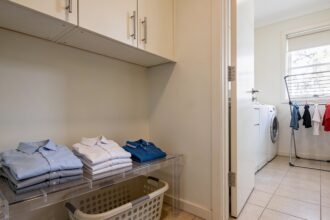
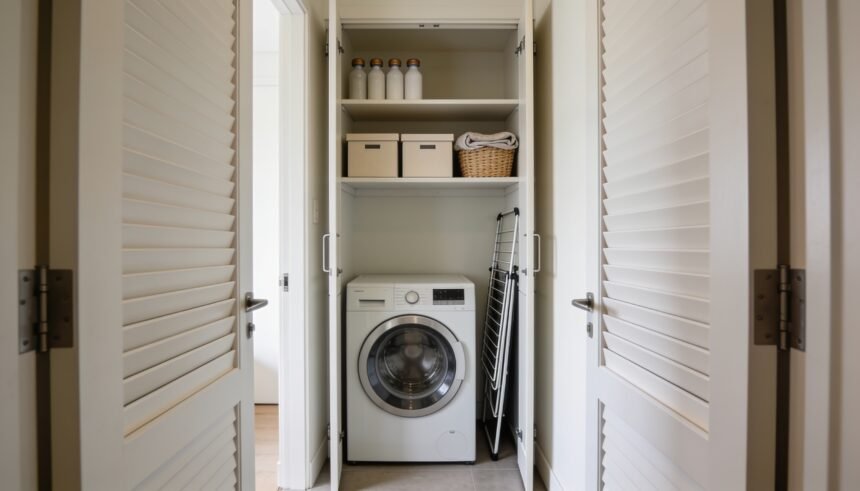
A European laundry is the machine-in-a-cupboard layout common in Australian apartments and townhouses: a washing machine, sometimes a dryer stacked above it, a shelf and a pair of doors. The same approach works when the machine lives under a kitchen bench or in the bathroom. The layers below are an editorial starting point, not a required design.
Step 1: Measure the space and the door swing
Measure the width, depth and height of the cupboard with a tape, then note where the taps, hoses, power point and drain sit, because they take up space a shelf or basket cannot use. Write the numbers into your phone before you shop.
Check the machine and dryer manuals for the clearance the manufacturer requires around each appliance, and keep that space clear regardless of what you would like to store there. A dryer that is stacked or wall-mounted must be installed the way its manual describes; storage is planned around it, not on it.
Open the doors fully and watch what they hit. Bifold and sliding doors leave the cupboard front clear; a hinged door in a hallway or a kitchen needs the hallway or the kitchen, so nothing you store can sit in the door path.
Step 2: Sort what lives in the laundry into three groups
Empty the cupboard onto the floor or a bench and sort by how often each item is touched:
- Every wash: detergent and its measure, pre-wash treatment, pegs, the basket for the current load.
- Weekly or less: spare bags, cleaning cloths, the iron, vacuum attachments, the pet towel.
- Does not belong here: anything that arrived because the laundry was the nearest cupboard.
Return only the first two groups. Move the third group out before you assess whether the space is too small; a cupboard laundry is often full of things that never needed to be in it.
| Group | Where it goes in a cupboard laundry | Trade-off to check |
|---|---|---|
| Every wash | The shelf or bench section closest to the machine door | Chemicals still go up high, so this level holds the measure, pegs and basket, not the bottle |
| Weekly or less | The upper shelf, or a lidded box beside the machine if the floor allows | Anything on the floor beside the machine must not block hoses or the machine being pulled out |
| Chemicals and pods | The highest shelf, or a lockable cupboard | If the only high shelf is above head height, keep the daily measure lower and refill it from the high shelf |
Step 3: Put chemicals up high, in their original containers
Product Safety Australia’s guide to chemical and poison risks for children says to store products up high in cupboards, out of reach and out of sight of children, to keep them in their original containers and to put them away immediately after use. Where the only cupboard is low or accessible to a child, it says to fit a child-resistant lock. [S1]
That rules out the two most common small-laundry shortcuts: leaving the bottle on top of the machine and decanting powder into a jar without a label. The ACCC has specifically warned that laundry capsules should be kept out of sight and reach of children, preferably in cupboards or storage compartments they cannot reach or that are lockable. [S3]
If the cupboard has no high shelf, move chemicals to another lockable spot in the home rather than lowering the standard because the laundry is small. The Poisons Information Centre number in the Product Safety Australia guide is 13 11 26. [S1]
Step 4: Use the wall above the machine safely
The space above a front loader is the storage a cupboard laundry usually wastes. A fixed shelf or a free-standing shelving unit that straddles the machine turns it into the weekly-items layer.
Product Safety Australia’s toppling furniture guide says to secure furniture with angle braces, anchors or furniture straps, to keep the heaviest items at the bottom of drawers or shelves because top-heavy furniture is easier to tip over, and to put locking devices on drawers so children cannot use them as steps. Renters, it says, should talk to their landlord or agent about installing anchor devices. [S2]
For a wall-fixed shelf, follow the fixing manufacturer’s instructions for your wall type and the shelf’s stated load; this guide does not supply fixing specifications. Leave enough room to open the detergent drawer, lift a top-loader lid and pull the machine out for a repair.
Step 5: Give dirty and clean washing separate places
A small laundry rarely has floor space for three sorting baskets, so keep sorting simple: one basket for the incoming load and a clear spot for clean washing that is not the top of the machine, or the machine top becomes the household drop zone. If what lands there is school bags and shoes rather than washing, they belong in a drop zone in a small entry. The route from dirty clothes to compatible loads and back to their owners is set out in the guide to sorting systems that stop the laundry mountain.
Plan where the airer folds away when it is not in use, such as the gap between the machine and the wall or the inside of the door, and measure that gap before choosing one. How to get washing dry indoors is covered in the guide to drying washing through a wet season; here the only job is giving the airer a home.
Step 6: Adapt the layers for a kitchen or bathroom laundry
When the machine sits under a kitchen bench, keep laundry chemicals out of the food and crockery cupboards and apply the same rule as in the laundry: high, original container, lid sealed and put away straight after use. A low cupboard beside the machine is convenient, but if a toddler can open it, Product Safety Australia’s advice is a child-resistant lock. [S1]
In a bathroom, put the every-wash items on the highest shelf you can reach without a stool and keep lids closed between loads. The back of the cupboard or bathroom door can carry pegs and small items on a hook or shallow rack without taking shelf space.
In both rooms, the third group from Step 2 matters more, because whatever cannot fit does not get a spare cupboard down the hall.
What to change when the cupboard still overflows
- Bottles back on the machine top: the high shelf is out of reach for the person doing the wash; keep a small daily measure lower and the bottle high.
- The door will not close: something on the floor is in the door path; move it to the upper shelf or out of the laundry.
- The airer lives permanently open: its parking spot was never measured; find the gap first, then choose the airer.
- The upper shelf is full of things nobody uses: run the three-group sort again and move the third group out.
- A free-standing unit rocks: anchor it as the toppling furniture guide describes, or take it out. [S2]
Start with the tape measure
Tonight, measure the cupboard, note the appliance clearances from the manual and empty the space into three groups. Put the chemicals up high first, then decide what the remaining shelf space is for.
How we checked this
Checked on 22 September 2026 against Product Safety Australia’s guide to chemical and poison risks for children in the home, its toppling furniture and televisions guide, and the ACCC’s public warning on laundry detergent capsules. [S1] [S2] [S3] The three storage layers, the sorting groups and the placement table are editorial judgement, not a hands-on trial or a measured result.
The one-page family week
One printable page that holds the whole week: meals, school, activities and who is doing the pickup. Free, and we send one useful email a week.
One email a week. No spam, unsubscribe in a click.