What is in this guide
Own-brand groceries are the highest ratio of saving to effort available to an Australian household. The change takes no extra time, no new skill and no different cooking, and in most categories nobody in the house can tell.
But “most” is doing work in that sentence. There are categories where the difference is real and switching produces complaints and waste, which costs more than it saves.
Here is the category map.
One caveat up front, and it is the honest one: no product testing was done for this article. Nothing below is a taste test, a laboratory comparison or a ranking of specific products. It is a framework for deciding which categories to try, built on how grocery categories are structured, and the verification step is always the same: you try it in your own house.
Why the difference is smaller than people assume
Own-brand products in Australia are frequently manufactured by the same companies that produce branded lines, sometimes in the same facilities. This is well established and openly discussed in the Australian grocery sector, and it explains why so many own-brand products are indistinguishable from the branded equivalent.
That does not mean the products are identical. Specifications differ, and an own-brand item is usually made to a price rather than to a recipe. It does mean that the assumption that own brand means low quality is not a safe general rule, and it varies far more by category than by retailer.
Australian supermarkets also run tiers: a budget line, a mainstream own-brand line and often a premium own-brand line. The mainstream tier is usually where the sensible swap sits, and the budget tier is where most of the genuinely noticeable differences are.
Categories where nobody notices
These are the ones to switch first. In most households the swap is invisible.
Anything that gets cooked into something else. Tinned tomatoes for a bolognese, stock for a risotto, flour for a cake, oil for frying, sugar, tinned legumes, pasta for a heavily sauced dish. Once it is in a sauce, the original product is not identifiable.
Basic dry goods. Rice, plain pasta, oats, dried herbs, baking staples. These are commodities.
Cleaning products and paper goods, mostly. Dishwashing liquid, surface spray, foil, baking paper, cling film, bin liners. Two exceptions noted below.
Frozen vegetables. Peas, corn, beans and spinach are the same crop in a different bag.
Tinned fish, tinned fruit, tinned legumes.
Milk, cream and plain yoghurt. Australian dairy standards apply regardless of the label on the carton.
Bread for toast. Bread eaten fresh is a different question, but bread that is toasted or frozen is not.
Sauces and condiments used in cooking, as opposed to the ones put on the plate.
Baby wipes, nappies and similar. Frequently the largest single saving available to a household with a baby, and worth trying in a small pack rather than assuming either way.
Categories where the difference can be real
Not “worse” universally. These are the ones where households most often notice, so test rather than switch wholesale.
Chocolate and biscuits. Different recipes, and people have strong preferences.
Coffee and tea. Tasted directly, and habitual.
Anything eaten plain. Bread eaten fresh, yoghurt eaten from the tub, cheese on a board, fruit juice. If it arrives on the plate unmodified, the differences are visible.
Specific soft drinks. Strong brand loyalty and easily identified.
Nappies, for some children. The economics are compelling and fit varies, which is why a small pack first is the right approach in both directions.
Cling film and bin liners. The two exceptions in household goods. Thinner film and thinner liners genuinely fail more often, and a liner that splits is a false economy.
Sauces used as condiments, where they are tasted directly.
Tinned tomatoes, sometimes. Worth mentioning as the counterexample to their own category: the cheapest tier can be thinner and more watery, which matters if the sauce is the dish rather than a component.
The method that works
Households resist this change when it is announced. They rarely notice it when it is not.
Swap five items a week, quietly. Do not announce it. Start with the cooked-into-something-else list, because those are invisible by definition.
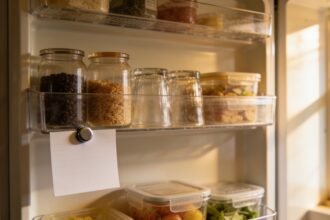
Decant into containers. If flour, rice and pasta live in containers, the packet is never seen. This is also the pantry moth control described in freezer and pantry staples worth always having, so it is worth doing anyway.
Let complaints decide. If nobody says anything within three weeks, the swap is permanent. If somebody genuinely notices and cares, switch that one item back. One or two reversals is a normal outcome and does not undo the saving from the other thirty.
Keep one branded item that matters to somebody. This is not sentimentality, it is what makes the rest of it sustainable. A household that keeps the coffee and switches everything else saves far more than a household that switches everything and reverts in a month.
Reading the shelf properly
Use the unit price, not the ticket price. Australian supermarkets display unit pricing on shelf labels, usually per 100g, per 100ml or per kilogram, and it is the only way to compare a 750g box with a 1.2kg one. It is printed small and it is the most useful number on the label.
Check the unit price even on specials. A branded item on a deep special is sometimes cheaper than the own brand, and buying own brand on principle rather than on price is not the point.
Check the actual size when a product changes. Package sizes shift, and a familiar price on a smaller pack is a price rise.
How much this saves
No figure is given here, deliberately. The saving depends on what a household buys, where it shops and which tier it switches to, and any percentage quoted would be invented.
What can be said is the structure of it: the swap costs nothing in time, nothing in effort and nothing in cooking, which makes it the only item on the grocery savings list with no ongoing cost attached. Everything else in feeding a family of four on a weekly grocery budget requires either planning or behaviour change. This one requires picking up a different box.
Next: feeding a family of four on a weekly grocery budget has the other three levers, freezer and pantry staples worth always having covers what to stock, and a family budget that survives a real month covers measuring whether it worked.
The one-page family week
One printable page that holds the whole week: meals, school, activities and who is doing the pickup. Free, and we send one useful email a week.
One email a week. No spam, unsubscribe in a click.