What is in this guide
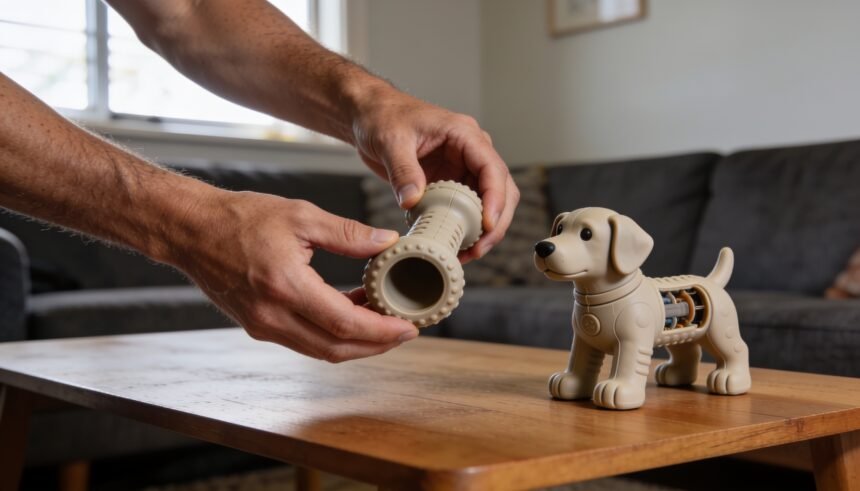
Judge a dog toy for a strong chewer by matching its stated purpose, dimensions and construction to how your dog uses toys, then checking the instructions for supervision, cleaning and replacement. Treat words such as “tough” as a reason to read the details, rather than enough information to choose.
The useful question is specific: what makes this toy a better candidate than the one you are replacing? A clear answer might concern its intended activity, a different shape or more complete sizing information. A darker colour or a stronger adjective does not answer it.
Start with what happened to the last toy
Before browsing, write a short description of the previous toy and what ended its useful life. Keep this factual: “pulled at the stitched ear”, “worked on the narrow end” or “ignored it during fetch” is more useful than “destroys everything”.
Separate damage from lack of interest. If the toy stayed intact but your dog never chose it, buying a more substantial version of the same thing may not address the reason you want a replacement. If it was enjoyed but damaged, identify the feature involved before searching for another design.
Include the activity you intended. Were you buying something for a shared game, something to carry, or a toy specifically intended for chewing? Write that purpose at the top of your shopping note. It gives you something concrete to compare with the next product’s instructions.
Read the intended use before the toughness claim
Open the full description and care information, rather than comparing thumbnail pictures. Look for a clear statement of what the toy is designed to do and any restrictions on its use. If a listing describes fetch or tug but says nothing about chewing, do not fill that gap yourself.
A useful message to the seller is: “Is this model intended for sustained chewing, and where are its use and replacement instructions?” Ask about the exact model and size you are considering. A general answer about the brand leaves the original question unresolved.
If your actual shopping problem is providing activities during absences, the separate guide to enrichment products for a dog home alone covers that buying brief. Do not use a strong-chewer label as permission to leave a new toy with your dog unsupervised.
Check dimensions and construction together
RSPCA Australia advises selecting suitable toy materials and size, avoiding loose or sharp components, and matching enrichment to the animal’s playing style. It also recommends supervision and regular checks of condition. [S1]
Use those broad criteria to question the listing. Find the dimensions of the actual variant, its stated material and any size-selection guidance. A photograph of a dog holding the toy is less useful for comparison than measurements and instructions you can read.
Look across all available views. Note seams, attachments, projecting ends and separate components, then compare them with your description of the last toy’s failure. These are questions to investigate, not proof that a design will fail. Ask for another photograph if the underside or joins are hidden.
Avoid declaring a winner simply because one candidate looks heavier or feels harder in your hand. This checklist cannot establish how either will perform with your dog. Where the maker’s sizing advice is unclear, ask for clarification before ordering instead of inventing your own size rule.
Make the care routine part of the decision
Read how the toy is meant to be cleaned and what condition changes mean it should be replaced. If the instructions are missing, count that as missing information rather than assuming a familiar cleaning method will suit it.
Consider where the toy will be used and stored. In a small flat, you may want a cupboard location for equipment brought out during shared play. If several people look after the dog, keep the instructions somewhere they can find them and agree which toys come out with a person present.
For the cleaning process itself, washing pet toys and bowls covers that separate household job. Here, the buying question is whether you can follow this particular item’s care directions with the facilities and time you have.
Compare two candidates without inventing a score
Suppose two listings both describe their toys as suitable for strong chewers. One names the material, provides measurements for each size and includes use, cleaning and replacement instructions. The other provides a lifestyle photograph and a toughness claim. This is an illustrative comparison, not a review of real products.
The first gives you more information on which to make a decision. It does not prove that the toy will last longer. The next step for the second is a question to the seller, rather than a low durability score you have no evidence to assign.
Use a short comparison note:
- Purpose: Does the stated use match the activity you are buying it for?
- Fit: Can you identify the exact dimensions and follow the sizing guidance?
- Design: Have you checked the feature that caused trouble last time?
- Instructions: Are supervision, cleaning and replacement directions available?
- Unanswered questions: What would you need to know before buying?
Leave unknowns visible. Do not turn five incomplete answers into a numerical rating that looks more certain than the information behind it.
Buy one candidate and review its place in the household
Once a candidate meets your requirements, there is no need to buy multiples before you know whether your dog chooses it. Keep its instructions and introduce it with supervision as directed. A purchase is still a candidate, even after a careful comparison.
Record what you actually observe without turning a single session into a lifespan prediction. “Chose it for fetch” and “condition unchanged after this session” are bounded observations. Neither establishes that the toy will suit every activity or remain intact indefinitely.
An intact toy your dog enjoys can take its place alongside existing favourites. Organising a dog toy rotation helps manage that collection without making every shopping trip an excuse to replace it.
Before your next purchase, write one sentence about what the previous toy lacked. Use that sentence to ask for a specification, photograph or instruction that would change your decision. If the answer remains unavailable, leave that candidate on the shelf.
How we checked this: Checked on 30 October 2026 against RSPCA Australia guidance. The comparison method is editorial; no products were tested, ranked or certified, and no durability outcome is promised.
The one-page family week
One printable page that holds the whole week: meals, school, activities and who is doing the pickup. Free, and we send one useful email a week.
One email a week. No spam, unsubscribe in a click.