Start by checking who benefits from the recommendation, what evidence of use the reviewer provides, and whether that evidence fits your pet. Spotting genuine pet product reviews means separating those questions: a disclosed promotion still needs scrutiny, while a review with no visible sponsorship label has not automatically earned your trust.
What relationship does the reviewer disclose?
Look near the recommendation, in the expanded caption and beside any shopping link. Search for a clear explanation of payment, a free sample, a loaned product or a commission on purchases. If the wording only says the creator is working with a brand, ask what that arrangement involved.
The ACCC’s review guidance says commercial connections and incentives should be disclosed. Its social-media guidance also covers paid and incentivised posts and expects claims to be truthful. For your purchase decision, treat disclosure as context, then examine the evidence separately.
Useful questions include: Was the item supplied free? Did the brand pay for the post? Does the writer describe any brand involvement in selecting products or approving content? If the answers are missing, record the relationship as unclear rather than assuming the review is independent or accusing the writer of dishonesty.
Does the review show use beyond opening the box?
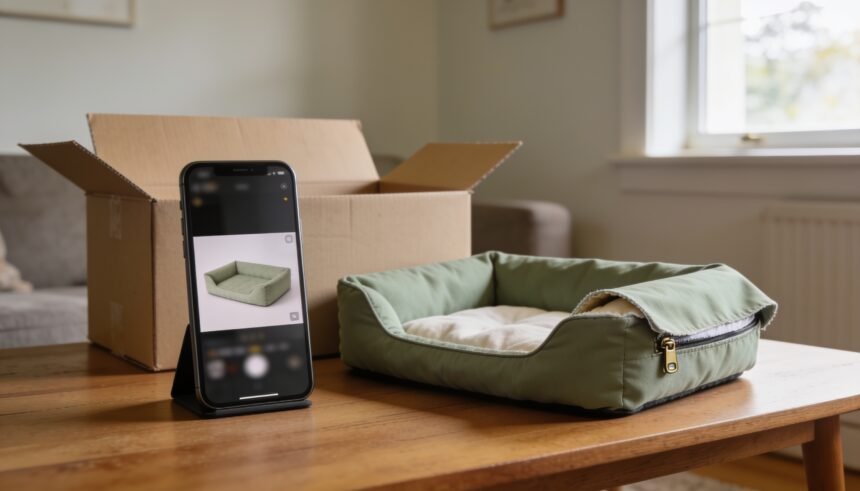
Look for an explanation of what the reviewer actually did. For a pet bed, that might include removing the cover, describing the wash process and showing how it fits back on. For a feeder, it might include identifying the food used and showing the parts that need cleaning.
Ask how long the item was used and under what conditions. Treat an unboxing as evidence about what arrived and initial impressions. Do not use it to settle questions about repeated washing or wear unless the reviewer supplies later observations.
Photos and videos can help you inspect a specific detail, but do not let attractive footage replace an explanation. A pet sitting beside a product leaves unanswered whether it used the item, for how long, and with what result.
A researched comparison can still help with dimensions or care instructions if it identifies its sources and states that no use testing occurred. Match the conclusion to the kind of evidence offered.
Is the pet in the review relevant to yours?
Before reading the verdict, write down the job you need the product to do. Include the details that would change your choice: your pet’s size, how it uses the item, the space available and your cleaning routine.
Then look for equivalent context in the review. A bed photographed with a curled-up small dog leaves the fit for a larger dog that stretches out unresolved. Ask for usable sleeping dimensions rather than relying on the overall impression of the photograph.
For feeding equipment, the guide to a dog eating too fast provides a separate starting point for understanding the purchase question. Keep the review assessment focused on what was demonstrated for the particular pet and product shown.
Which warning signs deserve a closer look?
The ACCC lists generic reviews, similar wording and sudden clusters of positive or negative feedback as possible warning signs. These are reasons to investigate, not proof that an individual review is fabricated.
Read past the star average. Choose recent favourable and critical comments, then look for details you can compare: the same model, size, component or cleaning problem. Separate complaints about delivery from observations about the product itself.
Check what a purchase badge means on that platform. The ACCC says platforms requiring proof of purchase may be more reliable. Still ask whether the comment answers your question; a purchase record does not tell you how thoroughly the item was assessed.
If several pages repeat the same description, seek a different source of information rather than counting each repetition as separate support. Compare the review with the manufacturer’s dimensions and care instructions, and look for an independently described experience.
Can a sponsored review still help?
Judge each claim on its support. Consider a hypothetical sponsored dog-bed review that clearly states the bed was supplied free, identifies its size and shows the cover being removed. You could use that demonstration to understand the opening and fastening. You would still need other evidence before accepting a claim about long-term durability.
Now consider an apparently unpaid comment saying only that the same bed is excellent. It offers less detail for that particular question, even though no commercial arrangement is visible.
Neither example establishes which bed to buy. They show why disclosure and usefulness need separate checks. For the product itself, comparing pet product quality before buying takes the next step into materials, construction and care information.
What should you do before buying?
Choose the review most responsible for your interest in the item. Write three short notes: the disclosed relationship, the strongest demonstrated detail, and the important unanswered question. If the missing answer could change your purchase, ask for it or postpone the decision. You do not need to prove a review is fake to decide it gives you too little information.
How we checked this: ACCC review and social-media guidance checked on 21 September 2026. The pet-specific questions and hypothetical comparison are Dovelyne editorial guidance. No products or reviewers were tested or authenticated.
The one-page family week
One printable page that holds the whole week: meals, school, activities and who is doing the pickup. Free, and we send one useful email a week.
One email a week. No spam, unsubscribe in a click.