A pet food subscription is worth considering when the ongoing delivered cost and repeat-order schedule suit the food you already buy. One-off purchases are the better fit when you want to approve each payment, choose each purchase date or avoid another account that needs monitoring.
Start with the same food, recipe, pack size and quantity on both sides. Comparing a subscription for a different food with your usual shop mixes two decisions together: what to feed and how to buy it. This guide deals with the second decision only.
Does the ongoing order cost less?
Write down the full checkout total for a one-off order and the equivalent repeat order. Include delivery and any compulsory charges. Use your Australian delivery postcode rather than assuming a displayed delivery offer applies to your address.
Difference per equivalent order = one-off checkout total minus ongoing subscription checkout total.
A positive result means the repeat order is cheaper on the figures you entered. A negative result means it costs more. That calculation assumes you buy the same quantity and use it; it says nothing about the quality of the food.
Keep an introductory offer in a separate line. For a broader check of the advertised saving, see spotting false discounts when shopping. If there is a first-order discount, check what the next order will cost and whether later prices are fixed or can change. Do not use the introductory total as your estimate for every future delivery.
If you must add something to reach a delivery threshold, record that extra spending too. An item you already planned to buy is different from an item added solely to unlock the offer. Compare the actual basket you will pay for, rather than the discount beside the food.
Will the delivery rhythm match your cupboard?
Before choosing an interval, note when you open and finish your current pack under your existing routine. Use that observation to plan purchases, without changing portions to suit a delivery schedule.
Then inspect the available order intervals and the estimated time between dispatch and arrival. An order date is not an arrival date. Allow for the delivery estimate when choosing when the next order should be placed, and decide how you would buy your usual food if a parcel were late.
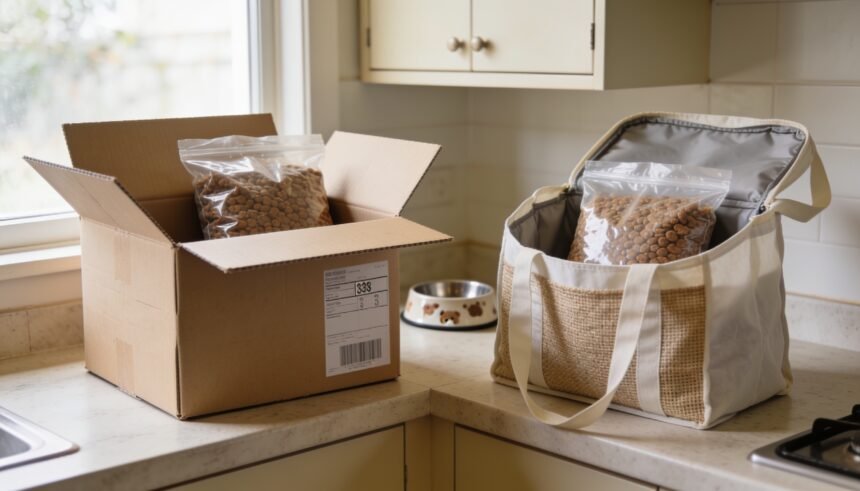
Look at what is already unopened before scheduling more. If another pack will arrive while the previous spare is still waiting, consider a longer interval or a one-off purchase when stock runs lower. A growing pile is a reason to review the schedule, even if each bag was discounted.
Check that the delivery quantity fits the space you have allocated. If the two options involve different pack sizes, use comparing pet food pack size and value without switching brands before returning to the delivery schedule. Keep that pack-size calculation separate from the decision to authorise recurring orders.
What should you check before setting up repeat orders?
Find these answers in the current service terms or account instructions before committing:
- Payment: When is the next payment taken, and can you choose or move that date?
- Changes: What is the deadline for changing quantity, moving an order or skipping it?
- Stopping: How do you pause or cancel, and does that affect an order already being processed?
- Availability: What happens if the exact food is unavailable? Check whether any substitution needs your approval.
- Delivery: Can you receive the parcel at your address, and what happens if delivery fails?
Do not assume that pausing future orders also stops a payment or parcel already in progress. Read the distinction in that provider’s terms. If the instructions are unclear, ask the provider before setting up the arrangement.
Treat the effort involved as part of the comparison. If changing an order requires a process you would struggle to complete during your working hours, include that inconvenience in your decision.
Which arrangement fits your household?
| Your situation | Arrangement to consider | What to check first |
|---|---|---|
| You repeatedly buy the same quantity on a predictable schedule | Subscription | Ongoing total and available delivery intervals |
| You prefer to approve every outgoing payment | One-off purchases | A reminder to reorder before stock runs low |
| You are often away or have irregular parcel access | One-off purchases, or a subscription with suitable controls | How far ahead changes must be made |
| You have limited storage | Either, with a manageable order quantity | Space for the new order alongside remaining stock |
| Carrying food home is difficult | Compare delivery under both arrangements | Delivered total, parcel access and order timing |
These are decision prompts, not findings that one arrangement always wins. Separate convenience from savings: a repeat order could be worth a higher total to you if it removes a difficult shopping task. Equally, a cheaper order may be poor fit if the payment date leaves too little room for other household purchases.
What is the next step?
Take your latest receipt and fill in four lines: the equivalent one-off checkout total, the ongoing repeat-order total, your likely reorder date and the deadline for making changes. Choose the arrangement that fits those figures and dates. If you subscribe, set a reminder before the first change deadline to check remaining stock and the next charge.
The one-page family week
One printable page that holds the whole week: meals, school, activities and who is doing the pickup. Free, and we send one useful email a week.
One email a week. No spam, unsubscribe in a click.