What is in this guide
Check whether the “was” price was genuinely charged for a reasonable period before the sale started. If a price jumped up shortly before being marked down, the advertised saving may not be real, and Australian courts have already found retailers can be held accountable for exactly this.
A real Australian case, not a hypothetical
In May 2026, the Federal Court of Australia found that Coles Supermarkets had made false or misleading representations about its “Down Down” discount claims, in a case brought by the Australian Competition and Consumer Commission. The ACCC’s case centred on Coles temporarily increasing the price of certain products for a short period, then applying a “Down Down” promotion at a price that was still at or above what the product had previously sold for, before that price increase.
Justice Michael O’Bryan found Coles had engaged in misleading conduct in 13 of the 14 sample promotions examined at the liability hearing, because the higher “was” price had not been charged for a genuinely reasonable period before the discount began. This matters for shoppers because it shows the exact mechanism: a brief price rise, followed by a “discount” back down to close to the original price, creating the appearance of a saving that never really existed.
What this means for reading a sale sign
You do not need to prove a legal case to protect your own budget. You need a habit of noticing prices over time rather than trusting a single sale sign.
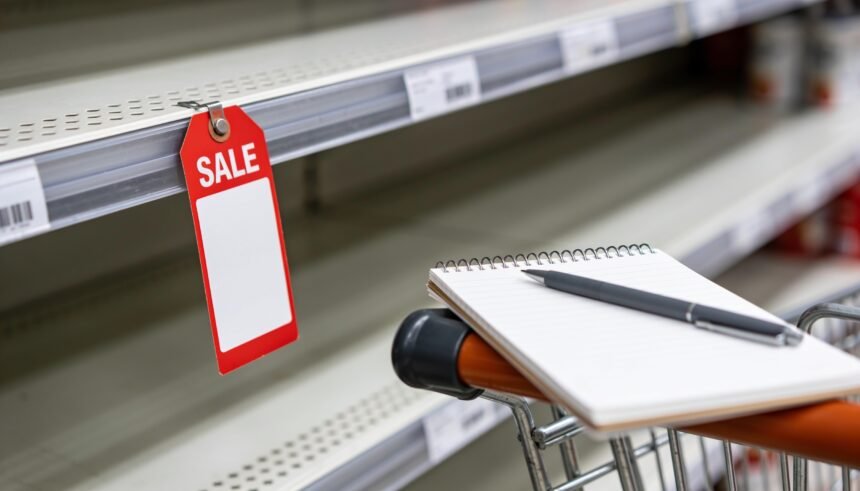
Track a handful of items you buy regularly. You do not need to track your whole trolley. Pick five or six products your household buys most weeks, and note the price roughly monthly, even just in a phone note. Over a few months, a pattern becomes obvious: a price that never really moves except during “sale” weeks is not offering the saving it appears to.
Be sceptical of a discount that appears very soon after a price rise. If you noticed a product get more expensive recently and it is now “on sale,” check whether the sale price is actually below what you were paying before the increase, not just below the inflated price.
Compare the sale price against the unit price, not just the percentage off. A “30% off” sticker on an inflated starting price can still be a worse unit price than a competitor’s everyday price. How to compare unit prices before buying household basics covers the calculation.
Watch for repeating “sale” cycles. If an item is “on special” almost every time you shop, the special price may effectively be the real price, and the higher shelf price in between is the one doing the work of making the special look bigger.
What the law requires, in plain terms
Under the Australian Consumer Law, businesses must not make false or misleading representations about the price of goods. A genuine “was” price generally needs to reflect a price the product was actually and recently sold at for a meaningful period, not a price briefly set purely to be discounted from. The ACCC has named pricing practices in the supermarket and retail sectors as an ongoing enforcement priority.
Keep this in proportion
This is not a reason to distrust every sale sign. Many discounts are genuine, particularly clearance, end-of-season and loyalty-program pricing. The point is to treat a percentage-off sticker as a starting point for checking, not as proof of savings on its own, especially for items you buy often enough to actually track. A family budget that survives a real month covers building this kind of price awareness into an ongoing household budget.
Your next step: pick one product you buy regularly and note today’s price, so the next “sale” has something real to be compared against.
The one-page family week
One printable page that holds the whole week: meals, school, activities and who is doing the pickup. Free, and we send one useful email a week.
One email a week. No spam, unsubscribe in a click.