What is in this guide
Start with the honest answer, because it decides whether the rest of this is relevant.
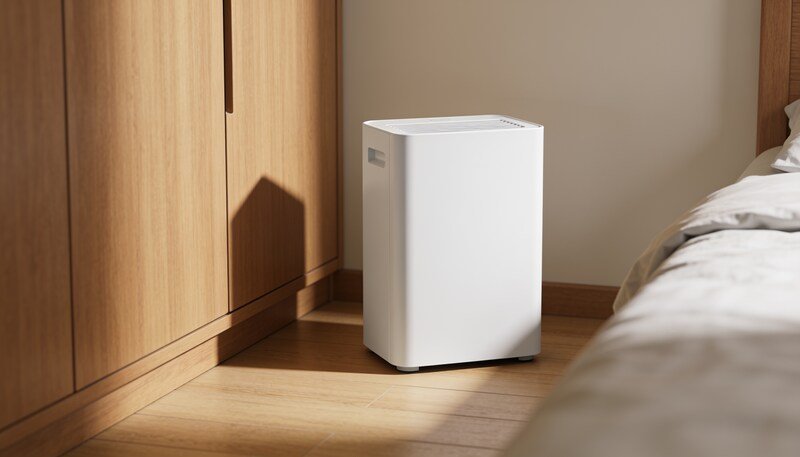
A dehumidifier does not treat mould. It removes moisture from air. If the moisture is what is feeding your mould, that is a genuine fix. If the moisture is coming from a leak, from rising damp, or from a bathroom with no working exhaust fan, a dehumidifier will run constantly, cost money, and change very little.
So the question is not “is this a good dehumidifier” but “is moisture in the air actually my problem”.
When it is the right purchase
- Condensation mould on cold external walls, in wardrobes, behind furniture, on window reveals. Mould behind the wardrobe explains how to identify this
- A room that cannot be ventilated properly: a bedroom with one small window, an internal room, a rental where you cannot install a fan
- Drying washing indoors through a wet season or a southern winter, where a dehumidifier in a closed room is dramatically more effective than a heater. Drying washing through an Australian wet season
- A humid climate where the air outside is wetter than the air inside, so opening windows makes things worse rather than better
- A specific enclosed space: a wardrobe, a caravan, a boat, a storage room, a garage full of tools
- After a flood or a leak has been fixed, to dry the structure out
When it is the wrong purchase
- There is an active leak or rising damp. Fix the water first. A dehumidifier running against a leak is a machine fighting a tap
- The bathroom has no working exhaust fan. Install or repair the fan. It is cheaper and it removes moisture at the source rather than after it has spread
- You never open the windows. Free ventilation beats paid dehumidification in most Australian conditions, most of the year
- You want it to clean the air. That is a different appliance and it does not address moisture
- The whole house is the problem. A single portable unit does not dehumidify a house. It dehumidifies a closed room
- You are renting and the cause is structural. That is a repair request rather than a purchase. Rental repairs covers it
The capacity rating that misleads
Dehumidifiers are sold by litres per day. It is the headline number and it is measured under test conditions that are warmer and wetter than your house.
A unit rated at 20 litres per day will not remove 20 litres a day in a cool Australian bedroom. Real extraction in a typical domestic room in winter is commonly a fraction of the rating, because performance falls as temperature and humidity fall.
How to read it:
- Treat the rating as a comparison between models, not as a promise
- Buy larger than the calculator suggests if the room is cold, because compressor performance drops with temperature
- Consider room volume, not floor area. A room with a raked ceiling holds much more air than its floor plan implies
- The water tank size matters more than people expect. A small tank on a machine working hard means emptying it twice a day, and a machine that is full is a machine doing nothing. Check whether it takes a continuous drain hose, which solves this entirely
Compressor or desiccant, which is an Australian climate question
This is the decision that actually matters and almost no retail page explains it.
Compressor (refrigerant) dehumidifiers cool a coil so moisture condenses out of the air. They are efficient in warm, humid conditions and their performance drops away as the room gets colder.
Desiccant dehumidifiers use a moisture-absorbing material and a heating element. They work well at low temperatures, they are generally lighter and quieter, and they put some heat back into the room.
So, roughly:
- Brisbane, Darwin, northern New South Wales, humid summers: compressor
- Melbourne, Hobart, Canberra, cold damp winters, unheated rooms, garages: desiccant often performs better
- Sydney, Adelaide, Perth: either, depending on whether your problem is summer humidity or winter condensation
If the problem is winter condensation in an unheated room, a compressor unit is the common wrong purchase, because that is exactly the condition it handles worst.
Running cost
This is the part retail listings leave out.
A dehumidifier is a continuous-load appliance. It is not a fan. Running one in a room for eight hours a day, every day, through a season is a real line on a power bill, and the desiccant type generally draws more power than a compressor unit of similar capacity because it uses a heating element.
Before buying, look for:
- The power rating in watts, which is what you multiply by hours and by your tariff
- Whether it has a humidistat, so it cycles off at a target humidity rather than running flat out. This is the single most important feature for running cost and cheap units often lack it
- A timer
- The noise rating, if published, because a machine in a bedroom that nobody can sleep next to is a machine that gets turned off
A target of around 50 to 60 per cent relative humidity is the usual recommendation for comfort and for discouraging mould growth. Chasing a much lower figure costs money and achieves little.
The free things to do first
If none of these are done, do them before buying anything:
- Pull furniture about 50 mm off external walls
- Open bedroom windows for ten minutes each morning
- Run the bathroom exhaust fan during and after every shower
- Use the rangehood when cooking
- Stop drying washing indoors, or confine it to one ventilated room
- Keep a low steady heat rather than short bursts
Doing all of that and still having condensation is the point at which a dehumidifier earns its place. Doing none of it and buying a machine is paying to solve a problem you could have stopped creating.
Before you buy
- Confirm the moisture is condensation rather than a leak
- Do the free ventilation changes first and see what is left
- Match the technology to your climate: compressor for humid heat, desiccant for cold damp
- Buy for room volume, and larger than the calculator says if the room is cold
- Insist on a humidistat
- Check the tank size and whether continuous drainage is possible
- Check the noise rating if it will run in a bedroom
- Check it carries the Regulatory Compliance Mark and buy from an Australian retailer
- Check the warranty term, which varies more than the price does
Common questions
Will it stop the mould I already have? No. Existing growth has to be cleaned. The dehumidifier stops it coming back, if moisture was the cause.
Can I use one in a wardrobe? A full machine in a closed wardrobe is usually impractical. Passive moisture absorbers are made for small enclosed spaces and are a different product at a different price.
What humidity should I aim for? Around 50 to 60 per cent relative humidity is the commonly recommended range. A cheap hygrometer tells you whether you have a problem before you spend hundreds on a machine, and it is the first thing to buy.
Is it cheaper than running the heater? For drying washing in a closed room, generally yes. For warming a house, no, because that is not what it does.
Do I need one in a new house? Sometimes. Newer homes are more airtight, and sealing a house without ventilating it concentrates moisture.
The short version
A dehumidifier is a moisture control and not a mould cure. Confirm the cause is condensation, do the free ventilation changes, then buy on technology matched to your climate, on a humidistat, and on tank size.
Buy a $20 hygrometer before you buy a $500 machine. It tells you whether you have the problem this appliance solves.
The one-page family week
One printable page that holds the whole week: meals, school, activities and who is doing the pickup. Free, and we send one useful email a week.
One email a week. No spam, unsubscribe in a click.