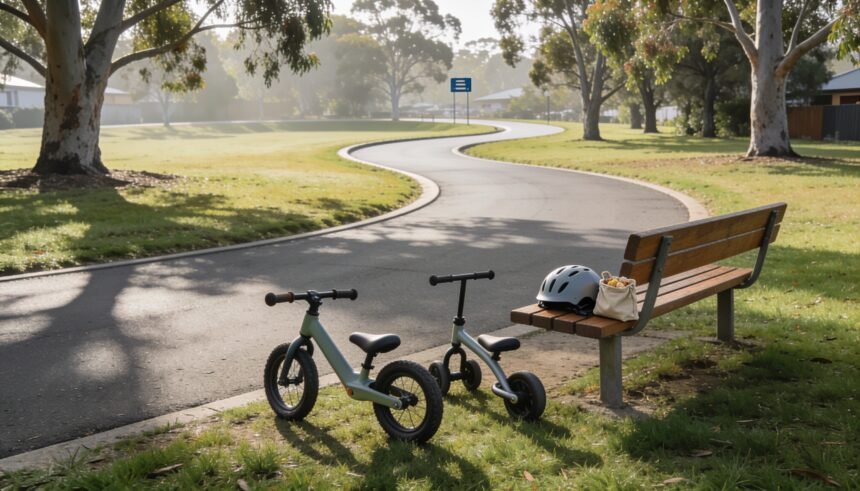
Choose a short park path with a clear return, a surface that suits your pram or bike, and toilets near the start. For children learning to ride, look for a designated learner track; for a family walk, start with the route description and grade rather than its scenic reputation.
Choose the outing before choosing the distance
Decide whether today is a walk, riding practice or a ride with a destination. Those are different outings. A child practising starting and stopping does not need a long trail, while a child walking beside a pram might enjoy reaching a particular tree or picnic spot.
Use this comparison to narrow the search. These are planning suggestions, not promises about an individual route.
| Your outing | Look for | Check before committing |
|---|---|---|
| Young walker with a pram | A short, even path with somewhere to pause | Steps and gates between the entrance and path |
| First riding outings | A designated learner cycling area | Who may use it and where accompanying adults can go |
| Child already comfortable on a bike | A short section of a permitted shared path | Crossings, hills and the return route |
| Siblings walking and riding | A compact park with both activities nearby | Whether one adult can manage the proposed arrangement |
For a preschooler, consider making exploration the whole activity. For an early primary child who wants a destination, choose one visible on the map and leave an extension optional. A birthday is not a distance recommendation: use what your child already manages on ordinary outings.
Read what the walking grade actually tells you
Parks Victoria explains that Grade 1 tracks have an even, flat surface without steps or steep sections. Grade 2 tracks can include gentle hills and occasional steps. Both categories can require no bushwalking experience, so that phrase alone does not tell you whether a route suits a pram.
Check the approach as well as the track. Find the exact entrance, then trace the connection from the car park or bus stop. If the description leaves access unclear, ask the park manager about that section rather than assuming the whole outing matches the main path.
A walking grade is also not permission to cycle. Look separately for the park’s cycling information and the particular path it covers. Keep a walking-only option for days when bringing the bike makes the plan harder.
Prefer a route you can shorten
An out-and-back route lets you choose when to turn around, but you still need to cover the distance back. A loop avoids retracing the same ground, though the next exit may be further away than it looks. A compact circuit near your starting point gives you the option of another lap without promising one.
Before leaving, identify a first stopping point and the way back from it. Tell the children that reaching it completes the outing. If everyone wants more, you can decide then. This avoids building the day around a distant playground that you feel obliged to reach.
If travelling without a car, include the walk to and from public transport in your plan. The advertised trail distance does not account for that extra part of the outing.
Use these Australian examples to guide your search
For a learner cycling area: Centennial Park, Sydney. The City of Sydney’s Learners Cycleway Playground listing identifies a children’s bike track alongside a playground, shaded areas and public toilets. It is an example of looking for riding practice and nearby facilities in one place. Check Centennial Parklands’ current access information and user restrictions before going, including arrangements for accompanying adults.
For a shared walking and riding route: Jells Park, Melbourne. Parks Victoria’s July 2025 opening notice describes the Lake Trail as approximately 2.5 km, with an asphalt path, seating and drinking fountains. The new trails accommodate walking, running and cycling. That gives you a specific route to investigate, rather than treating every track in the park as interchangeable. The full distance is optional; check the current map before choosing a shorter section.
These are examples of different outing formats, not a ranking of Australia’s best paths. Search your own council’s parks information for a learner track or short walking circuit before planning a cross-city trip. Brisbane families can use free things to do with kids in Brisbane to shortlist parks, then check the individual path details.
Give the walk a small job
Choose one activity that works from the path: spot three different leaf shapes, listen for birds at a stopping place, or take a photograph of an interesting tree. Leave natural objects where they are. There is no need to prepare a worksheet or turn every stop into a lesson.
For siblings with different interests, let one choose the observation task and the other choose the snack from what you brought. If riding and walking together becomes awkward, make them separate parts of the visit rather than extending the route to satisfy both.
Pack for the return and finish at the planned point
Bring water, a snack, your usual outdoor essentials and a bag for rubbish. If cycling, bring the child’s bike and helmet, and check the relevant park and state transport guidance before leaving. The fuller park or beach day packing list is useful when the walk is part of a longer day out.
For a free outing, choose a route with confirmed free access and use equipment you already have. Check parking or transport costs separately, and decide beforehand whether a café stop is part of the budget. A public park should not automatically be treated as a cost-free trip.
Check the forecast and the park’s current notices on the day. After the outing, take rubbish home, empty snack containers and note the entrance you used. Record whether the surface, distance and facilities worked for your family so the next visit needs less planning.
Your next step: choose one nearby path, locate the toilets and mark a turnaround point. That is enough of a plan for a short outing.
The one-page family week
One printable page that holds the whole week: meals, school, activities and who is doing the pickup. Free, and we send one useful email a week.
One email a week. No spam, unsubscribe in a click.