What is in this guide
Use the wardrobe for things you reach for often, and reserve under-bed storage for clearly grouped items you can pull out without rearranging the room. Start with what needs a home, then check the route in and out before choosing a box, bag or drawer.
The most useful under bed storage ideas begin with a specific job: spare bed linen, occasional shoes or a folded guest blanket. An empty gap does not need filling simply because it exists. The layout below is an editorial method for organising existing space, with choices to adapt to your room.
1. Give each space a job before emptying it
Start with one bedroom and write down what is competing for space. Separate everyday clothes, occasional belongings and items awaiting a decision. Leave the rest of the house alone while you work through that room.
Assign everyday clothes to the easiest wardrobe section. Consider under-bed space for a complete category you retrieve less often, such as spare linen for that bed. Keep clothes awaiting repair or a decision in a separate, temporary place with a clear next action. Otherwise, the new storage becomes a place to postpone the same sorting job.
Be specific about ownership. In a shared bedroom, give each person an identifiable section rather than mixing everyone’s occasional belongings into a single deep box. Shared linen can have its own container.
If the bedroom floor is collecting school bags or things waiting to leave the house, consider whether they belong in an entry drop zone instead. Moving them beneath the bed may put them further from where they are needed.
2. Check the way in and the way out
Look underneath the bed before deciding how many containers will fit. Note the legs, centre supports and any other obstruction. Measure the available opening and usable depth, then check the floor space beside it. A bedside table or wall may rule out access from one side.
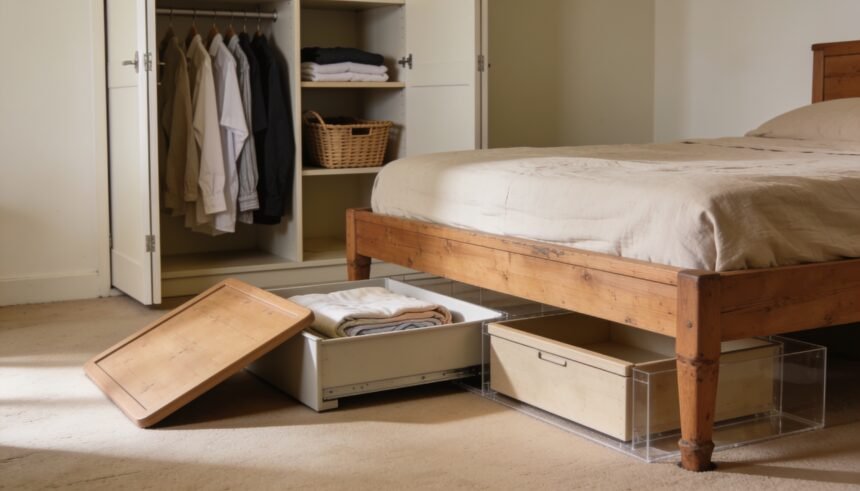
Allow for the complete container, including its lid, handle and wheels if fitted. Also decide where you will open it. Will it come all the way out, or does the lid need to lift while it is still partly beneath the frame?
Use an existing empty box or a piece of cardboard to try the planned footprint. This is a layout rehearsal, not proof that an unpurchased container will fit. For a fuller checklist, use the guide to measuring a space before buying storage.
Do not change the bed height or remove supports to make a container fit. Work within the existing bed’s instructions and available clearance. If the usable opening is too low, leave it empty and organise another space.
3. Compare containers by the access they need
Choose the shape after deciding what it will hold. Use this comparison as a starting point, then check the actual container’s dimensions and instructions.
| Option | Consider it for | Check before committing |
|---|---|---|
| Shallow lidded box | A defined group of spare linen or occasional accessories | Can you grip it, pull it clear and open the lid with the contents inside? |
| Zipped fabric bag | Folded spare bedding or clothing | Can you reach the zip, and does the filled bag still fit without forcing it under the frame? |
| Existing built-in bed drawer | Items that fit its intended storage use | Does the drawer open fully beside the other furniture? Follow its stated limits. |
| Low open tray | A small group you want to see and retrieve together | Are you willing to move the tray and its contents when cleaning beneath the bed? |
A large container suits a category you want to bring out together. Several smaller containers may suit separate categories, but each needs its own retrieval route. Avoid putting the one you use most often behind another box.
If you already own a suitable container, try that first. A matching set is optional. The useful comparison is whether you can retrieve the right group and put it back without unpacking unrelated things.
4. Arrange the wardrobe around ordinary clothes use
Keep current everyday clothing together in the most accessible area. Use hanging space for the pieces you prefer to hang and existing shelves or drawers for folded clothing. There is no need to make every category use the same method.
On a deep shelf, try a removable basket for one clothing group rather than placing another row loose behind the first. Check that the basket can come out through the wardrobe opening. With sliding doors, test access with each door in its normal open position.
Leave enough room to return clean washing without pressing it into the remaining gap. If everything fits only immediately after careful folding, reduce the contents or choose a simpler arrangement. Try broad groups such as tops, bottoms and sleepwear before creating lots of small divisions.
For a child’s section, use the separate guide to wardrobe storage children can reach and use. It covers the child’s ability to choose and return clothes, which needs its own layout decisions.
Renters with fixed shelving can start with loose containers inside existing storage. Check fit before adding any organiser, and keep the wardrobe usable without altering its structure.
5. Make hidden contents identifiable
Give each under-bed container a plain name that describes its contents. “Spare queen sheets” is more useful than “Bedroom stuff”. Put the label on the end visible from the access side, and update it when the contents change.
For opaque containers, keep a short contents list if the category name is not enough. Avoid a detailed inventory for ordinary items unless you will maintain it. The label should help someone find the item without opening every container.
Keep groups intact where practical. For example, put the pillowcases belonging to a spare sheet set with that set, rather than splitting the same bed’s linen between several locations. This is a suggested arrangement, not a rule about how many sets to own.
6. Try a complete retrieval and return
Fill one container before arranging the rest. Pull it out, open it, remove an item, return the item and put the container away. Try the same sequence with one wardrobe category using clean washing.
Change the part that gets in the way:
- The bedside table blocks access: use another accessible side or allocate that space elsewhere.
- The container is awkward when filled: reduce its contents or divide the category into smaller groups.
- The lid cannot open: plan to remove the box fully, or choose a different container format.
- Nobody knows where an item belongs: rename the category or combine overlapping groups.
- Returning one item requires emptying the shelf: leave more space or change the arrangement.
Keep a route for removing the containers when cleaning. At the next linen change or clean-laundry put-away, check whether the arrangement still works in ordinary use. Start with one category and one space today; add another only after the first can be used comfortably.
How we checked this
Reviewed on 29 September 2026 as an editorial organisation method. The comparisons describe choices to check in your own room, not product testing, measured benefits or a market survey. No brands, prices or specialist clothing-care claims are included.
The one-page family week
One printable page that holds the whole week: meals, school, activities and who is doing the pickup. Free, and we send one useful email a week.
One email a week. No spam, unsubscribe in a click.