What is in this guide
Measure both feet while your child stands, record the distance from heel to longest toe, then use the chosen brand’s size guide. Keep the original measurements: a home reading is a starting point for sizing, and the actual shoes still need a fit check.
1. Gather the tools and choose your method
You need plain paper large enough for the foot, a pencil and a ruler marked in millimetres. Have a flexible tape available if the brand asks for a measurement around the foot. Clarks Australia’s home method is for children who can stand unaided; otherwise, arrange an in-store measurement.
Read the intended brand’s instructions before starting, including any sock requirements. Put the tools together first so you are ready when your child is willing to stand still. Leave room on the paper to label each foot afterwards.
If you prefer a printable guide, follow its print settings. Ascent specifies 100% scale and describes its measuring guides as an estimate rather than a guaranteed fit. Avoid selecting a printer setting that shrinks the page to fit. You can also use plain paper without a printer.
2. Record the length of each foot
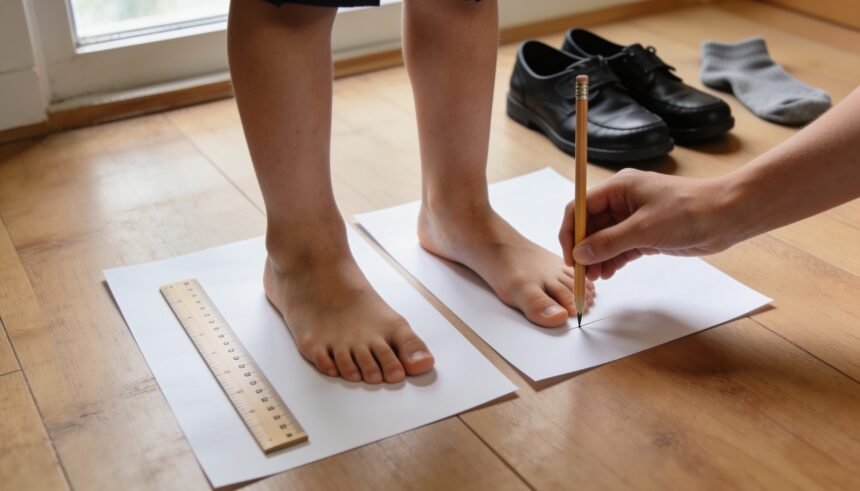
Clarks’ school-shoe guide describes standing on a flat surface with weight shared evenly between both feet. For a tracing, keep the pencil upright.
Its dedicated home guide offers a shorter method:
- Have your child stand tall on the paper with feet slightly apart.
- Mark the end of the longest toe, which may not be the big toe.
- Mark the furthest point at the back of the heel.
- Measure between the marks in millimetres.
- Repeat on the other foot and keep both readings, using the larger foot as the sizing reference.
As a practical recording habit, label each result immediately. If your child moved before you finished, use a fresh patch of paper and repeat that reading. Do not average a clear measurement with one you already suspect is wrong.
3. Check what the guide means by width
A measurement across the foot and one around it are different inputs. Clarks’ school-shoe article describes measuring across the widest part. Its home calculator instead uses circumference: wrap a tape around the joints at the base of the toes without squeezing. That calculator calls the result width.
Use the method requested by the particular chart or calculator. Do not enter a flat tracing’s width into a field expecting circumference. If the instructions are unclear, ask the retailer which measurement it needs before selecting a size.
In your notes, write either “across” or “around” beside the number. A bare label such as “width” leaves the next person to guess which method you used. This matters especially when one parent measures and another places the order.
4. Match the readings to the correct chart
Clarks advises checking the chart for the brand being purchased because sizing can vary. Read the units and the size-system heading, including whether the result is UK, US or EU. Millimetres and centimetres are not interchangeable: divide millimetres by ten when a chart requests centimetres.
Keep the measured foot length separate from any fitting allowance. Follow the chart’s instructions about extra room rather than adding your own allowance to every reading. If a result falls between entries and the guide gives no direction, send the retailer your measurements and ask.
Save a note with these fields:
- Date and child’s name.
- Left and right foot lengths, with units.
- Any width readings, labelled across or around.
- Socks used, if any.
- Brand, chart and size system consulted.
- Suggested size and any question still to resolve.
Treat that as a shopping note, not an instruction to replace the current pair. The guide to when school shoes need replacing covers that separate decision. If shoes do go on the list, include them in your school uniform budget.
5. Take the note to the next fitting
For the wider purchase decision, use the school shoe buying guide. Keep this measurement note with your back to school checklist, so the person organising the shoes has the readings and outstanding questions together.
Before closing the note, write one next action: check the brand’s chart, ask about an unclear measurement or arrange a fitting. That gives whoever handles the shopping a specific job to finish.
How we checked this: Reviewed Clarks Australia and Ascent measuring guidance on 23 September 2026. This is an editorial comparison of published instructions; no shoes or measuring methods were tested.
The one-page family week
One printable page that holds the whole week: meals, school, activities and who is doing the pickup. Free, and we send one useful email a week.
One email a week. No spam, unsubscribe in a click.