What is in this guide
To stretch school shoes that pinch, first check that the pair still fits, then consider a gentle width adjustment for a small tight spot in leather. Follow the shoe and stretcher instructions, avoid heat, and stop if the material changes or the fit remains uncomfortable. No method guarantees a damage-free result.
1. Find the problem before changing the shoes
Put both shoes on with the socks your child normally wears to school. Ask them to point to the exact spot: across the front, along one side, under the fastening or at the heel. Record which shoe is involved and whether the complaint started with a new pair or after months of comfortable wear.
Undo the fastening fully, straighten the tongue and fasten the shoe again normally. As a first check, make sure a folded sock or bunched tongue is not what your child is describing. Do this before treating the shoe itself.
If the toes reach the end, Clarks Australia’s replacement guidance says it is time for another pair. Set those shoes aside for a fitting rather than attempting to gain length. Our guide to measuring kids' feet at home can help you prepare a measurement note, while when school shoes need replacing covers the wider replacement decision.
For a pair bought recently, ask the retailer about fitting and exchange options before altering it. Explain the specific tight spot and bring the school socks. This is a practical ordering of jobs, not a statement about any retailer’s return policy.
2. Check the upper material and care instructions
Read the label, original listing or manufacturer’s care page. A black polished surface alone is not enough information. Write down the upper material and any special finish, then keep those details beside the instructions for the method you are considering.
Clarks’ stretching guidance identifies leather and suede as suitable for gentle mechanical adjustment. For synthetic or patent uppers, it recommends caution and a cobbler’s assessment when uncertain. With either finish, make professional assessment your first step rather than experimenting at home.
Before beginning, photograph the pair in good light. Include the tight area, stitching and sole join. The photographs are a reference for your own inspection, not evidence that stretching will work. If the material is already cracked or a seam is separating, ask a repairer to assess it before applying pressure.
3. Choose a controlled adjustment
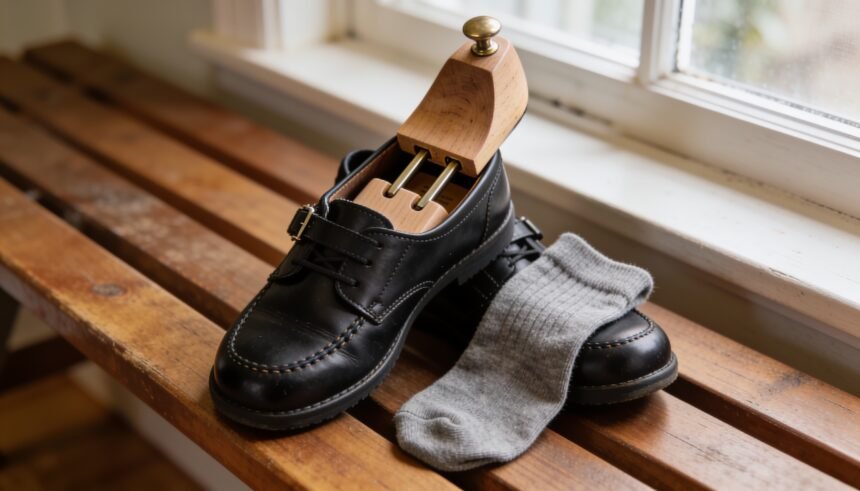
A stretcher lets you attempt an adjustment without asking your child to keep wearing a pinching shoe. Use one whose instructions cover the shoe’s size and construction. If you cannot confirm that it fits a children’s shoe, take the pair to a repairer instead of buying a tool on guesswork.
For a width adjustment, Clarks advises inserting the device snugly and expanding it without force. Treat that as a limited adjustment, with inspection between attempts:
- Read the device instructions completely before inserting it.
- Open the fastening and position the device as directed.
- Apply only the gentle adjustment the instructions describe.
- Leave it for the specified interval, without adding extra turns to hurry the result.
- Release the mechanism before removal, following its instructions.
- Inspect the shoe before asking your child to try it again.
Do one shoe at a time if only one has the tight spot. There is no reason to adjust the other merely to make the process symmetrical. Keep a short note of the setting or adjustment used so another adult does not unknowingly repeat it.
4. Check carefully before using a stretch spray
A spray is optional, and its label matters more than a general recommendation for leather. Mister Minit’s Australian spray instructions require a test on an inconspicuous area and exclude aniline leather, suede and nubuck. That is a useful example of why a product labelled for leather should not be assumed suitable for every leather finish.
If you already have a spray, compare its directions with the shoe’s care instructions. Follow the hidden-area test and check the result before proceeding. If the instructions require wearing the shoes afterwards and they still pinch, choose a repairer’s assessment instead of having your child complete that step.
Ask the repairer whether any treatment is needed, whether it suits the finish and whether the proposed adjustment targets the area you identified. There is no need to choose a chemical treatment before someone has assessed the actual shoe.
5. Leave heat and freezer methods out
Clarks Australia’s care guide says leather shoes should dry naturally and warns that artificial heat may ruin the leather. Keep the hairdryer, heater and hot-water treatment out of this workflow. Shoe care instructions are a better starting point than a promise of a quick result.
This guide also leaves out bags of freezing water and forcing household objects into the toes. That is a conservative editorial choice: use an instructed adjustment or get an assessment rather than improvise pressure inside the shoe. A shoe tree belongs to a different task. Clarks describes it as maintaining shape and size, so do not use one as a substitute for an adjustable stretcher.
6. Recheck the result and decide the next job
Inspect the finish, seams and sole join against your starting photographs. Stop if you see a new split, distorted stitching or a change in the surface. Do not conceal a change with polish and continue stretching.
If the shoe looks unchanged, try both shoes again with the normal school socks and fastening. Ask about the original tight spot and the overall fit. A short indoor check is a chance to reassess, not a promise that a full school day will be comfortable. Stop the check if the shoes still pinch.
For an unresolved spot, take the shoes and your notes to a shoe repairer. Mister Minit Australia lists leather stretching as an in-store service, but have the particular pair assessed before agreeing to work. Ask what can be changed, what the quote covers and when the shoes would be ready. If a different pair is needed, use the school shoe buying guide to organise that fitting.
How we checked this: Compared Clarks UK stretching guidance, Clarks Australia care and replacement guidance, and Mister Minit Australia instructions on 11 October 2026. Commercial guidance informs the material limits; the cautious workflow is editorial judgement. No shoes or methods were tested.
The one-page family week
One printable page that holds the whole week: meals, school, activities and who is doing the pickup. Free, and we send one useful email a week.
One email a week. No spam, unsubscribe in a click.