What is in this guide
This is not a water safety guide and it must not be used as one.
Go to a patrolled beach. Swim between the red and yellow flags. Have an adult actively watching, within reach of young children, at all times. Surf Life Saving Australia and Royal Life Saving Australia publish Australian water safety guidance, including what to do about rips, and they are the reference, not this article. Read them before the season rather than at the water’s edge.
Everything below is the practical half: timing, sand, and the things that decide whether a beach day with small children works.
Timing is the whole thing
Early morning or late afternoon. The middle of the day in an Australian summer is not usable with small children, and the good hours are before about ten and after about four.
Check the tide. Low tide gives shallow water, rock pools, flat sand for walking and far more to do with a toddler. High tide on a steep beach gives a narrow strip and dumping shorebreak, which is the worst combination with a small child.
Two hours, not five. Small children at the beach go from delighted to finished quickly. A short trip that ends well is repeatable.
Check the forecast and any warnings, and check whether the beach is patrolled on the day you plan to go, since patrol seasons and hours vary.
In northern Australia, marine stingers are a serious seasonal consideration. Follow the relevant state health authority advice and local signage without exception.
The sand problem
Nobody warns first-time beach parents about the sand and it is most of the practical difficulty.
Sand gets into everything. Food, eyes, nappies, the car.
Baby powder or talc removes dry sand from skin surprisingly well, which is the most useful tip in this article and the one most often passed between parents.
Take more water than you need for rinsing, separate from drinking water. A bottle for feet and hands before getting in the car saves the entire drive home.
A fitted sheet with bags in the corners makes a sand-free base for a baby, and a shaken-out towel does not.
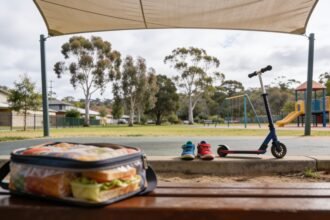
Put food in sealed containers, not open bags. Wind plus sand plus sandwiches is a lost lunch.
A dedicated beach bag that lives in the car means sand stays in one place. What to pack for a park or beach day covers what goes in it.
Shade and sun
Australian UV requires more than sunscreen.
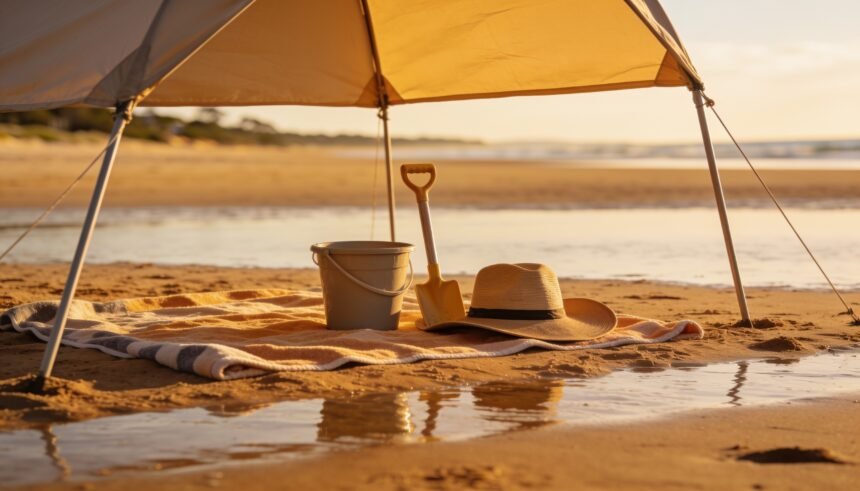
Bring shade, because most Australian beaches have none. A beach shelter, an umbrella, or a spot under a tree above the sand.
Rash shirts do more than sunscreen for extended water time, particularly for young children who are in and out for hours.
Hats that stay on, with a strap.
Sunscreen applied before you leave home and reapplied following the product’s instructions.
Sun protection guidance is published by Cancer Council and state health departments and is the authority.
Hot sand burns feet. This surprises people every summer and small children will not tell you until they are in trouble. Thongs or reef shoes, and check the sand with your hand.
With a baby or a toddler
One adult per small child in or near the water. This is the whole arrangement and everything else is secondary.
Shallow, flat and calm. A bay, a lagoon, a tidal pool or the flat end of a beach rather than surf.
Babies and very young children have particular sun, heat and water considerations and are best discussed with your child health nurse or GP rather than a general article.
Expect them to eat sand. It is unpleasant and generally not dangerous, and it will happen.
A shaded portable cot or a pram with a cover for sleeping, out of direct sun, and watch the temperature under any cover.
With primary-aged children
Set the boundaries before you get to the water, not once you are there. How far, which flags, who they check in with, and what to do if they cannot see you.
Pick a landmark. Not the umbrella, which looks like every other umbrella. A stairway, a tower, a building.
Teach them to go to a lifeguard if they cannot find you, and point one out when you arrive.
Rock pools at low tide are the best value part of a beach day for this age and involve no surf at all.
Making the day work
Go with another family. The children entertain each other and the adults can share watching in a structured way, with an explicit agreement about who is watching rather than an assumption.
Take a ball, a bucket and a spade. Very little else is needed.
Eat before the water, not after, because nobody wants to eat with sandy hands and everyone is hungry on the drive home.
Leave before the meltdown. Ten minutes before, ideally. Beach days end suddenly.
Something for the drive home: water, a snack, and a towel over the seat.
If the beach is not an option
Ocean pools, harbour beaches, lagoons and public swimming pools are all calmer, and many Australian councils run free or low-cost facilities. The same supervision rules apply everywhere.
Creeks and rivers vary enormously in safety, and current conditions, signage and local advice matter. Treat any waterway after rain with real caution.
Next: what to pack for a park or beach day covers the bag, free things to do with kids these school holidays covers other free options, and a free week of school holidays puts a week together.
The one-page family week
One printable page that holds the whole week: meals, school, activities and who is doing the pickup. Free, and we send one useful email a week.
One email a week. No spam, unsubscribe in a click.