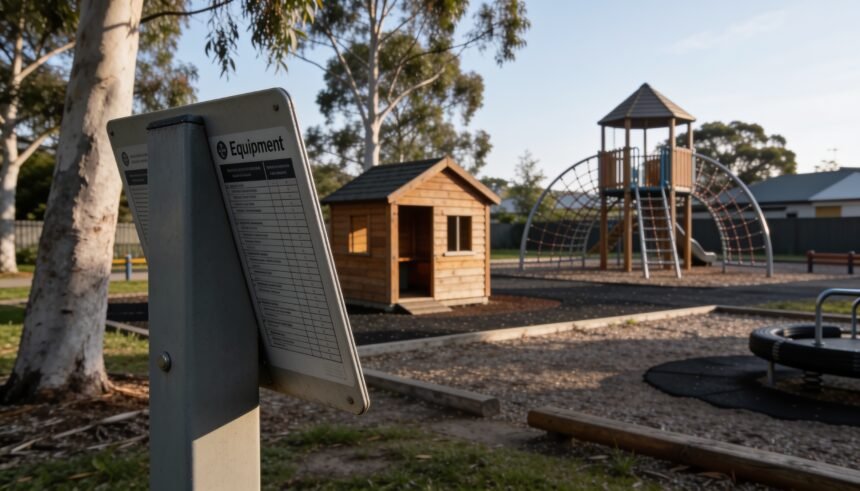
A playground age band tells you the age group the equipment or play area is intended for, according to the wording on that sign. Read it alongside any restrictions and instructions, and check which equipment it covers rather than assuming one label describes the whole park.
Start with the words around the numbers
An age range is only part of the message. A sign might say equipment is recommended for a particular group, designed for that group, or restricted to that group. Those phrases should not be flattened into a single meaning.
Kidsafe’s playground checklist specifically asks whether signs indicate the recommended age groups for equipment. Australian equipment manufacturer Proludic also describes signs that carry age requirements and restrictions, as well as directions for use. The wording therefore matters: an age recommendation and a use restriction are different kinds of information.
Read the complete sentence before explaining it to a child. If a hypothetical label says “recommended for ages 2 to 5”, describe that as the intended age group. If it says “not for children under 5”, retain that restriction when discussing the choice. This is a reading distinction, not a judgement about how a particular council enforces its rules.
Check whether the sign covers the park or one structure
Look at where the label sits and what it names. An entrance board can describe a play area, while a smaller sign beside a structure can provide information about that equipment.
Sunshine Coast Council’s design guidance distinguishes activity entry signs from manufacturer equipment user signs. It describes the latter as information to guide carers about equipment use. That distinction is useful when a large reserve contains several different play spaces.
For example, imagine an entrance board describing a family playground and a label beside a climbing frame giving a narrower age range. Do not turn the broad description into an answer about the frame. Read the equipment information as well. Equally, a label on one structure does not automatically describe a nearby playhouse or the entire reserve.
If the relationship is unclear, make a note of the sign and the structure it stands beside. Ask the operator which equipment the wording applies to. That is a more useful question than asking whether the park is simply “for toddlers”.
Understand the familiar overlapping bands
You may encounter labels such as 2 to 5 years and 5 to 12 years. The US Consumer Product Safety Commission’s playground handbook uses those groups for preschool-age and school-age children, alongside a toddler group of 6 through 23 months. It recommends communicating intended age groups through signage or labels.
These are US guidance categories, not a universal Australian labelling system. Read the actual local sign, even if its numbers differ from a range you have seen elsewhere.
The shared age of five in the two US bands is an overlap in the categories. It does not mean every five-year-old must leave one area for another on their birthday. Nor does an age category provide an individual assessment of a child’s abilities. The handbook recognises variation near the cut-off ages.
For a family conversation, keep the explanation modest: “This label describes who this area is intended for.” Avoid turning it into a score for bravery, maturity or how well a child compares with friends.
Keep age information separate from the other instructions
Reading the age band does not finish reading the sign. Proludic’s description of playground signage includes directions for use as well as age information. Treat each part as its own instruction or description.
A hypothetical sign could carry an age range, an equipment instruction and the operator’s contact details. The age range answers who the equipment is intended for. The instruction addresses use. The contact details tell you where to ask a question. None of those fields makes the others redundant.
Do not translate being within the printed range into a promise that every activity will suit that child. This article interprets labels; it does not inspect equipment or establish its condition. For the wider outing, compare the features that make a playground work for your family, including the layout and facilities you need.
Plan for siblings without making the label a contest
For a hypothetical visit with a three-year-old and an eight-year-old, look for information about each play area before settling on a destination. A single attractive photograph may show only the structure one child wants to use.
Make a small shortlist based on the information available: which areas are described for each age group, how those areas relate to one another, and whether the park has the facilities your household needs. These are planning questions, not a claim that a particular layout guarantees suitability.
Keep the rest of the outing manageable with a park or beach day packing list. If you are comparing a park visit with a beach day with young children, compare the whole outing rather than assuming the same age information will apply to both settings.
Ask a precise question when the label is missing
A faded label or an unclear online listing leaves an information gap. It does not supply an alternative age range. Contact the council or other operator and name the park, the structure and the detail you need confirmed.
A useful enquiry is: “Which age group is the climbing structure beside the entrance intended for, and is there a separate user instruction sign?” That gives the operator something concrete to answer.
For your next visit, read the age wording in full, identify what it covers, and check the remaining instructions before choosing the play area.
How we checked this
Checked on 10 October 2026 against Australian Kidsafe, manufacturer and council signage guidance, with US CPSC guidance used only to explain its familiar age categories. Examples are hypothetical editorial applications. No park inspection or equipment testing is claimed.
The one-page family week
One printable page that holds the whole week: meals, school, activities and who is doing the pickup. Free, and we send one useful email a week.
One email a week. No spam, unsubscribe in a click.