What is in this guide
A small kitchen for five people has a volume problem, not just a space problem. The usual small-kitchen advice, corner organisers, stackable containers, vertical dividers, helps at the margins, but the real fix is deciding what earns bench-level and eye-level storage based on how often it is actually used, not what category it belongs to.
Store by frequency, not by type
The instinct in a small kitchen is to group by category: all the plates together, all the pots together, all the snack food together. For a household of five, that instinct wastes the best storage on things that are not used daily.
Sort instead by how often each item comes out:
| Frequency | Where it goes | Examples in a family-of-five kitchen |
|---|---|---|
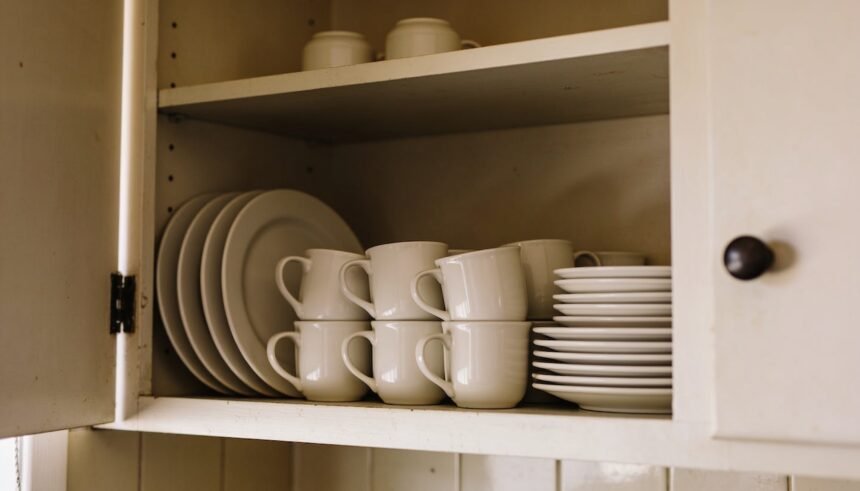
| Daily | Eye level, easy reach, no stacking to dig through | Everyday plates and cups (enough for the whole household), school-lunch containers, the pans used most nights |
| Weekly | Lower or higher shelves, one layer of reaching acceptable | Baking trays, the second set of dishes for guests, bulk snack stock |
| Occasional | Top shelves, under-bench, or another room entirely | Good plates, appliances used a few times a year, spare serveware |
A family of five typically owns more of everything: more plates, more lunch containers, more snack packaging. The daily-frequency shelf is where that volume actually needs to live, even if it means the occasional-use items move somewhere less convenient, including out of the kitchen altogether.
Duplicate items need a decision, not more shelves
Five people usually means five of some things: water bottles, lunch containers, cutlery sets. Adding more shelving to store all of it fully assembled is rarely the answer in a genuinely small kitchen. Two approaches work better:
- Store the daily-use quantity together as a set, rather than spread by type. Five lunch containers with five matching lids stored as one group are easier to find complete than a drawer of forty mismatched lids sorted by size.
- Decide a real ceiling on quantity for anything that multiplies per person, water bottles especially, and store only up to that number. Extras beyond the ceiling are the ones worth passing on, not the ones that need a new storage solution.
Use height, not just corners
Small-kitchen advice defaults to corner solutions, but height is usually the more available resource in an older Australian kitchen with high ceilings and shallow cupboards. A single shelf added above the existing top shelf, purely for occasional-use items, moves an entire category out of daily competition for space without touching the layout anyone uses day to day.
What to move out of the kitchen entirely
Not every food-adjacent item needs to live in the kitchen if the kitchen itself is small:
- Bulk pantry stock beyond a week or two’s worth, if there is a linen cupboard, garage shelf or laundry cupboard with spare capacity.
- Serveware and equipment used only for entertaining, which by definition is not needed on a normal week.
- A second small appliance used occasionally, stored wherever there is room rather than taking permanent bench space for an occasional job.
Moving these out is not a failure of the kitchen; it is matching where things live to how often they are actually reached for.
Bench space is the scarcest resource
In a small kitchen, bench space disappears fastest, not cupboard space. Keep only what is used daily on the bench itself (the kettle, one cutting board, whatever is used every single day), and give everything else, even things used a few times a week, a home inside a cupboard or drawer rather than a permanent spot on the bench.
Revisit it as the household changes
A system built for five people with three still in high chairs looks different a few years later. Revisit the daily/weekly/occasional sort roughly once a year, or whenever something that used to be reached for constantly stops being used daily, since that item has earned a demotion to a less convenient shelf.
Pick one cupboard today and sort it by how often each item is actually used, not what it is, and let that decide what moves to eye level and what moves out.
How we checked this
Reviewed on 27 September 2026. This package is Dovelyne editorial organisation method based on ordinary small-kitchen constraints, not a tested or measured program, and makes no renovation or product-specific claims.
The one-page family week
One printable page that holds the whole week: meals, school, activities and who is doing the pickup. Free, and we send one useful email a week.
One email a week. No spam, unsubscribe in a click.