What is in this guide
- Write down what the gate needs to separate
- Read the exact model’s instructions first
- Make a doorway record you can send to the seller
- Compare the opening adults will actually use
- Treat pet features as questions, not bonuses
- Compare two candidates with the unknowns visible
- Plan the space on both sides before ordering
For a home with dogs and toddlers, start with a gate intended for children, then assess whether its documented design also fits your dog and doorway. ACCC Product Safety advises against using pet gates for children because they are not designed for that purpose. A pet-gate label alone is not enough. [S1]
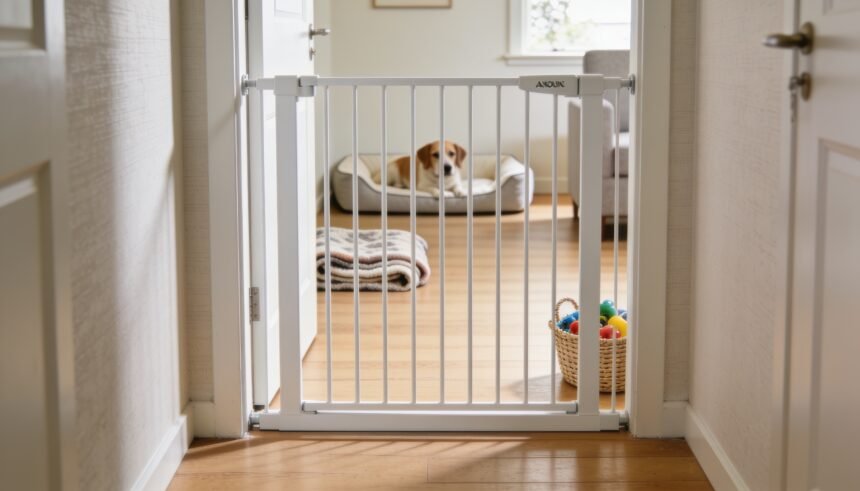
That distinction changes the shopping brief. You are looking for a candidate that meets the child-use requirements in its instructions and suits the way your household uses the space. Neither a photograph of a dog beside it nor the words “extra tall” settles both questions.
Write down what the gate needs to separate
Describe the job before comparing models. “Keep the dog away from the play area while adults use the doorway” is more useful than “buy a strong gate”. Add where the dog will be, where the toddler will be and which adults need to move between the spaces.
Keep the dog’s behaviour factual. Note whether your dog has previously jumped a barrier, pushed against one, chewed at a panel or simply waited beside it. These observations are questions to raise with the manufacturer, not a home test that establishes which gate will contain the dog.
Also decide whether the gate is meant to remain in one opening or move between rooms. Make a separate note for each location. A candidate that fits one doorway does not automatically meet the requirements for another.
Read the exact model’s instructions first
Find the manual before adding anything to the basket. Check its stated child age or developmental limits, permitted locations, mounting requirements and conditions for stopping use. If the listing only discusses pets, ask for documentation that specifically addresses child use rather than interpreting the word “family” as evidence.
Keep the model number beside the manual. Similar-looking products and different versions can make an online comparison confusing. If a seller sends generic brand information, ask again for the instructions belonging to the exact item and variant you would receive.
For a broader method of separating useful specifications from advertising, comparing pet product quality before buying gives you a way to organise the missing information. Here, intended child use is the first question, before finish, colour or convenience.
Make a doorway record you can send to the seller
Take a photograph of the whole opening and note its width, skirting boards, nearby doors and the surfaces on either side. Compare that record with the manufacturer’s measurement and fitting directions. Do not assume the width shown in a listing describes every configuration pictured.
Ask which parts are included and whether the documented configuration requires separately purchased extensions or fittings. Record the complete parts list alongside the model, so two candidates are being compared on the same basis.
If you rent, identify any fitting questions you need resolved before purchasing. Do not choose a different mounting method simply because it sounds easier to remove. Where stairs or another hazardous location are involved, take the exact location to the manufacturer and consult the ACCC guide rather than adapting a general doorway comparison into an installation plan.
Compare the opening adults will actually use
The gate’s overall width and the passage adults walk through are different shopping questions. Find both measurements if available. Consider the route with a laundry basket, groceries or a vacuum cleaner, and check the documented swing direction against nearby furniture and doors.
Look at how the latch is operated and how you confirm it has closed. Ask for a demonstration in a shop or a model-specific video if the photographs leave this unclear. An auto-close label is worth investigating, but it does not explain every condition in which the feature operates.
Write down the awkward trips in your household rather than imagining an empty hallway. A doorway used repeatedly during dinner preparation deserves more thought about adult access than an opening crossed occasionally. This is a convenience comparison, not evidence that one latch is safer than another.
Treat pet features as questions, not bonuses
A small pet door, unusual panel or extra opening may sound convenient if you also have a cat. Ask how that feature is addressed in the child-use instructions, including whether it can be used in the configuration you want. Leave the feature out of your requirements if its permitted use remains unclear.
Do the same with height claims. Extra height is a specification to discuss alongside your dog’s observed behaviour, not a promise against jumping. Avoid choosing solely by dog breed, body weight or a lifestyle photograph when the maker has not provided relevant suitability information.
If what you actually need is a separate resting enclosure for your dog, choosing a dog crate addresses that different purchase. Keep those briefs separate while comparing equipment, so a gate does not quietly become a substitute for something you intended to use another way.
Compare two candidates with the unknowns visible
Imagine one listing supplies a child-use manual, configuration details and clear passage measurements. Another shows an attractive tall gate with a dog beside it but provides no child-use information. This is an illustrative comparison, not a review of real products.
The first gives you more to assess. It has not thereby proved suitable for your doorway or dog. The second needs an answer about intended use before appearance becomes relevant.
For each candidate, keep five short entries:
- Intended use: The exact manual and its limits.
- Location: Your doorway record and any unanswered fitting questions.
- Configuration: Included parts and documented accessories.
- Adult access: Passage width, swing and latch operation.
- Dog suitability: Observed behaviour to discuss with the manufacturer.
An unanswered question should stay unanswered on the sheet. Do not convert it into a reassuring tick because another feature looks substantial.
Plan the space on both sides before ordering
Decide where beds, toys and household equipment will sit after the purchase. Making a comfortable dog spot in a shared living room helps with that room-planning task. A gate is only one item in the layout, and it should not consume the space you intended to keep usable.
Choose one candidate only when its documentation answers your brief. Save the manual and model details with the purchase record so other adults can find the same information. If the central questions remain unresolved, send the doorway photograph and your five-entry comparison sheet to the seller before ordering.
How we checked this: Checked on 30 October 2026 against the ACCC Product Safety safety gate guide. The shopping method is editorial. No gate was tested, ranked or certified, and no child-use or dog-containment outcome is guaranteed.
The one-page family week
One printable page that holds the whole week: meals, school, activities and who is doing the pickup. Free, and we send one useful email a week.
One email a week. No spam, unsubscribe in a click.