What is in this guide
Read a flea and tick product label by matching the exact pack, finding the full parasite claims, then reading the restrictions and directions together. Copy the wording that matters rather than relying on a front-panel summary. Leave any unclear instruction unresolved until the supplier or your vet can clarify it.
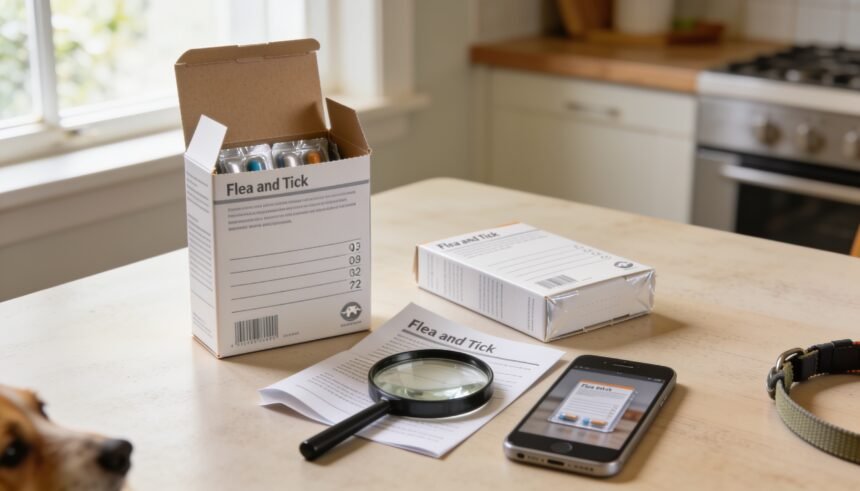
Reading a flea tick product label is an information check before use. The result should be a clear record of what the pack says, not a decision about which treatment your pet needs. Keep the carton, inner packaging and supplied leaflet together while you work.
1. Match the full product name and variant
Start with the animal named on the pack. Then record the full product name, format, stated weight band or life stage, and pack size where shown. Write these details together so that a question about the label refers to one identifiable item.
Do not identify a pack by its colour or brand name alone. If you have two similar cartons, place them separately and finish checking one before moving to the other. A remembered instruction from the previous purchase is not a substitute for reading the pack in front of you.
For an online purchase, compare the selected variant with the photographs. Request readable images of the remaining panels if only the front is shown. If a photograph and the selected item disagree, record that mismatch rather than borrowing instructions from the pictured version.
Food labels are a separate task. Our guide to reading a pet food ingredient list order covers that information without mixing it into this checklist.
2. Find the complete flea and tick claim
Locate the detailed statement of what the product claims to control. Read the surrounding wording and any qualification, even when the front has a prominent flea or tick heading.
APVMA’s specific labelling requirements say tick-control claims must identify the tick species. They also allow scientific parasite names to appear in the complete claim on another panel rather than in the main-panel summary. That makes the full claim worth finding before you write a coverage note.
Copy each named parasite separately. Preserve wording such as control, prevention or aids in control as it appears; do not rewrite different phrases into the same promise. If a parasite you are looking for is not named, mark it as not found on the label you have checked. Do not add it to the list because the pack uses a broad description.
This is particularly useful when a pack mentions several parasites. Give each its own line, including any limitation alongside it, instead of writing a single note that says everything covered.
3. Keep durations attached to their claims
If the label states a duration, copy it beside the particular claim it qualifies. Check whether another parasite has a separate duration or qualification elsewhere. Do not move a prominent timeframe from one sentence to every other claim on the pack.
Keep the duration wording separate from the administration instructions in your notes. A coverage statement and a direction about when to administer a product answer different questions. If you cannot tell which claim a timeframe belongs to, photograph the whole panel and ask for clarification.
Use a simple record rather than trying to condense the label into a calendar immediately:
| Label field | What to copy |
|---|---|
| Named parasite | Complete name used in the claim |
| Claim wording | The stated action and any qualification |
| Duration, if stated | The timeframe and the claim it belongs to |
| Related instruction | Its location on the pack or leaflet |
| Unresolved detail | The exact wording you need explained |
Leave an unstated field blank with a note saying not found. A blank is more useful than an assumed answer when you take the record to someone else.
4. Read restrictions before extracting instructions
APVMA’s veterinary label guidance groups directions under headings including restraints, contraindications, precautions, side effects, dosage and administration, and general directions where relevant. Look through the whole directions section rather than stopping at the most prominent instruction.
Record any animal, age, weight or other restriction exactly as printed. Do not turn that transcription into a judgement about whether your pet qualifies. If a restriction needs interpretation for your animal, take the complete label to your vet.
Find the supplied leaflet and any panel the carton tells you to consult. Read the labelled method and any conditions together, without substituting instructions from another format or product. This article does not provide an application method or calculate a dose.
For broader help separating quantities, ingredient information and claims, use how to read a pet health product label. Keep active-ingredient details in your record if needed for an enquiry, but do not treat a matching ingredient name as permission to transfer another product’s instructions.
5. Check identifying details and resolve missing information
Find any batch code, printed expiry date, storage wording and supplier contact details. Copy the description beside each date so that your notes preserve what it means. If printing is unreadable, retain the pack and photograph the affected area.
For Australian product information, APVMA’s PubCRIS database provides registration details and, in most cases, a copy of the product label. Search using the full product identity and compare the result with your pack. A similar name is not enough to resolve a missing leaflet or conflicting instruction.
If information differs between the carton, inner pack, retailer page or database label, keep the versions together and ask the supplier to explain the difference. Do not choose whichever wording is easiest to follow. Questions about what those instructions mean for your pet belong with your vet.
Once the information is clear, organising pet health product storage can help you keep the pack and leaflet findable for the next check.
6. Finish with a usable handover note
Photograph the front, full claims, directions and identifying details. Open each photograph and check that the small print can actually be read. Save them with the full product name rather than a vague file name such as pet treatment.
If another adult handles pet supplies, show them where the original instructions are kept. A short household note can point to the pack and record unanswered questions, but it should not replace the directions with an abbreviated version.
Choose one concrete question if anything remains unclear: which claim does this duration qualify, does this label match the selected variant, or where is the missing leaflet? Have the pack details ready when contacting the supplier, and leave use unresolved until the relevant question has been answered.
The one-page family week
One printable page that holds the whole week: meals, school, activities and who is doing the pickup. Free, and we send one useful email a week.
One email a week. No spam, unsubscribe in a click.