What is in this guide
Keep pet health and wellness products in their labelled packs, follow each product’s storage instructions and choose a secure place children and pets cannot access. A useful home setup also keeps human medicines separate and makes it easy to find the right pack, its dates and its leaflet.
Storing pet health products safely at home starts with the products you actually have. A supplement tub, grooming liquid and prescribed medicine need their own label check; a shared shelf does not mean shared storage requirements.
1. Give each pack a storage note
Work through one product at a time while children and animals are elsewhere. Read the storage wording on the container, carton and any supplied leaflet. For help locating the relevant panels, use how to read a pet health product label.
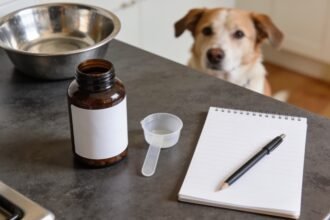
Make a short inventory with these fields:
- Full product name and variant.
- The pet it belongs to, where applicable.
- Storage instructions copied as written.
- Printed date and the wording beside it.
- Opening date and any stated instructions after opening.
- Where the pack and its leaflet will live.
This is an organisation record, not a replacement label. Leave blank fields marked as unclear rather than filling them from memory or a similar product. If the carton and container disagree, keep both and ask the supplier or dispensing veterinary practice to clarify.
2. Choose the location after reading the instructions
Follow the individual pack’s requirements rather than applying one temperature or refrigeration rule to everything. If refrigeration is specified, plan a separate secure location that follows those instructions. Do not assume every product belongs in the same cupboard because it is sold for pets.
For medicines, the US Food and Drug Administration advises secure storage away from children and pets. It also cautions that a high shelf may be accessible to climbing animals and that child-resistant containers are not necessarily pet-resistant. Nationwide Children’s Hospital recommends a locked cabinet for pet medicines.
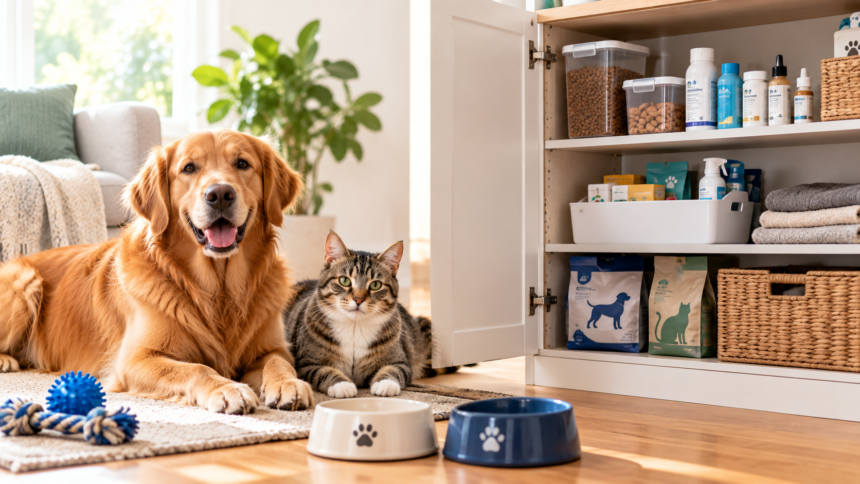
In a small home, measure the available storage space before buying an organiser. Check that cartons fit upright where required by their instructions and that the door closes properly. An attractive basket is useful for grouping packs, but it does not provide a lock or make an accessible shelf secure.
3. Organise whole packs, not loose contents
The FDA recommends keeping pet medicines in their original containers with labels intact, and storing them separately from human medicines. Keep the pet’s name and directions readable.
For the wider wellness collection, use the same packaging-first approach as an organisational habit: arrange existing tubs, bottles and cartons inside an outer tray instead of transferring their contents into matching jars. Keep a leaflet beside its matching pack, perhaps in a small sleeve attached to the tray. Position any homemade tray label so it does not cover the manufacturer’s information.
Where several pets have their own products, assign each animal a distinct section. A name on the section is more explicit than remembering that one pet’s items go on the left. Keep spare unopened packs behind the matching current pack, with their date panels accessible for checking.
Keep this inventory available when considering another purchase. The questions to ask before buying a pet health or wellness product help with that separate decision; an empty space in the cupboard is not a reason to add another product.
4. Keep printed dates and opening dates distinct
Write the date you open a product on a separate note or an unobstructed part of its packaging. Preserve the printed date, batch details and instructions. If the label gives an after-opening period, copy that instruction beside your opening note so another adult can find both pieces of information.
Do not invent a standard number of weeks for all liquids, chews or powders. If the label does not answer the question, record it for the supplier or dispensing practice. A calendar reminder can prompt a check; it cannot establish whether a product remains suitable to use.
Before buying a replacement, compare your inventory with the actual cupboard. Check whether the remaining pack is opened, what its label says and whether a spare is already there. This is also a chance to remove empty cartons from the active section without losing a leaflet that still belongs to a current product.
5. Make the return routine clear to everyone
Choose a simple household rule: retrieve the required pack, follow its instructions, close it as directed and return it to its assigned secure location. Keep reminder notes elsewhere if needed, rather than leaving a product on a bench as the reminder.
For a pet sitter or another adult taking over, show them the actual storage location and the original instructions. Include the location of any separately stored product in the handover. An inventory helps someone find things; it should not become an improvised set of treatment directions.
If a label is unreadable, packaging is damaged or you discover that storage instructions have not been followed, set the item apart securely and ask the supplier or veterinary practice what to do next. Keep its identifying details available. This guide cannot determine whether it remains usable or which disposal method applies.
Start with the pack that currently has no permanent home: read its storage instructions, choose a suitable secure location and tell the other adults where it now belongs.
The one-page family week
One printable page that holds the whole week: meals, school, activities and who is doing the pickup. Free, and we send one useful email a week.
One email a week. No spam, unsubscribe in a click.