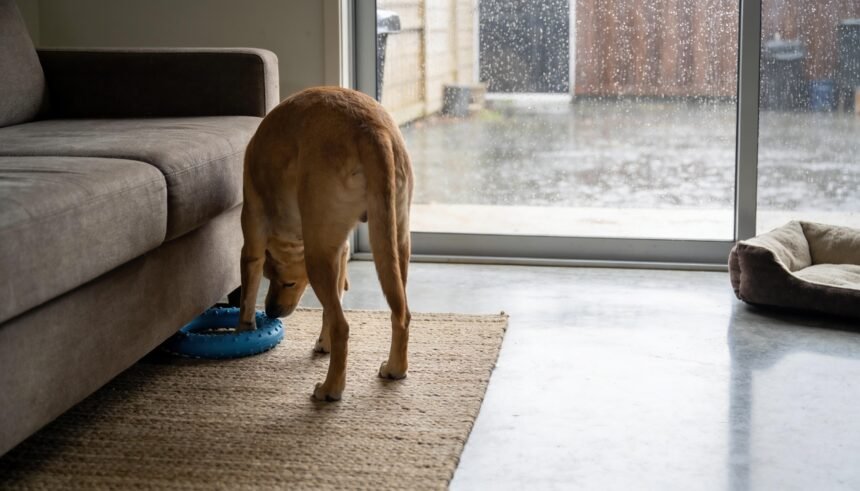
Start with an easy toy search, a short round of familiar training and time to rest. Choose indoor activities for your dog around the space and attention you actually have on a rainy day, rather than trying to fill every hour or turn the lounge room into an exercise circuit.
Pick something that fits the room
Use this as a starting menu, not a checklist to finish. One activity that your dog wants to join is enough for the next break in your day.
| What you have available | Try this | Keep the setup simple |
|---|---|---|
| One clear patch of floor | Practise a familiar cue | Work beside the sofa, away from household traffic |
| A room you can supervise | Find a favourite toy | Start with the toy partly visible |
| No energy for preparation | Offer a choice of familiar toys | Put out two and join the game your dog chooses |
| A busy household | Alternate a dog activity with a separate children’s activity | Give each its own space |
| A dog already resting | Leave the next game for later | Keep their usual resting spot available |
Before starting, clear children’s small toys, shoes and trailing charging cables from your chosen area. Choose a surface where your dog can move comfortably without sliding. Keep games on the floor, with no furniture jumps or stair races.
For a unit with a short hallway, use one room rather than trying to create a running route. A wet day does not require rearranging the whole house.
Hide a favourite toy in plain sight
Dogs Trust includes finding a hidden favourite toy among its enrichment suggestions. Begin with a toy your dog already enjoys: place it on the floor while they watch and invite them to find it.
On another turn, leave part of it visible beside the sofa. Keep it reachable without climbing or squeezing behind furniture. Make the next search easier if your dog looks confused or loses interest; the object is an enjoyable search, not a difficult test.
For your own setup, stick to one toy and one room initially. That gives you a clear end to each round and avoids leaving a collection of hidden objects around the house. Move the hiding spot when you want a variation, rather than adding more equipment.
If your dog would rather play with the found toy than search again, follow that choice. You do not need to reset the game immediately.
Practise something your dog already knows
Choose a familiar cue, such as sitting or coming to you over a short distance. Ask once, then reward the response with something your dog enjoys. The RSPCA recommends reward-based training, short sessions and a quiet space with few distractions.
Keep this separate from trying to teach an ambitious new trick. On a crowded wet afternoon, a familiar task is easier to organise: you already know the cue, the reward and what counts as a successful response. Leave jumping and elaborate obstacle courses off the plan.
The RSPCA also recommends ending with something the dog knows. Finish there rather than repeating until either of you is frustrated. Put any training supplies away before returning to work or cooking, so the session has a definite end.
Give familiar toys another turn
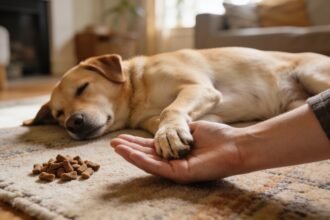
Choose two intact toys your dog already uses and offer them in your cleared play area. Let your dog select one, then join in if they invite play. Keep watching while toys are out, and put damaged ones aside.
This is a useful option when you want interaction without hiding anything or preparing food. Its trade-off is your attention: it is a shared activity, so save it for a break when you can participate.
If making an activity is part of the appeal, cheap enrichment using things already in the house covers homemade options and their separate supervision considerations.
Make space for the rest of the household
Give children’s projects and dog games separate areas. A workable arrangement is a table activity for the children while an adult supervises the dog nearby, rather than mixing craft pieces into the dog’s search area. If you cannot supervise both, alternate them.
For a child’s own project, choose from indoor activities for primary school kids. Keep the dog’s bed out of the play route and let a resting dog stay there. The RSPCA recommends a quiet resting place where a dog can remain undisturbed.
Plan the next break, not the whole day
Try the toy search at your next free moment, familiar training at a later break and a quiet period in between. This order is a planning suggestion, not a prescribed routine or a promise that your dog will sleep afterwards.
Indoor games do not remove the need for toilet access and suitable exercise. Keep those needs in the day’s plan, alongside meals and rest, rather than counting a completed search as a replacement walk.
Before putting the toys away, decide which single activity you could easily repeat later. Start now by clearing one patch of floor and placing a favourite toy where your dog can see it.
How we checked this
Checked on 19 September 2026 against Dogs Trust enrichment guidance and RSPCA guidance on training and home environments. The activity order and household arrangements are editorial suggestions. No hands-on testing, measured activity durations or exercise-equivalence claims are made.
The one-page family week
One printable page that holds the whole week: meals, school, activities and who is doing the pickup. Free, and we send one useful email a week.
One email a week. No spam, unsubscribe in a click.