What is in this guide
To read a school booklist without overbuying, check the correct year and subjects, match every specification, then subtract suitable supplies you already have. Keep unclear quantities or substitutions on an ask list before ordering, and buy the confirmed shortfall rather than adding a spare set of everything.
1. Find the list that applies to your child
Check the school name, school year and year level before reading individual items. If you are preparing for 2027 with a 2026 list, use it to sort existing supplies, then wait for the new instructions before buying exact books or specialist equipment.
Read the introductory notes and footnotes as well as the order table. Look for instructions about what the school provides, what to retain from last year, ordering dates and what to bring on the first day. Mark any supplied item so it does not also enter your separate shopping basket.
For secondary school, keep the confirmed subject selection beside the list. Babinda State School’s 2026 Year 7 and Year 8 requirements, for example, have separate general, core and compulsory elective sections. Ask which sections apply if your child’s enrolment details are unclear. For a broader cross-check, use stationery for high school subjects.
2. Read quantities together with their units
Keep the quantity column attached to the full item description. A line requesting one box is different from a line requesting one pencil. Babinda’s Prep list gives one box of 12 lead pencils, illustrating why the unit matters.
If a retailer’s order page offers a multipack, compare its contents with the school’s wording before changing the quantity. Do not enter the requested number of individual items as the number of packs. Equally, do not assume one packet satisfies a request for several packets.
Use this reading check beside each line:
| What to read | What to record before shopping |
|---|---|
| Quantity and unit | Number of individual items, boxes, packets or sets requested |
| Full description | Size, ruling, page count, colour, grade or model where specified |
| Applicability | Year level, subject and any condition attached to the item |
| Existing stock | Suitable quantity available for this child |
| Unclear wording | The exact question to send to the school |
When a unit is missing, ask rather than interpreting the larger quantity as a precaution. Keep the answer with the list so another adult placing the order uses the same meaning.
3. Match the book, not just the cover
Copy the whole exercise-book description. Compare dimensions, ruling, page count and any subject designation with the item you intend to buy. Babinda’s Year 1 instructions specify ruled books that are not A4, while its Year 2 list requests A4 lined books. An apparently similar book can fail the requested format.
Keep separate lines separate until you understand their purpose. If English and science each request an exercise book, do not merge them into one book simply because the descriptions match. If a general section and a subject section both list the same tool, ask whether one personal item can serve both or whether separate supplies are intended.
For a set text, copy the title, author, edition and ISBN where supplied. Ask about an older or secondhand copy before purchasing it if the identifying details differ. For a workbook with completed pages, ask whether it is acceptable before counting it as reusable stock.
If a named product is unavailable, send its full description and your proposed substitute to the school. A brand name alone does not tell you whether an alternative is approved.
4. Subtract only supplies that are ready to use
Gather stationery from the school bag, homework area and storage drawer in one place. Check it against the current list rather than deciding that everything used last year needs replacing.
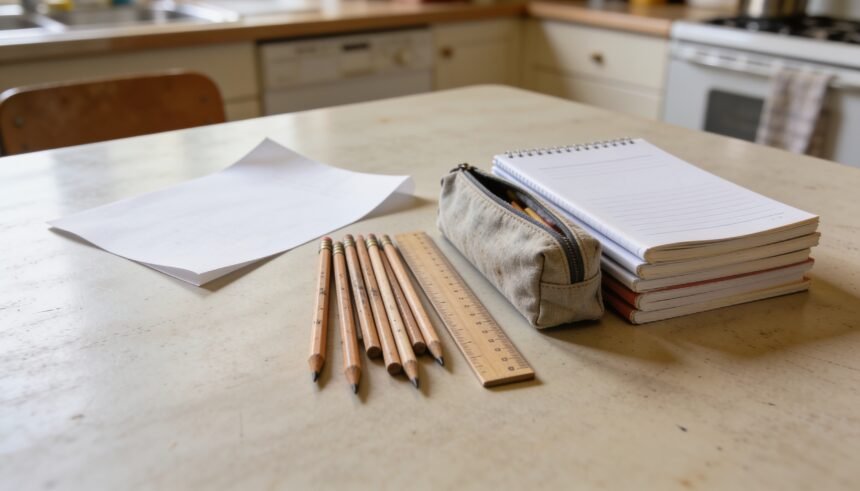
Count a ruler if its markings are clear and it meets the requested length. Check that the pencil-case zip closes, the sharpener works, glue is usable and markers write. For books, check the format and whether the school accepts the remaining unused pages. Put uncertain items in the ask group rather than counting them as available.
Here is an illustrative calculation, not a recommended school quantity: if the list requests four matching exercise books and you have two unused books with the correct specifications, the purchase shortfall is two. A four-book retail pack would leave two surplus books. Decide whether those extras have a confirmed use before choosing the pack.
Allocate shared household stock to each child once. Two children cannot each count the same available ruler as their own school supply. Put accepted items into separate piles or bags as you tick them off. For primary equipment checks, refer to what stationery a primary school child actually uses.
5. Resolve the ask list before adding extras
Send a short, specific question rather than asking whether the whole list is necessary. For example: “Does the ruler in the general section also cover maths?” or “May we reuse this book with the same ruling and unused pages?”
Check whether quantities are required at the start of the year and where spare supplies belong. Do not reduce a confirmed classroom requirement because it looks large. Avoid adding another full set beyond that requirement without a reason. Babinda’s list explicitly asks families to purchase only listed equipment; follow your own school’s instructions.
Check labelling before writing names on individual items. Babinda’s Prep list distinguishes supplies to label from those to leave unlabelled. Use that as a reminder to read the notes, not as a rule for another school.
If your question concerns the supplied pack and purchasing arrangement, see book packs and school stationery lists explained. Keep that decision separate from calculating what is missing at home.
6. Reconcile the order with the marked list
Before paying, compare every basket line with the school requirement and your allocated stock. Check that a pack has not been added twice, quantities use the right units, and an optional accessory has not slipped in beside a required item.
If buying from several shops, keep one shared list. Record an item as ordered immediately, including supplies being bought by another parent or carer. When the order arrives, check the actual contents and specifications before labelling or covering books.
Keep the marked list for later requests. Use restocking stationery without repeating the whole shop when something genuinely needs replacing during term. Start now by giving every line one decision: reuse, buy or ask, with a purchase quantity beside each confirmed buy.
How we checked this
Checked on 6 October 2026 against Babinda State School’s published 2026 booklist. The source supports the school-specific examples only. The reading and stock-check method is editorial guidance, with no measured savings or product testing. Your child’s current school instructions take priority.
The one-page family week
One printable page that holds the whole week: meals, school, activities and who is doing the pickup. Free, and we send one useful email a week.
One email a week. No spam, unsubscribe in a click.