What is in this guide
Label the items worth chasing, in a spot that survives handling, using the name your school asks for. Then give your child a two minute check before leaving each class. Labelling school stationery gives a finder an owner to return it to; it does not make a pen impossible to lose.
Sort the pencil case by surface and value
Tip the pencil case out and sort it into three piles before you label anything. The first pile is the calculator and anything else with a smooth, flat plastic surface and a price that hurts to replace. The second is rulers, glue sticks, sharpeners and pens with a barrel wide enough to take a small label. The third is pencils, erasers and short pen refills that will be used up or thrown out within a term.
Label the first pile carefully, the second pile quickly and the third pile only if your school requires it. Time spent labelling a pencil that will be sharpened away is time not spent on the calculator.
If the same item keeps vanishing regardless of labels, the problem is usually storage or a hand-over point rather than identification. The guide to stationery that keeps disappearing works through that separately.
Use the name the school can actually use
Check the school handbook or stationery list before writing a batch of labels. St Columba Anglican School, for example, asks for a child’s full name rather than initials on equipment. Your own school’s wording is the one to follow.
Keep the class or year level on a separate small label, or leave it off. A calculator labelled with a full name is still returnable next year; one labelled with last year’s class is not obviously current.
Start with the calculator
A calculator is the one item here worth ten minutes of care. High school lists usually specify a model, so a lost one is replaced with the same model at full price. The high school stationery list explains the specified-calculator convention.
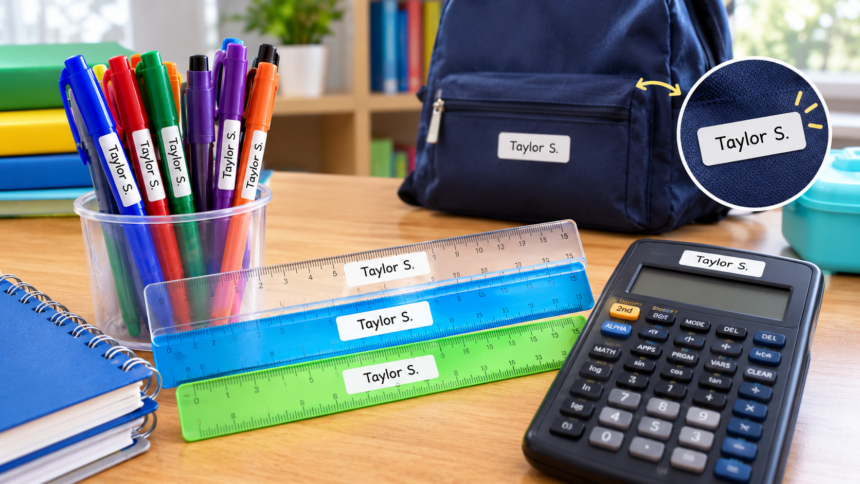
Place the label on the back, on a flat area clear of the battery cover, screws and any rubber feet. Do not cover the model number or the solar panel on the front. If the calculator has a slide-on cover, label the cover and the body separately, because they part company in a bag within weeks.
Follow the label maker’s application instructions. Stuck On You, as one example, specifies a clean, dry, smooth, flat surface, firm pressure to remove air bubbles, and no washing for at least 48 hours after application. That timing is that maker’s instruction, not a universal rule. A calculator is rarely washed, so the practical point is a clean surface and firm pressure at the edges.
Label rulers, glue sticks and pens without covering what they do
A ruler takes a label on the reverse side, away from the measuring edge and the markings. On a clear ruler, put the label near one end so it does not sit under the numbers when the ruler is flipped.
A glue stick takes a label on the barrel, not the cap. Caps are swapped and lost constantly, and a label across the cap join stops it closing properly. Sharpeners with a smooth flat side take a label; small barrel sharpeners usually do not, and a marker initial is the fallback.
Pens are the awkward pile. A fine-tipped permanent marker on the barrel is faster than a label and does not interfere with the grip. Only label pens your child will keep for a term, such as a fountain pen or a favourite fineliner set, and label the case they live in rather than each pen.
For primary students, check the school’s list first. Some schools supply and pool classroom stationery, in which case labelling every pencil is wasted effort. The primary school stationery list covers how those arrangements differ.
Choose a label that suits the surface
Small stick-on labels suit smooth plastic and are the sensible choice for a calculator, ruler and glue stick barrel. Marker suits pencils, cheap pens and anything with a textured or curved surface too narrow for a sticker. Iron-on and clothing labels belong on uniforms, not stationery. The name label guide compares label types and how each one fails.
Whatever you use, write clearly enough that a teacher who does not know your child can read it at arm’s length.
Build the two minute end of class check
Labels get gear back from lost property. A check stops it going there. Give your child a fixed count they can say aloud: calculator, ruler, pens, glue, case zipped. Practise it at home with the actual pencil case and bag so every item has one place.
Keep spare labels and a marker with the stationery at home, so a replacement item is labelled the evening it arrives rather than after it is lost.
If something does stay at school, ask where stationery is collected and when families can check it. Schools differ on how long lost property is held, so a labelled calculator is only as recoverable as your timing. Start tonight with the calculator, then work through the pencil case one pile at a time.
The one-page family week
One printable page that holds the whole week: meals, school, activities and who is doing the pickup. Free, and we send one useful email a week.
One email a week. No spam, unsubscribe in a click.