What is in this guide
A useful primary school stationery list starts with pencils, colouring supplies, glue, scissors and the books specified by the teacher. Buy only what your child’s school asks families to provide: some schools supply classroom stationery, and the exact pencil type, book format and labelling instructions can differ.
Check what the school supplies first
Before filling a basket, find the list for your child’s school, year level and coming school year. Check whether it asks you to provide stationery at all. Oakbank School’s 2026 guidance, for example, says it supplies stationery to classrooms from Reception to Year 6.
If you are preparing for 2027 and only a 2026 list is available, use it to sort what you already own. Wait for the new list before buying items with exact specifications.
Tick off the items that have a classroom job
Use this as a cross-check beside the school list, not an additional shopping order. The item groups below appear in the verified primary lists from Babinda State School and Bunbury Cathedral Grammar School. Copy quantities from your own list.
| Tick if requested | What it is for | Check before buying |
|---|---|---|
| [ ] Lead pencils | Writing and drawing | Grade, shape and pack quantity |
| [ ] Eraser and sharpener | Correcting pencil work and keeping a usable point | Sharpener size and any container requirement |
| [ ] Coloured pencils, crayons or textas | Colouring and adding detail | Which types are requested; do not automatically buy all three |
| [ ] Glue sticks | Sticking paper into books and making paper projects | Stick size and quantity |
| [ ] Scissors | Cutting paper | Requested size and left- or right-handed option |
| [ ] Ruler | Measuring and drawing straight lines | Length and material |
| [ ] Exercise books and scrapbooks | Written work, drawing and pasted work | Size, ruling, page count and quantity |
| [ ] Whiteboard markers and eraser | Writing on and clearing a whiteboard | Marker type and colour; keep permanent markers separate |
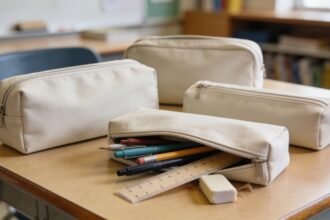
| [ ] Pencil case and folders | Holding tools and organising papers | Size, number and folder format |
Match the specification before choosing the colour
Pencil grade is worth checking. Bunbury Cathedral Grammar’s 2026 Year 1 list asks for 2B triangular pencils. It also specifies exercise books with 18 mm dotted thirds. These are that school’s requirements, not a rule for every Year 1 child.
Photograph or copy the full book description before shopping. Do not reduce it to “two writing books”. Compare the label on the book with every part of the description, including the ruling and dimensions. If a matching book is unavailable, ask the teacher about an alternative before substituting.
For scissors, check the handedness option as well as the size. For a pencil case, lay out the requested tools and check they fit before choosing one. Leave room to close it without forcing the zip.
Ask before adding extras or labelling everything
Pens, highlighters and specialist art materials belong on the shopping list when the school requests them. Avoid treating a larger stationery bundle as the default. Babinda’s 2026 guidance specifically asks families to stick to listed equipment and says novelty items will be sent home.
Check labelling instructions before writing names on every pencil. Babinda’s Prep list separates items to label from items to leave unlabelled. Ask your teacher which supplies stay with your child and which go into classroom storage.
For questions about purchasing arrangements, use book packs and school stationery lists explained. Keep secondary-school purchases separate; stationery for high school subjects covers that next stage.
Turn the school list into a smaller shopping list
- [ ] Reuse: Gather existing supplies and match them to the requested specifications.
- [ ] Check condition: Try the sharpener, check marker ink, open glue sticks and inspect pencil-case zips.
- [ ] Buy: Record only the missing or unusable items, with the exact quantity beside each.
- [ ] Ask: Circle unclear descriptions, proposed substitutes and items the school may supply.
- [ ] Pack: Follow the teacher’s instructions about what to bring initially and where spare supplies belong.
Keep that marked-up list for the next check rather than placing a second complete order. Your next step is to give every line one of three labels: reuse, buy or ask.
How we checked this
Checked on 19 September 2026 against three school-issued 2026 sources. These show supply arrangements and requested equipment, not measured classroom use or product performance. Your child’s current school list takes priority.
The one-page family week
One printable page that holds the whole week: meals, school, activities and who is doing the pickup. Free, and we send one useful email a week.
One email a week. No spam, unsubscribe in a click.