What is in this guide
Set up a sibling stationery swap box with usable spares that each child willingly offers, keeping required school supplies and treasured items out. Use one small container for permanent handovers, agree how children choose from it, and keep loans separate so nobody mistakes borrowed stationery for something they now own.
1. Choose a box that fits the supplies you already have
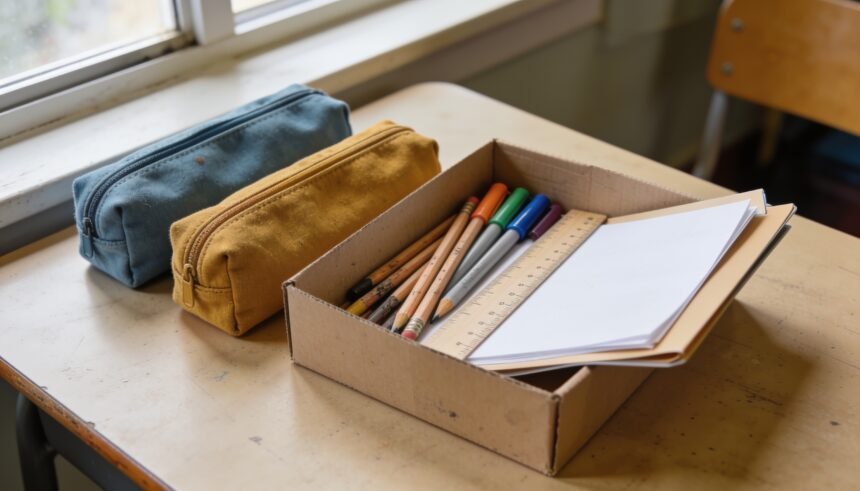
Start with an empty shoebox, shallow tub or spare drawer organiser. Lay the longest item beside it before deciding where the box will live. A ruler that sticks out or a lid that presses against pens is a reason to choose another container, not to buy an elaborate storage system.
A shallow open tray suits a homework shelf where everyone can see the contents. A lidded box suits a cupboard that needs to hold other things above it, but adds a step whenever someone wants a pencil. Choose according to the available space and how the children will use it.
Put the box near the homework supplies, rather than inside one child’s bedroom. In a small home, one section of an existing drawer is enough. Keep the arrangement compact: if it needs several layers of sorting before anyone can find a pen, reduce what goes in.
2. Protect each child’s school kit first
Ask each child to bring only the stationery they might want to offer. Do not tip every pencil case into a communal pile and work backwards from there. Keep the school bag and everyday homework kit intact while sorting the extras.
Check each child’s current school list before treating something as surplus. A spare exercise book may already be allocated to a subject or requested for later in the year. Use the guide to reading a school booklist without overbuying when you need to match existing stock to those instructions.
Make a small keep pile for required supplies, favourites and items the child is unsure about. Uncertainty is enough reason to leave something out. A gift, a matching pen set or a ruler bought for a particular class does not become available simply because another sibling wants it.
For household supplies bought as shared stock, say that clearly. They can go into the box as family spares without pretending that one child donated them.
3. Check that every offered item is usable
Give the box a simple entry rule: someone else should be able to use the item as it is. Try pens and markers on scrap paper, check that lids fit, and look at rulers for readable markings and intact edges. Check whether an offered glue stick still works before including it.
Short pencils can go in if the receiving child finds them comfortable to use. Keep loose, unused paper together in a folder or envelope. An unfinished exercise book needs a separate decision: leave personal writing with its owner and offer only unused pages or a book the owner has deliberately cleared for sharing.
Do not put dried pens, empty glue sticks or items awaiting repair in the swap box. Place anything needing attention elsewhere and decide whether it is worth keeping. The box should not require its next user to finish a sorting job.
Keep specialist equipment outside the everyday swap pile. If an older sibling offers a calculator or a subject tool, check the receiving child’s requirements and arrange that transfer directly.
4. Agree what putting something in the box means
For the simplest arrangement, entering the box means an item is offered as a permanent handover. Once another child chooses it, it belongs to that child. Explain this before the first item goes in, and let the offering child reconsider until someone takes it.
Keep borrowing outside that rule. A child lending a favourite pen for tonight’s homework should hand it over directly, with an agreed return point. A loan left among giveaway items asks everyone to remember an exception they cannot see.
You do not need equal contributions. One child may have changed subjects while another has nothing spare. Do not make giving away a possession the price of taking a useful family spare.
If the children specifically want to trade two personal items, agree that exchange together and keep it separate from the box. Both children should understand what is changing hands and be willing to do it. Avoid assigning pretend prices or turning ordinary supplies into a points system unless the family actually wants that extra administration.
5. Make the first handover together
At the first setup, let each child show what they are offering and ask whether anyone has a use for it. For example, one sibling might offer an unused ruler while another offers spare coloured pencils. Those are possible arrangements, not quantities every family needs.
If two children want the same item, pause the handover. Ask whether someone needs it for a specific task, whether a shared homework tool would work, or whether the giver wants to keep it. An item can stay out of circulation while you decide.
For later visits to the box, agree that children take what they need for a named use rather than emptying it into their own stash. If that rule becomes difficult to manage, return to choosing items together at a regular check-in.
When something becomes one child’s school supply, update its identification using the labelling guide for pens, rulers and calculators. Do not leave two conflicting names on a handed-down item. A tool staying in the household homework area can remain shared.
6. Keep a small reset routine
Check the box when you already check pencil cases or prepare for a new term. Remove items that no longer work, straighten loose paper and ask whether any newly offered supplies still have a purpose. Keep the lid able to close without forcing it.
Before buying replacements, look through the box against the actual missing-item list. The guide to restocking stationery mid-year covers that wider stock check. A box full of coloured markers does not replace a required writing pen, so match the item rather than counting the contents.
If school supplies keep ending up in the box by mistake, move the box away from the school-kit storage and repeat the entry rule. If supplies disappear after a handover, use a routine for keeping track of missing stationery rather than adding more spare stock immediately.
For siblings living across two households, agree whether an offered item may travel before it changes hands. Keep anything expected back at a particular home out of the permanent handover box.
Begin with one container and a few usable offers. Ask each child what they are happy to pass on, then leave everything else in its current home.
How we checked this
Reviewed on 11 October 2026 against the Dovelyne writing contract and published article inventory. This is an editorial organisation method, with no measured savings, product testing or claimed effect on sibling behaviour.
The one-page family week
One printable page that holds the whole week: meals, school, activities and who is doing the pickup. Free, and we send one useful email a week.
One email a week. No spam, unsubscribe in a click.