What is in this guide
When kids lose stationery, first check whether it is actually missing, stored at school or used up before sending another full set. For personal supplies, try a small kit matched to the teacher’s requirements, labels where requested, and a return-to-case check at the end of each task.
Check where the item should be before deciding it is lost
Start with the classroom arrangement. Ask which items belong to your child, which stay in a desk or tray, and whether any supplies are shared. A pencil absent from the bag is not enough information to decide what needs replacing.
Check the labelling instructions too. Babinda State School’s Prep 2026 list tells families to leave some stationery unlabelled, including pencils, erasers and glue sticks. Its Year 1 list asks for everything labelled. Follow your child’s instructions rather than naming every item automatically.
If the original requirements are unclear, use what stationery a primary school child actually uses as a cross-check beside the school list. For older children, check stationery for high school subjects before removing anything needed for a particular lesson.
Match the missing-item pattern to a quick check
Treat these as possibilities to investigate, not explanations already established.
| What you notice | What to check first | What to try next |
|---|---|---|
| The whole pencil case is absent | Last classroom, desk tray, locker and homework spot | Agree where the case goes immediately after use |
| One tool repeatedly disappears | Last task, whether it was lent, and nearby storage | Give that tool one return place and check it before moving on |
| Supplies vanish after homework | Table, floor, bag pockets and household stationery drawer | Pack school tools back before clearing the table |
| Glue or pencils need frequent replacement | Whether they are missing or actually finished | Record used-up supplies separately from lost ones |
| Unfamiliar stationery comes home | Whether it was borrowed or mixed up | Arrange its return through the child or teacher |
Search the bag’s smaller pockets with your child. Ask them to check their own desk or locker and the school’s lost-property process where appropriate. Avoid turning a missing pencil into a claim about another child.
Try the fixes in this order
1. Make a record of the working kit
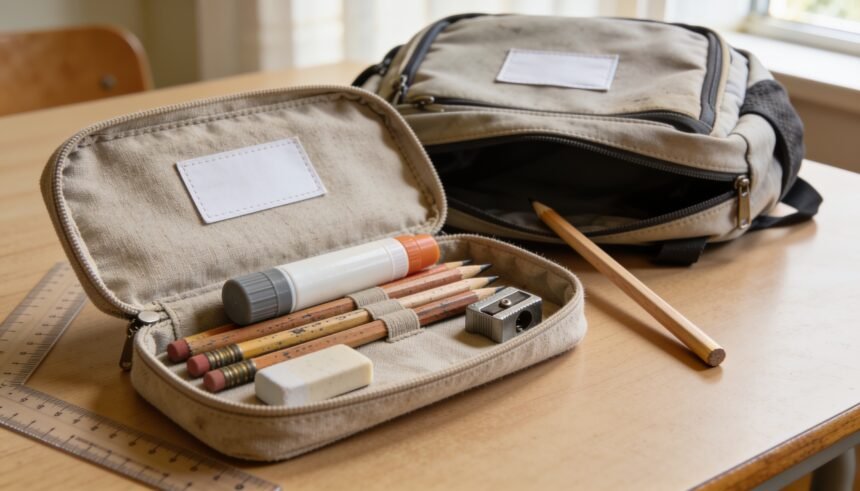
Lay out the personal supplies that should travel in the case. Take a quick photo or write a short contents list. Keep it simple enough to compare with the case when something is missing; there is no need to catalogue every coloured pencil individually.
Ask the teacher where spare stock belongs. Keep reserves at home only if the school does not ask for them in the classroom. A smaller travelling kit is a suggested starting point, not a reason to underpack required equipment.
2. Give each item a clear return place
Use the existing case if it closes properly and holds the required tools. Choose a consistent section for loose items, or follow the school’s case arrangement. Babinda’s Year 1 list, for example, specifies separate small cases for colours and other stationery; that is one school’s arrangement, not a universal requirement.
Where personal labels are requested, check that the name is still readable on the item itself. A named case does not identify a loose ruler found elsewhere.
3. Practise one pack-away sequence
Try: tools into case, zip closed, case into its agreed bag pocket. Practise after homework first. For classroom use, ask whether the same check fits the teacher’s pack-up routine.
If an item is lent, suggest asking for it back before leaving the work area. Avoid making your child responsible for tracking the whole class’s supplies.
4. Review one school week
As a manageable trial, note the item, where it was last used and whether it returned. Choose a check time that fits your household. This week is a review window, not a promised time to establish a habit.
Keep essential learning supplies available while looking for missing items. If replacements are needed, use the short-list approach in restocking stationery without repeating the whole shop.
Ask the teacher when the same item keeps disappearing
Share the specific pattern: which item, when it was last packed and what has already been checked. Ask about classroom storage, borrowing arrangements and a suitable pack-up reminder. If your child reports someone deliberately taking supplies, pass that account to the teacher without trying to investigate classmates yourself.
For the next school day, choose just one repeatedly missing item. Confirm where it belongs, record that it was packed, and agree when your child will check for it again.
How we checked this
Checked on 23 September 2026 against Babinda State School’s published 2026 stationery list. School instructions establish the labelling and case examples only. The troubleshooting table and tracking trial are editorial suggestions, not tested loss-prevention results. Your child’s current classroom instructions take priority.
The one-page family week
One printable page that holds the whole week: meals, school, activities and who is doing the pickup. Free, and we send one useful email a week.
One email a week. No spam, unsubscribe in a click.