What is in this guide
Labels do not fail randomly. Each type fails in one predictable way, and almost all of it is a mismatch between the label and the surface.
- Iron-on labels fail on polyester and on anything with a stretch or waterproof coating, and they fail at the corners first
- Stick-on labels fail in a dishwasher, on textured plastic, and on anything that flexes
- Sew-in labels essentially do not fail, and nobody has time
- Marker pen fades and bleeds, and on dark fabric it is invisible from the start
This is an editorial comparison of label types. Nothing here was applied or washed by us.
Which label for which surface
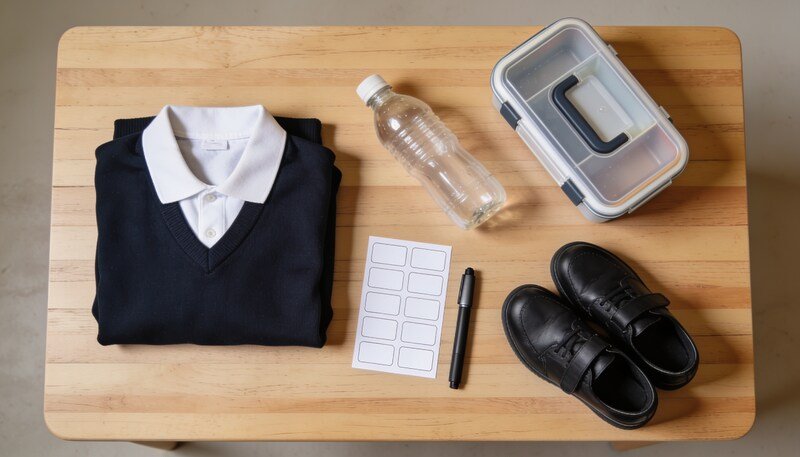
School uniform, cotton or poly-cotton. Iron-on works well. Apply to the care label or the inside back of the collar rather than to the outer fabric, press for the full stated time, and press again after it cools.
Sports and swim gear, polyester, elastane, waterproof or coated. Iron-on is the wrong choice: these fabrics either will not take the adhesive or cannot take the heat. Use a sew-in, or a stick-on designed for fabric, or a tag-style label that loops through an existing seam or care tag.
Jumpers and hats, the two most-lost items. Whatever type you choose, label these twice, in two different places. A jumper is taken off at the first warm moment of the day and left wherever that happened.
Lunchboxes, drink bottles and containers. Stick-on, and specifically one sold as dishwasher-safe. Apply to a flat, clean, dry surface, not across a curve and not across a join. Then wash it on the top rack anyway, because heat and the bottom rack are what lift labels. Leakproof lunchboxes that are genuinely leakproof covers the container itself.
Shoes. Stick-on labels inside the shoe under the tongue, or a shoe-specific label. Nothing on the outside survives a term.
Books, folders and pencil cases. Any sticker works. This is the easy case.
Devices and cases. A label on the case, not on the device, because the device belongs to the school under most bring-your-own-device arrangements and its surface matters at resale.
What to actually write
A first name and a surname initial is the usual advice, and it is enough for lost property to do its job.
Do not put a phone number or an address on anything visible from the outside. Australian child safety and eSafety guidance is consistent on limiting identifying information that a stranger can read from a child’s belongings. If you want contact details on a bag for a genuine loss, put them inside the bag rather than on the outside.
A class or year is useful and dates quickly. Writing the year on a uniform that will be handed down or sold through the secondhand shop shortens its life. Leave it off anything you intend to pass on.
Consider what gets handed down. A younger sibling inheriting a jumper with the wrong name on it is a small annoyance every winter. Label the care tag, which is easy to cover or replace, rather than the garment.
Buying notes
- Buy a pack per child, with a mix of sizes. The small ones are for pens and rulers, the large ones for lunchboxes
- Iron-on and stick-on packs are usually sold separately. You need both
- Check the dishwasher claim specifically for anything going on a container
- Personalised packs take time to arrive. Order in December, not the week before school starts
- Plain labels you write on yourself are cheaper, arrive immediately, and are perfectly adequate. A permanent marker on a plain white iron-on holds up well
- Colour or icon per child is genuinely useful in a house with three children and one dishwasher
Applying them so they last
- Clean and dry the surface first. On plastic, wipe with alcohol or detergent and let it dry fully. Most sticker failures are a residue problem
- Follow the stated iron temperature and time, and use no steam. Under-pressing is the usual iron-on failure
- Press a second time after cooling, which is on most instructions and skipped by most people
- Let stick-on labels cure for the stated time, often 24 hours, before the first wash
- Do the whole session at once. Label everything on one afternoon rather than as each item appears, because the second session never happens
- Keep the leftovers somewhere you will find them in April, because there will be replacements
What about lost property anyway
Labelling improves the odds and does not guarantee anything.
- Check lost property regularly, not at the end of term when it has been cleared
- Ask how your school handles it, because practice varies and some schools clear it weekly
- Label the things worth recovering and accept losses on the rest. A labelled hat comes back; a labelled pencil does not
- The secondhand uniform shop is where lost jumpers often end up, and it is worth a look
Back to school checklist for Australian families covers the wider January job, school uniforms: what a year costs explains why recovering a jumper matters financially, and what back to school actually costs per child puts the whole month in context.
Before you buy
- Work out which surfaces you actually need to label, and buy both iron-on and stick-on
- Check the dishwasher claim for container labels
- Order early enough for personalised packs to arrive
- Use a first name and surname initial, and keep contact details off outside surfaces
- Label the care tag on anything that will be handed down
The one-page family week
One printable page that holds the whole week: meals, school, activities and who is doing the pickup. Free, and we send one useful email a week.
One email a week. No spam, unsubscribe in a click.