What is in this guide
To get rid of pantry moths, find and remove infested dry food, clean the cupboard’s cracks and corners, and protect the remaining food in tightly sealed containers. Catching flying moths is only part of the job: the food source needs attention before you can stop the cycle.
Find what is feeding them
Pantry moths often arrive as eggs or caterpillars in purchased dry goods, although adults can enter through doors and windows. An infestation is not proof of a dirty kitchen.
University of Sydney entomologist Tanya Latty explains that warmer weather speeds their development. Australian late spring and early summer can bring a noticeable increase, but moths can occur year-round.
The caterpillars feed in the food, then move away to form cocoons. That is why the moth on the ceiling may be some distance from the packet responsible.
Check the food before naming the insect
Use these clues to decide where to look:
| What you find | What to check next |
|---|---|
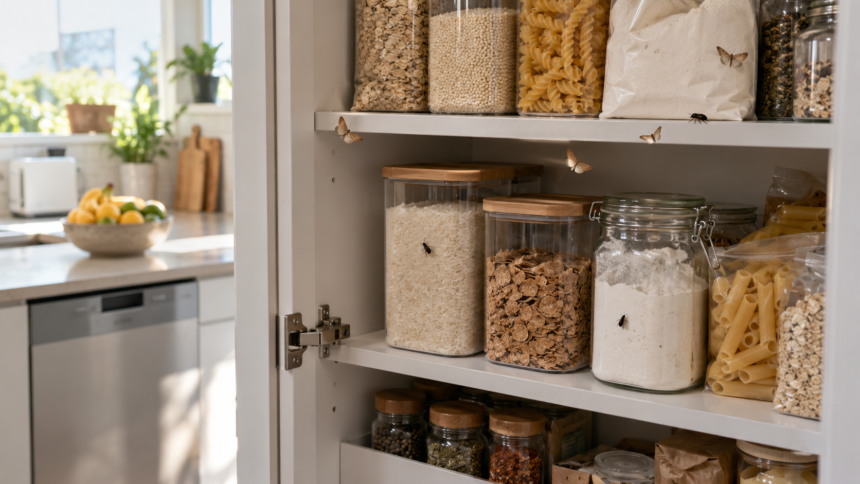
| Fine silk webbing binding grains together | Inspect that packet for caterpillars and check surrounding dry goods. |
| Small moths with grey and bronze-brown wings | Search stored food for supporting signs rather than identifying from colour alone. |
| Small beetles in cereal or flour | Treat this as a stored-food pest search; pantry pests include beetles as well as moths. |
| Moths without any connection to food | Get identification help before assuming the pantry is the source. |
Work through the fixes in order
1. Inspect every dry-food packet. Once insects are flying or crawling outside a packet, search the whole cupboard. Check flour, pasta, cereal, nuts, dried fruit and spices, including unopened packs. University of Maryland Extension specifically warns that unopened containers also need inspection.
Use a clear section of the bench for checked items and keep suspect packets separate. Work shelf by shelf so you do not lose track of what you have examined.
2. Remove infested food. Seal the affected packet in a bag and take it out of the house. Do not transfer its contents into a fresh jar. Inspect the other packets before putting anything back.
3. Vacuum the empty cupboard. Concentrate on corners, cracks and shelf edges, then empty the vacuum or discard its bag after use. Check lid recesses, hinges and nearby wall or ceiling corners for cocoons too.
4. Wash the shelves. After vacuuming, wash with warm soapy water. Keep the storage area dry before restocking. Cleaning is a removal step, not a lasting barrier against another infested packet.
5. Protect the checked food. Use glass, metal or sturdy plastic containers with tight-fitting lids. A folded packet inside a cardboard box is not equivalent to a sealed container. Reuse suitable containers you already have before planning a container purchase.
Use traps as a check, not the whole fix
Indian meal moth pheromone traps attract adult males. They do not remove the infested food, and a moth-specific trap will not catch pantry beetles.
If using one, follow its placement instructions and treat fresh catches as a reason to inspect food again. Do not judge the cupboard clear simply because a trap is empty.
Recheck persistent activity and get help identifying it
University of Minnesota Extension notes that adult Indian meal moths can still appear for up to three weeks after infested food is removed. Continued sightings beyond that point warrant another source search, rather than assuming the first clean failed immediately.
Include dry pet food, birdseed and dried decorative plant material in the search. If repeated inspections reveal nothing, ask a pest professional to identify the insect and help locate its source. A clear photo and notes about where it appears are useful starting points.
Prevent the next cupboard clean-out
Check purchases for damaged packaging, clean up spills and avoid topping new food onto old contents. Empty and clean a container before refilling it. Buy quantities you will use, rather than leaving rarely used ingredients at the back indefinitely.
For a layout that makes those packets easier to find, see pantry organisation that survives a family.
Start now: inspect the packet with the clearest signs, then work through the remaining dry goods before restocking.
How we checked this
Checked on 21 September 2026 against an Australian entomologist’s explanation and university extension guidance. This is an editorial synthesis, with no hands-on testing or product ranking.
The one-page family week
One printable page that holds the whole week: meals, school, activities and who is doing the pickup. Free, and we send one useful email a week.
One email a week. No spam, unsubscribe in a click.