What is in this guide
Keep an older cat interested with brief, gentle games, easy food puzzles and comfortable places to watch what is happening. Adapt the activity to what the cat chooses to do, including watching or batting a toy from a resting position, rather than trying to recreate the energetic play of its younger years.
Start when the cat is ready
Choose a time when your cat is already awake and showing interest in the room. The American Animal Hospital Association recommends fitting play to the individual cat’s age, personality and activity level. For a quieter senior, that means offering an invitation and seeing what happens before adding speed or distance.
You could sit nearby with a familiar toy while the kettle boils or before settling down in the evening. There is no need to wake the cat or make every invitation into a session. If it turns away, leave it there and try another time.
For the broader household setup, keeping a cat happy indoors covers enrichment beyond the play session. Here, the useful question is smaller: what can this cat comfortably enjoy today?
Bring the game down to floor level
Cats Protection recommends gentler, shorter play for elderly cats and notes that watching or swiping at a slowly moving fishing-rod toy still provides stimulation. Start with the toy close enough to notice, moving slowly along the floor rather than dangling high overhead.
Try a short movement, then pause. Give the cat time to look, reach or follow. A game can happen beside a resting mat without requiring a leap onto furniture or a sprint down the hallway. Let the cat catch the toy instead of keeping it permanently out of reach.
Keep hands and feet out of the game. Use the toy as the object to chase and catch. Put wand toys and anything with string away afterwards, and check for loose parts or damage before using them again.
Cats Protection says games of one or two minutes can be enough. Treat that as permission to keep things brief, not a minimum to complete. PDSA also advises stopping when enthusiasm fades and allowing rest between sessions.
Offer variety without emptying the toy cupboard
PDSA recommends finding out which toys a cat prefers, keeping only one or two available and swapping them every few days. Start with what you already have. A toy that rolls, one that can be held and a supervised teaser offer different ways to participate.
Change one part of the invitation at a time. If the cat ignores a rolling toy, try a slower movement with a teaser at the next opportunity. If it enjoys batting while lying down, keep that option available rather than making standing up the next requirement.
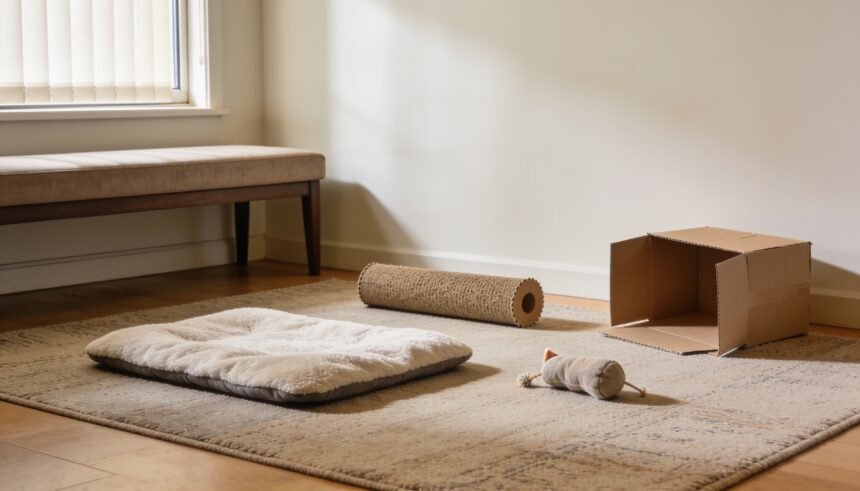
A cardboard box on its side is another simple option. The open side provides an entrance without climbing over a high rim. It can be a place to investigate or sit, with a toy moved nearby during supervised play.
Make food activities easy to understand
RSPCA NSW includes food puzzles and small food searches among its enrichment suggestions. For an older cat, begin with an obvious, accessible task rather than a complicated dispenser. Use a little of the cat’s usual food, keeping its existing feeding plan intact.
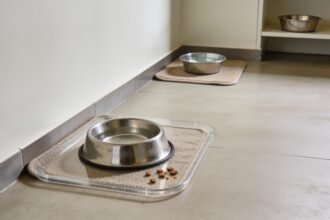
For example, place a few pieces openly in a shallow food puzzle beside the normal feeding area. Let the cat investigate while you stay nearby. The first question is whether it can comfortably reach and retrieve the food, not how long the puzzle takes.
If the mechanism is ignored or the food remains inaccessible, return it to the usual bowl. There is no need to withhold the rest of a meal to persuade the cat to solve something. If the cat has a prescribed diet or feeding restrictions, keep those in place and ask its vet before changing how food is offered.
Make favourite activities reachable
Cats Protection recommends steps or ramps to favourite spots, rugs on slippery surfaces and horizontal scratching mats for older cats. Look at the route to an activity as well as the activity itself. A good viewing spot is of little use if reaching it requires a jump the cat no longer chooses to make.
Start with a lower, stable viewing place or an appropriate secure step to an existing favourite. Check the return route too. Avoid balancing loose objects into a staircase. For placement details, window perches and quiet enrichment covers the viewing area; the older cat’s access needs should decide whether that position is suitable.
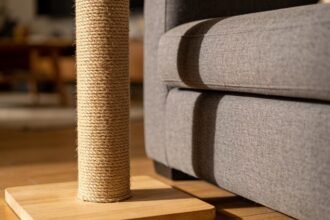
A flat scratching surface provides another option close to the floor. Leave the familiar post available if it is still used. Redirecting cat scratching explains how to offer an acceptable surface where the cat already wants to scratch.
Leave room for quieter interest
RSPCA NSW describes sensory enrichment as things to see, smell, hear and touch, alongside play and food activities. Watching from a comfortable spot and investigating a box can therefore sit alongside a gentle game in the day’s choices. Every activity need not involve chasing.
The organisation also recommends letting cats initiate interactions and control their duration. This matters in a busy household: ask children to offer the toy and wait, then put it away if the cat declines. Keep a resting place available where nobody follows with another invitation.
Know when to ask the vet
This guide is for everyday enrichment, not a rehabilitation programme. Follow any activity restrictions your vet has already given. Cats Protection advises discussing changes in health or behaviour with a vet rather than dismissing them as ageing. A new reluctance to play belongs in that conversation, not in a more demanding exercise routine.
For your next attempt, choose one familiar toy, an awake cat and an easy place to play. Offer a slow movement, allow a catch and let the cat decide when the game is finished.
The one-page family week
One printable page that holds the whole week: meals, school, activities and who is doing the pickup. Free, and we send one useful email a week.
One email a week. No spam, unsubscribe in a click.