What is in this guide
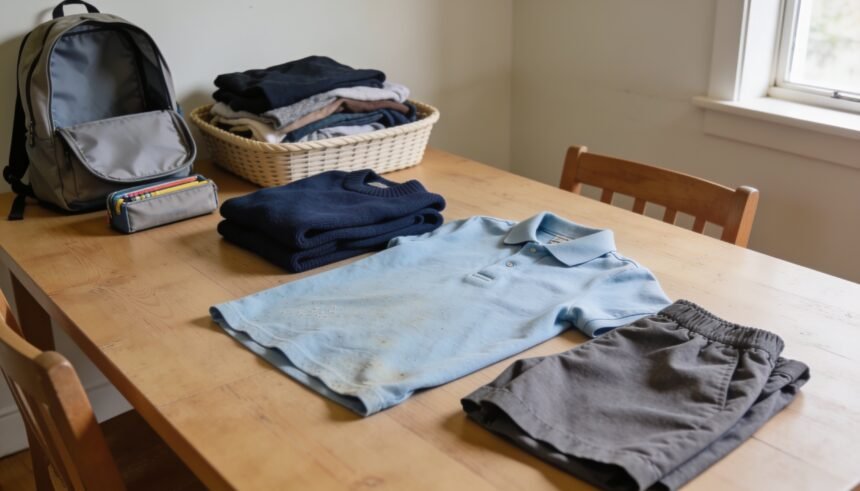
Keep secondhand school uniforms and hand-me-down gear when they match the school list, fit your child and can be made ready without a repair you will struggle to finish. Sort everything before buying more, so a bag of donated clothes becomes a clear list of usable items and remaining gaps.
1. Put the school list beside the hand-me-downs
Start with the current uniform and equipment lists, not the contents of the bag. In NSW public schools, uniform requirements are determined with the school community and communicated to parents. That makes your own school’s information the reference for what to keep. [S1]
Match each garment to the required colour, style and use. Check whether it is everyday uniform, sports clothing or an optional item. If an older crest or design appears in the bundle, ask the school whether it is still accepted before spending time altering it.
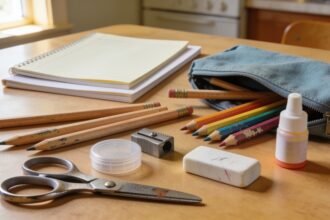
Do the same for supplies. A spare pencil case may fill a gap; a calculator that does not match the requested model needs checking before it goes in the schoolbag. Keep the broader back-to-school checklist nearby if you are also organising forms, bags and first-day arrangements.
Make four piles: ready after washing, repair first, keep for later and pass on. Put uncertain items aside with a specific question attached, rather than silently counting them as sorted.
2. Try clothes on before counting them
Use the printed size to choose what to try first, then assess the actual garment. Ask your child to sit, bend and raise their arms. Check that they can manage the buttons, zip or waistband themselves and that the clothing feels comfortable to them.
Look for previous alterations. A shortened hem may have room to let down, but inspect it rather than assuming extra fabric is available. Check the waistband, knees, seat, underarms and cuffs for loose stitching, holes or thin patches. Open and close every fastening.
Choose your own limit for cosmetic wear. A faded polo may be acceptable to your household if the school permits it; a stain that your child dislikes may make that same polo a poor choice. Ask before setting aside several near-identical items that will never be worn.
Only count garments that fit and are usable now towards the school wardrobe. Keep larger pieces on a separate list so they do not hide a shortage for the coming term.
3. Decide whether a repair will actually happen
A free item still needs someone to finish the work. For each repair, name the task, who will do it and when it will be ready. Sewing on a button you already have is a different commitment from finding a replacement zip and arranging alterations.
If paid work is needed, get a quote before accepting or buying the item. Compare the complete amount, including collection or postage, with an alternative you can use immediately. There is no useful saving to calculate from a garment that remains in the repair pile.
For a bundle, judge the asking amount against the pieces you need and can use. Do not divide it across every garment if half the bag is the wrong size or style. You can also ask whether the seller will separate the useful pieces, without assuming they will agree.
Set a deadline for any missing essentials. Willmot Public School, for example, says its donated secondhand stock cannot guarantee all items or sizes. Treat that as one school’s stated limitation, not a national stock forecast. [S2] If you need another source, the guide to finding a uniform shop or swap group covers that search.
4. Check bags and stationery separately
A uniform bundle and a box of school supplies need different checks. Work through ordinary gear with the current equipment list beside you.
| Item | What to check | Keep it when |
|---|---|---|
| Backpack | Base, lining, strap stitching, buckles and every zip | It carries the required items and your child can open and wear it comfortably |
| Library bag | Seams, handles or closure, and space for books | It meets the school’s request and needs no unfinished repair |
| Pencil case | Zip, lining and space for the listed stationery | It closes with the required supplies inside |
| Pens and pencils | Try each pen on scrap paper; check pencils can be sharpened | They work and match what the class requires |
| Ruler | Check the edge and that the measurement marks remain readable | It is usable for classroom work |
| Exercise books | Required format, remaining blank pages and old personal details | The school accepts the book in its present condition |
Do not apply this table to helmets, other protective equipment or electronic devices. Those need checks specific to the item. Keep them off the ready list until separately assessed.
5. Clean, relabel and put the useful items away
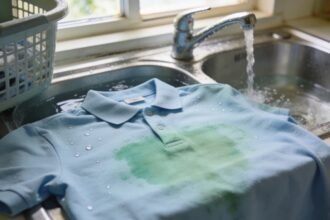
Read garment care labels before washing, especially when a bundle contains different fabrics. Avoid making an unfamiliar stain treatment the condition on which an item becomes usable. Decide whether you can accept the mark if it remains.
For a backpack, follow its care instructions; the guide to cleaning a school bag covers that job in more detail. Leave cleaned items to dry fully before packing them away.
Remove or cover the previous owner’s name where practical, keeping care instructions readable. Check inside pockets and pencil cases for old notes or personal details. Then add the new child’s identification using the school’s guidance. For small supplies, see labelling pens, rulers and calculators.
Put ready uniforms in the drawer and ready stationery with the schoolbag. Cross each item off the shopping list only at this point. Anything awaiting repair stays on a separate task list.
6. Keep only a manageable amount for later
Choose one storage place for larger uniforms and note what is inside, including the actual garment sizes. Check that stash before the next shopping trip. If space is tight, prioritise pieces that have a clear likely use rather than keeping every offered item.
Ask the next household what they need before passing on leftovers. Describe alterations and faults, and check a uniform shop’s donation requirements before dropping anything off. Willmot asks families to wash donated uniforms, for example; other receiving services should be asked directly. [S2]
Start with one bag today: match it to the school list, try on the likely pieces and write down only the gaps left after that check.
The one-page family week
One printable page that holds the whole week: meals, school, activities and who is doing the pickup. Free, and we send one useful email a week.
One email a week. No spam, unsubscribe in a click.