What is in this guide
Choose specials that fit meals you already know how to make, then check the cost of everything else those meals need. Keep breakfast, lunch, vegetables and familiar essentials on the list before adding extra discounted packs, so the offer serves the week you have planned.
1. Give the shop a shape before opening the catalogue
Write down the meals and snacks needed until your next shop. Include lunches away from home, late finishes and the evening when there is barely time to cook. Check what is already in the pantry, fridge and freezer before deciding what to buy.
Eat for Health recommends planning meals and snacks, shopping from a list and knowing how purchases will be used. Treat that as the starting point for grocery specials meal planning: the catalogue supplies possible ingredients, while your household supplies the requirements.
Choose familiar meal formats with room for a swap. A vegetable pasta, a bean dish with rice or a tray bake can be a starting point if you already have a recipe your household enjoys. Keep a fixed choice for a difficult evening rather than expecting every dinner to follow the offers.
2. Sort offers into replace, restock or leave
Give each tempting special a specific job before putting it in the trolley.
| Decision | What it means | Question to answer |
|---|---|---|
| Replace | It takes the place of an ingredient already on the list | Which item will you cross off? |
| Restock | It is a regularly used staple running low | How much is at home, and where will this pack go? |
| Leave | It adds a purchase without meeting a planned need | Would you choose it without the special label? |
A replacement should work in the actual recipe. Check the ingredient form, preparation and cooking method, not just the food name. Dried beans and tinned beans, for example, should not be treated as an automatic same-step swap in your recipe.
Keep existing dietary requirements in place. If a familiar product matters to the household, compare suitable versions rather than buying an unsuitable alternative for its discount.
3. Compare the whole meal before accepting the special
The ACCC explains that unit prices let you compare similar products using a standard quantity. Check matching units, such as per kilogram or per 100 g, and compare the full pack prices too. A smaller pack may suit today’s spending limit even when its unit price is higher.
Then write down every extra purchase the special would require. Include sauces, sides and seasonings missing from your kitchen. Compare the amount payable for the complete shopping list before and after the change, rather than considering only the discounted ingredient.
For a multi-buy, check the required quantity and total payment. Give each pack a use and a storage place. If buying the offer means removing food needed for another meal, choose the smaller purchase or leave the offer.
4. Build a small plan around the offers that pass
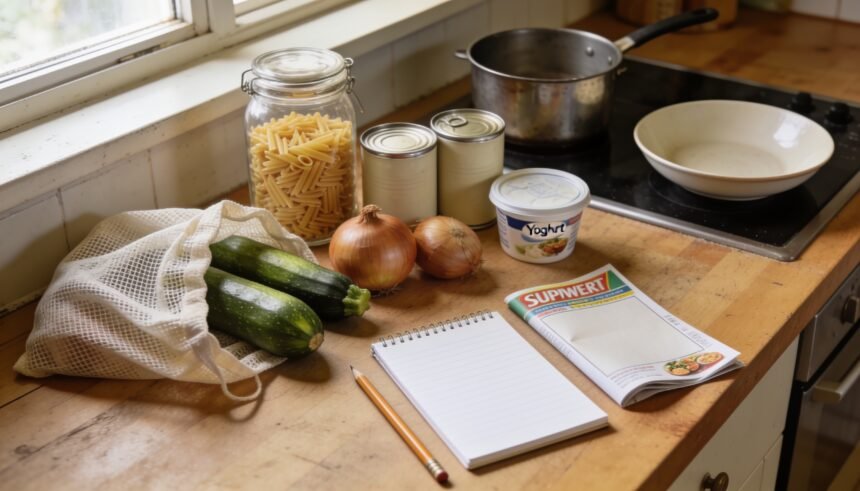
Here is an illustrative decision worksheet, not a current catalogue or a complete weekly menu. Assume you already have pasta, rice, tinned tomatoes, onions, oil and your usual seasonings. Check quantities against your own familiar recipes.
| Possible special | Meal it could support | Check before choosing it |
|---|---|---|
| Zucchini | Your usual tomato and vegetable pasta | Can it replace the planned vegetable, and how much will the recipe use? |
| Tinned beans | Your familiar bean and rice dish | Does the recipe use this type of bean, and are any other ingredients missing? |
| Plain yoghurt | Breakfasts already on the plan | Is it a product people will eat, and will the pack fit the planned uses? |
Suppose zucchini passes the price and recipe checks. Cross the original pasta vegetable off the list before adding zucchini. If the beans would require several extra purchases, keep the dinner you originally planned. The yoghurt offer gets its own breakfast check rather than being justified as part of dinner.
This method does not require every ingredient to be discounted. An ordinary-priced item can stay because it completes a meal. Keep fruit, vegetables and the other foods your household needs visible on the list instead of spending the available money on disconnected offers.
5. Keep a fallback for an unavailable or unsuitable offer
Beside each replacement, write the original ingredient or another familiar option. At the shelf, return to that choice if the special is unavailable, the pack is too large or the actual price comparison disappoints.
For an online order, review proposed substitutions and the final basket before confirming. Do not assume a replacement has the same pack size, ingredients or price as the item you chose.
If another supermarket has an appealing offer, consider the extra journey, transport cost or delivery charge before splitting the shop. With limited time or no car, keep the comparison within shops you can practically use.
Treat snacks and convenience food as deliberate purchases too. There is no need to turn the trolley into a judgement about your cooking. The useful question is whether each item fits the food, money and time available this week.
Before your next shop, choose one advertised special and finish this sentence: “This replaces ___ in ___, and the extra ingredients I need are ___.” If you cannot fill it in, leave it off the list for now.
How we checked this: ACCC and Australian Government Eat for Health guidance checked on 22 September 2026. The offer filters and meal worksheet are editorial suggestions. No products were tested, and no current prices or savings are claimed.
Related on Dovelyne: Feeding a family of four on a weekly grocery budget · Freezer and pantry staples worth always having · Mince, chicken and lentils: stretching protein
The one-page family week
One printable page that holds the whole week: meals, school, activities and who is doing the pickup. Free, and we send one useful email a week.
One email a week. No spam, unsubscribe in a click.