What is in this guide
You do not need to know the child well. You need one current fact from a parent, a gift category that still works if your guess is slightly off, and something that can be handed over or posted without drama.
The mistake is guessing at taste. A child you see twice a year has changed since you last saw them, and whatever they were obsessed with at Easter may be embarrassing by Christmas. Buy for the age and the household rather than the personality you remember.
This is an editorial guide. No product has been tested, given or ranked by Dovelyne, and no prices are quoted because they change.
Step one: get one fact from a parent
A single message to the parent solves most of the problem. Keep it short and specific so it gets answered.
- Ask the current age and the next birthday. A child who is “about six” might be turning seven next month, and age bands on toys and books are tighter than they look
- Ask what they are into right now, and treat the answer as a direction rather than an order. Do not chase a specific character or brand from it
- Ask what the house does not want. Some households limit screens, noise, glitter, weapons, sweets or anything with a thousand pieces. A polite no from the parent saves the gift going straight into a cupboard
- Ask what they already have too much of. The answer is usually plush toys, art supplies or building blocks, and it rules out an entire aisle
If the parent does not answer, the age alone is enough for the categories below. If you cannot get even that, buy for the household instead, which is covered further down.
Step two: pick a category that survives a wrong guess
Some gifts fail completely if the age or interest is wrong. Others are useful across a wide range. When you are guessing, choose from the second group.
- Books. A picture book or chapter book is rarely resented, is easy to post, and a slightly-too-old book simply waits on the shelf. Ask the bookseller for the age band if you are unsure
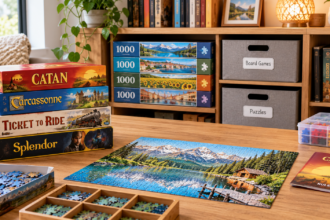
- Puzzles with a wide range. A puzzle a year too easy is still finished with satisfaction; a year too hard becomes a family activity. Jigsaw puzzles for kids by age explains how to choose by difficulty rather than piece count
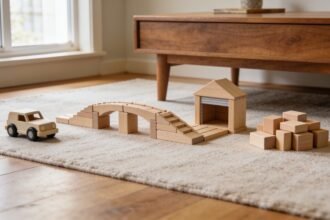
- Open-ended construction and STEM sets rather than a single-build kit. STEM toys by age covers what suits each stage, and a set that is part of a system still gets used alongside whatever the child already owns
- Consumables. Good paper, real paints, modelling clay, a baking set. They are enjoyed completely, take up no permanent space, and do not compete with existing toys. Gifts for kids that do not end up in the bin makes the case for consumables and experiences in more detail
- A family game. A card or board game is a gift to the whole household and does not depend on the one child’s taste. Choose one with an age range that covers the youngest player in the house
Avoid when guessing: clothing without a current size from the parent, anything for a specific character, electronics that need an account or a subscription, and anything that makes noise without a volume control.
Step three: make it easy to receive
A gift you are not there to hand over needs to arrive intact, be recognisable as a gift, and not create work for the parent.
- Buy where the parent can return or exchange it. A national retailer with stores in the child’s city is easier for a parent than an online-only seller. Checking a returns policy before you buy online covers what to look for, and a gift receipt inside the parcel makes an exchange painless
- Post it to the parent, not the child. Address it to the adult so it is not opened on the doorstep, and include a card with the child’s name so it is clearly theirs
- Check size and weight before choosing. Boxed toys with air inside them cost more to send than they cost to buy. Books, puzzles, card games and craft supplies post cheaply and survive the trip
- Skip the gift wrap if it is being posted. Wrapped presents are often unwrapped for customs or damaged in transit. Send it in the retailer box with a card and let the parent wrap it
- For overseas family, check the destination country’s rules on batteries, liquids and food before sending. Australia Post publishes what can and cannot be sent to each country
If you are visiting rather than posting, the same size rule applies in reverse. A gift that fits in your carry-on is a gift you will actually bring.
When you know almost nothing
Sometimes there is no reply, no age and no sense of the household. In that case, stop trying to buy for the child and buy for the family.
- A voucher for a bookshop or a general retailer, with a note that it is for the child to choose. Older children enjoy the choosing, and parents appreciate not receiving a fourth soft toy
- A contribution to something bigger. Many parents are saving for a bike, an instrument or a school trip. Offering to put money towards it is welcome, and it is the one gift guaranteed to be the right size
- An experience the family can use. A zoo, museum or aquarium pass in the child’s city, checked with the parent first so it does not clash with a membership they already hold
- Something for the sibling as well. If there is more than one child in the house, a gift for one of them and nothing for the other starts an argument you will not be there to hear
Keep the gift going after it arrives
A game with a missing piece or a puzzle with a lost corner is retired within weeks. If you are giving something with parts, a note suggesting the box goes straight into a labelled tub helps. Keeping board games and puzzles complete has the simple storage habits that make a gift last past the first holiday.
A short message a few weeks later asking whether the gift arrived, and whether it was any good, does two useful things. It tells you what to buy next time, and it makes the child aware that the gift came from a person and not from the post.
Safety when you are not there
You are buying for a house you do not live in, and often for a child with a younger sibling. Check the age label against the youngest child in that house rather than only the recipient. Australia has a mandatory safety standard for toys intended for children under three years of age covering small parts, and Product Safety Australia publishes current recalls, which is worth a look for any brand you do not recognise or any marketplace seller.
Before you buy
- Send the parent one message: age, current interest, what the house does not want
- Choose from the forgiving categories: books, puzzles, open-ended sets, consumables, a family game
- Buy where the parent can exchange it, and put a gift receipt inside
- Choose something that posts or travels without special handling
- If you know nothing, give a voucher, a contribution or an experience, and remember the sibling
The one-page family week
One printable page that holds the whole week: meals, school, activities and who is doing the pickup. Free, and we send one useful email a week.
One email a week. No spam, unsubscribe in a click.