What is in this guide
- What the unit price is actually telling you
- Know where it will be, and where it legally will not
- Step 1: Match the unit before you compare the number
- Step 2: Read the unit price on the special, not just the special
- Step 3: Use it the same way online
- Step 4: Check the unit price against your household, not just the shelf
- What to do when it is missing or wrong
- Make it a habit in one shop
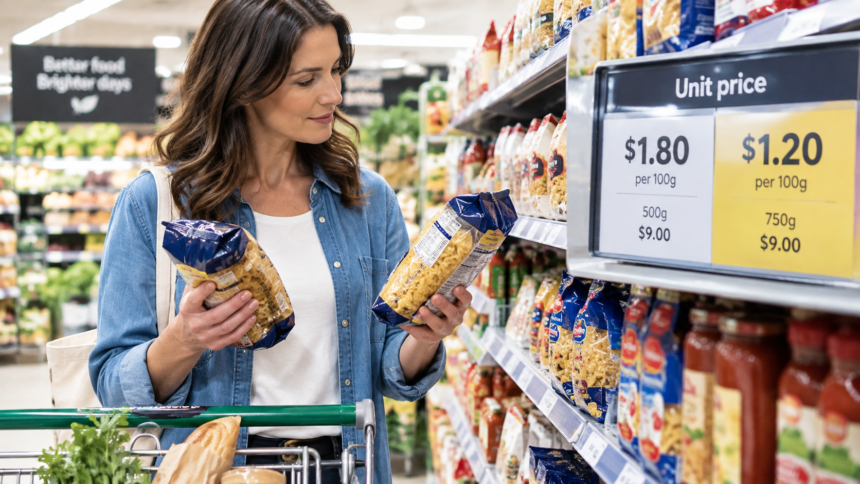
To use unit pricing, read the small price beside the shelf price, check it is in the same unit as the product you are comparing it with, and decide on that figure rather than the pack price or the special ticket. In Australia, large supermarkets and online grocery stores must display it, so the number is already there for most food, drink, cleaning and personal-care items.
What the unit price is actually telling you
The unit price is the selling price, GST included, expressed per standard measure: per 100 grams, per 100 millilitres, per kilogram, per litre, per metre, per item or per 100 items. [S3] The ACCC describes it as the figure that lets you compare similar products and find the best value for money. [S1]
The pack price answers one question: what will this cost today. The unit price answers a different one: what am I paying for the amount inside. Only the second makes two brands, two pack sizes or a special and a regular line comparable, because it removes pack size from the decision.
Under the Unit Pricing Code the figure must be prominent, close to the selling price, legible and unambiguous, and shown in dollars and cents rounded to the nearest cent. [S2] In practice that means it is on the shelf ticket, on the online listing and in the printed catalogue, next to the selling price.
Know where it will be, and where it legally will not
The Code is mandatory for store-based grocery retailers with more than 1,000 square metres of floor space displaying groceries that sell the minimum range of food-based items, and for online retailers selling that range. [S2] Smaller shops, greengrocers, butchers and specialty stores can display unit prices but are not required to. [S1]
Even in a large supermarket, some tickets carry no unit price, and that is allowed:
- Bundled packs of different items sold together for one price. [S3]
- Same-price promotions where any item from a mixed range sells for one price. [S3]
- Some marked-down goods, such as perishables reduced for quick sale and damaged or discontinued stock. [S3]
- Exempt categories such as alcohol, tobacco, toys, appliances, hardware, clothing and meals prepared in store for immediate eating. [S3]
When the unit price is missing on something you want to compare, the pack still states its weight, volume or count. The method for working the figure out yourself, including multipacks and cost per wash, is in how to compare unit prices for household basics.
Step 1: Match the unit before you compare the number
Products in the same aisle can use different units, and the Code sets some of them deliberately. Beverages are priced per litre; cheese, flour and ice per kilogram; packaged eggs per 100 grams; herbs, spices and powdered stock per 10 grams. [S3] Everything not on that list uses the standard unit for how it is supplied: per 100 millilitres by volume, per 100 grams by weight, per metre by length, per item by count. [S3]
So two honest labels can read “per 100 g” and “per kg” a shelf apart. Compare only once both figures use the same unit. If they do not, convert one before deciding, or pick the two products whose labels already match and compare those first.
Counted items have their own rule. Packs of 40 or fewer items are generally priced per item, packs of 41 or more per 100 items, and a retailer may use one common unit across all sizes of that product. [S3] Nappies, dishwasher tablets and bin liners are the usual places this shows up. Divide a per-100 figure by 100 to get the per-item figure before comparing it with a small pack.
Toilet paper follows the same logic: rolls with 41 or more sheets are priced per 100 sheets. [S3] Use that figure to compare quantity, then think about ply and sheet size separately.
Step 2: Read the unit price on the special, not just the special
A promotional ticket changes the selling price, and the unit price beside it should change with it. Read the unit price on the yellow ticket rather than assuming the discount makes it the cheapest per unit on the shelf. A larger pack at its ordinary price can sit below a smaller pack on special, and the only way to know is to compare the two unit figures in the same unit.
For a multi-buy on the same product, work out what you pay for the full quantity you must take home to get the offer, then compare that with the single pack you would otherwise buy. Whether the discount itself is genuine is a separate question, covered in how to spot false discounts and sale tactics.
Step 3: Use it the same way online
Online grocery listings are not a looser version of the shelf. A retailer required to unit price in store must show the unit price near the selling price wherever that selling price appears online, including category pages that list the range, and in catalogues and social-media adverts that show a selling price. [S3] Television, radio and similar video or audio adverts are the exception. [S3]
When ordering online, compare on the listing page before opening each product, because the unit price is required there. Where the site lets you sort or filter by unit price, use it; where it does not, the figure is still beside each selling price. Read it in the same unit, exactly as you would in the aisle.
Step 4: Check the unit price against your household, not just the shelf
A lower unit price is a quantity advantage. It does not change three other things: you pay for the whole pack today, it needs somewhere to live, and it has to be used before it spoils or before you forget it exists. A large tub with the best unit price in the aisle is not a saving if half of it is thrown out.
For food, ask whether the household will finish the bigger pack in the time it stays good. For cleaning products and detergents, the unit price compares quantity, not doses, so a concentrated product can look expensive per litre and still cost less per wash; that calculation is in the household-basics guide linked above. For anything, ask whether the larger pack displaces something needed this week.
If you want to see which purchases are worth changing, review a recent receipt first. How to cut a grocery bill without eating worse walks through that audit.
What to do when it is missing or wrong
If a required unit price is absent, uses a unit that does not fit the product, or does not match the selling price on the ticket, raise it with the store or the online retailer first. If that does not resolve it, anyone can report a unit-pricing issue to the ACCC, which enforces the Code. [S1]
You do not need to know the Code in detail to make a useful report. Note the product, the pack size, the selling price, what the ticket showed and the date, and describe the problem in plain words.
Make it a habit in one shop
Pick three staples you buy every week. On the next shop, ignore the pack price and the promotional ticket for those three, read only the unit price, check the unit, and choose on that. Repeat it the following week. Once the unit figure is the first thing you read on a ticket, the rest of the trolley follows without extra time in the aisle.
How we checked this: Checked on 22 September 2026 against the ACCC’s consumer and business guidance on unit pricing, the ACCC’s guide for grocery retailers and the text of the Competition and Consumer (Industry Codes – Unit Pricing) Regulations 2021. The shelf habit, household-fit checks and three-staples starting task are editorial suggestions. No products were tested and no retail prices or savings are claimed.
Related reading: How to Use a Shopping List to Avoid Impulse Buys at the Supermarket.
The one-page family week
One printable page that holds the whole week: meals, school, activities and who is doing the pickup. Free, and we send one useful email a week.
One email a week. No spam, unsubscribe in a click.