What is in this guide
- Start with what both children can use
- Give building toys a shared setting and separate projects
- Use pretend-play props without assigning the older child a job
- Put modelling materials on two workspaces
- Check whether a game lets both children participate
- Make sharing workable in the space you have
- Try one activity before adding more toys
Building blocks, pretend-play props and modelling dough are useful starting points for a four-year-old and a seven-year-old to share. Choose materials each child can use, then leave room for different challenges: both should have something to do without the older child having to run the activity.
Start with what both children can use
Before looking for another toy, put out a familiar set and watch where each child needs help. Can both connect the pieces, handle the tools or understand the basic action? Does one child want to build while the other wants to act out a story? Those details give you a more useful starting point than assuming age alone tells you what will work.
Raising Children Network advises considering children’s interests and abilities when choosing toys. For shared play, make two quick lists: what each child enjoys and what each can manage. Look for an overlap, such as vehicles, animals or making things, without requiring identical skills.
Keep the specific toy’s age guidance, warnings and instructions in view. An older sibling’s ability to use a set does not establish that it suits the younger one. For the separate question of construction and science kit fit, see STEM toys by age and what children can do alone.
Give building toys a shared setting and separate projects
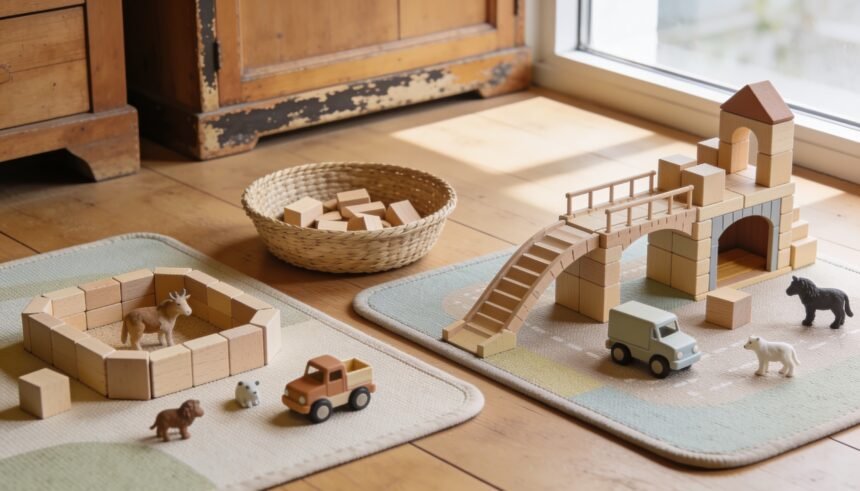
Try blocks or a construction system both children already use comfortably. Suggest a town, zoo or garage, then ask each child what they want to make within it. One might build a low enclosure while the other designs a bridge. They can connect the projects if they want to.
This avoids making one finished model the only acceptable result. It also gives you a practical response when the older child wants more complexity: offer an extra design problem, such as making space for a particular vehicle, rather than changing the younger child’s task.
Divide the available pieces into two starting piles, leaving a small shared supply between them. Ask before joining or altering the other person’s construction. If one child wants to knock something down, keep that action within their own building area.
Cornell Cooperative Extension describes blocks and modelling materials as versatile resources that children can use differently at different stages. The town arrangement here is an editorial suggestion, not a tested formula for harmonious play. Our explanation of what open-ended play means covers why the same materials can support several possible outcomes.
Use pretend-play props without assigning the older child a job
Toy food, dolls, animals, vehicles and simple dress-up props offer a way to share a setting without sharing every action. For a pretend cafe, one child could prepare food while the other arranges tables or invents an order. For an animal rescue story, they could each choose an animal and decide what happens next.
Offer roles rather than allocating them by age. The seven-year-old does not always need to be the shopkeeper, reader or organiser. The four-year-old can choose the story too. Swap roles when both agree, or let two stories happen beside each other.
Writing can be an optional addition for a child who wants it. A menu or pretend ticket need not be readable for the other sibling to join in. If explaining the game becomes most of the activity, simplify the setup to a few familiar props and one shared idea.
Put modelling materials on two workspaces
Modelling dough offers another possible shared activity with different finishes. Put a portion on each child’s mat or tray and give both access to familiar, suitable tools. Suggest making food for a pretend picnic, creatures for a scene or whatever each child chooses.
A simple shape and a detailed model can belong in the same picnic. Avoid making the older child’s work the example the younger one is expected to copy. Equally, let the older child keep adding detail rather than asking them to finish when their sibling does.
For drawing, use the same arrangement: separate sheets with an optional shared theme. A single large picture is worth trying when both want to work on it, but it need not be the default. Two workspaces let each child decide where their contribution begins and ends.
Check whether a game lets both children participate
For a shared game, look at the actual actions required. Can both children recognise the pictures, remember the rule and take a turn? A matching game might suit one pair, while another pair would rather build something together. Reading, speed and complicated scoring are useful things to check before setting it up.
If the rules include a simpler version, consider starting there. Agree on any other changes before play begins, so neither child discovers halfway through that the rules have changed for their sibling. Give the older child a choice about joining a simpler game; they can prefer a separate activity.
For purchasing decisions, questions to ask before buying a family board game covers player count, reading demands and other practical checks. Here, the immediate aim is to find a format both children want to join, rather than persuade them to enjoy the same game.
Make sharing workable in the space you have
In a small living room, mark out two building spaces with mats or trays and keep a clear place for shared supplies. On the dining table, agree when the activity must be packed away before starting an elaborate project. Offer to photograph an unfinished construction if the child wants a record.
Keep special possessions separate from the shared supply. Before inviting both children to use a set, establish whose it is and whether its owner has agreed. A shared activity can use household materials while an individual birthday gift remains its owner’s choice.
If both repeatedly want the same tool, try taking turns, finding a suitable spare or choosing an activity with fewer bottlenecks. Avoid buying an entire second set before you know which part is causing the problem. For keeping shared materials accessible afterwards, see storing and rotating educational toys.
Try one activity before adding more toys
Choose one set already at home, offer two workspaces and suggest a common theme. Let each child choose a contribution. Notice whether either child spends most of the session waiting, asking for help or directing the other.
Use that information for the next attempt: change the theme, separate the projects further or offer a different material. Playing alongside each other is a reasonable option. There is no need to turn every toy into a joint activity or expect every shared session to last until both children are ready to stop.
Your next step: ask each child what they would like to make with one familiar set, then help them find a way for both ideas to fit in the available space.
The one-page family week
One printable page that holds the whole week: meals, school, activities and who is doing the pickup. Free, and we send one useful email a week.
One email a week. No spam, unsubscribe in a click.